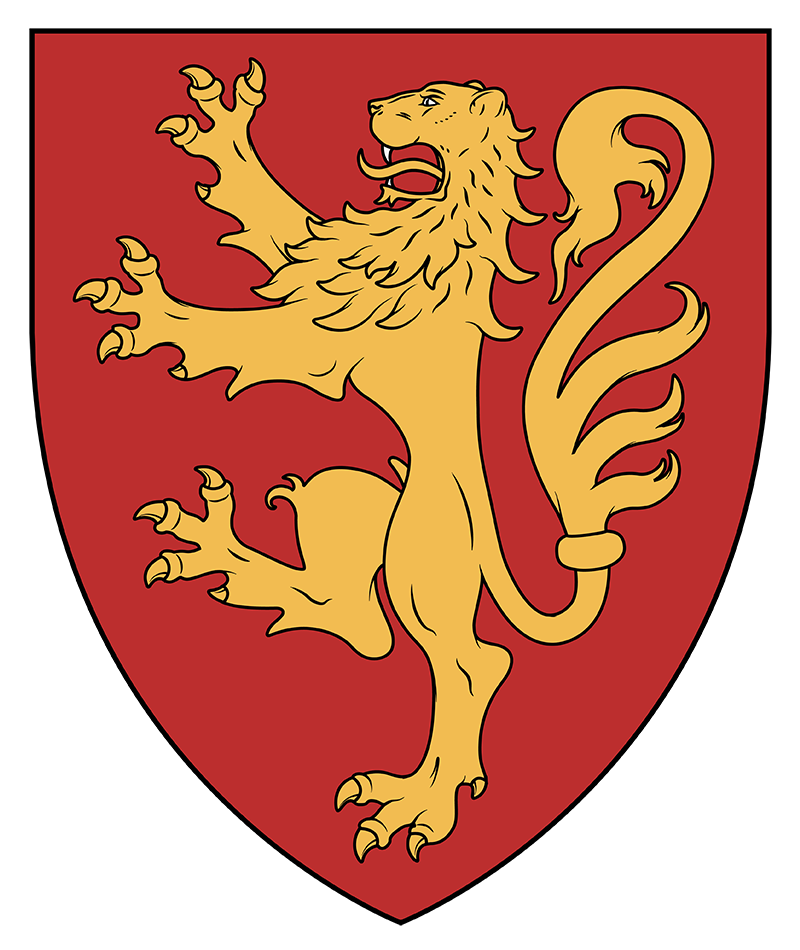
Henry II - King of England (1154-1189)
Henry Plantagenet
Henry II ruled England from 1154 to 1189 and was the first of the Plantagenet kings. He ended the Anarchy, rebuilt royal authority, and ruled an empire that stretched from the Scottish border to the Pyrenees. His reign saw the murder of Thomas Becket and a rebellion by his own sons, and he died with his family turning against him.

Orford Castle in Suffolk, built by Henry II between 1165 and 1173.
Henry was born at Le Mans on March 5th, 1133, the eldest son of Geoffrey, Count of Anjou, and Empress Matilda, the daughter of Henry I and the widow of the Holy Roman Emperor. Geoffrey was said to wear a sprig of broom, the planta genista, in his hat, and the nickname Plantagenet later passed to the family. In late 1142, when Henry was about nine, his uncle, Robert FitzRoy, Earl of Gloucester, brought him to England while his mother fought King Stephen for the crown. Henry lived in Robert's household at Bristol, a major stronghold of his mother's supporters, for about four years, and was educated there by a master named Matthew. In 1149, he returned to England, and on Whitsunday, May 22nd, at the age of sixteen, he was knighted at Carlisle by his great-uncle, King David I of Scotland. The ceremony was part of an alliance against Stephen, and Ranulf, Earl of Chester, was also there.
Meanwhile, his father had conquered Normandy. Geoffrey gave the duchy to Henry in 1150, and when Geoffrey died in 1151, Henry also became Count of Anjou. In May 1152, he married Eleanor of Aquitaine, whose marriage to King Louis VII of France had been annulled only two months earlier. The marriage made Henry Duke of Aquitaine, and he now controlled more of France than the French king himself.
In January 1153, Henry landed in England with a small army, and the two sides faced each other across the Thames at Wallingford but declined to fight. After Stephen's son, Eustace, died that summer, Stephen agreed to name Henry as his heir. Stephen died in October 1154, and Henry was crowned at Westminster Abbey, with Eleanor, on December 19th. He was twenty-one years old.
Henry set out to undo the damage of the Anarchy. He sent away the foreign mercenaries, ordered the unlicensed castles built during the war to be torn down, and took royal castles back from the barons. In 1155, he took Scarborough Castle from William le Gros, began work on it around 1157, and built the keep, or Great Tower, between 1159 and 1169. At Bowes Castle, he built a stone keep, and on the Suffolk coast he built Orford Castle as a new fortress, not a rebuild of an earlier one. Between 1165 and 1173, he raised its distinctive stone keep and the surrounding castle to guard the coast and to control East Anglia against the power of Hugh Bigod, Earl of Norfolk.

The Château de Chinon, which Henry rebuilt and where he died.
Henry also changed how England was governed. He strengthened the system of traveling royal judges, known as justices in eyre, who rode circuits to enforce the king's justice across the country. In 1166, he issued the Assize of Clarendon, which required local juries, usually twelve lawful men from each hundred, to swear an oath and name anyone suspected of serious crimes such as robbery, murder, or theft. Those named were arrested and brought before the royal judges, often to be tried by ordeal. This system of juries of presentment helped lay the foundations of the common law and was an ancestor of the later grand jury. He spent much of his reign traveling across his lands, and he was so restless that his courtiers complained they never knew where he would be next. He made Chinon in Anjou one of his main residences and rebuilt much of the castle there.

The King's Hall in Henry II's Great Tower at Dover Castle, decorated as it might have looked when he stayed there.
His greatest fortress project in England was Dover Castle, the nearest English port to France. Henry transformed it into one of the strongest castles in Europe, and its massive Great Tower also served as a royal residence. Today, the tower is furnished and decorated as though the king were still living there, with a throne room, hall, and other rooms of his court.
The greatest crisis of his early reign was his quarrel with Thomas Becket. Henry made Becket his chancellor in 1155 and, in May 1162, appointed him Archbishop of Canterbury, expecting his friend to help him bring the Church under royal control. Becket was consecrated on June 3rd, 1162, and instead defended the Church's rights. The two men fell out over the Constitutions of Clarendon, issued at the royal council at Clarendon in January 1164. Becket fled to France and returned in early December 1170 after a reconciliation. At Christmas that year, Henry was at Bures in Normandy when he flew into a rage. According to Edward Grim, an eyewitness to the murder, he cried: "What miserable drones and traitors have I nourished and promoted in my household, who let their lord be treated with such shameful contempt by a low-born cleric!" Four of his knights, including Reginald FitzUrse, went to England and murdered Becket in Canterbury Cathedral on December 29th, 1170.
Henry denied he had ordered the killing, but he was blamed. On July 12th, 1174, he did penance at Canterbury. He walked barefoot, dressed as a pilgrim, from outside the city into the cathedral, and he knelt and prayed at the place of the murder and at Becket's tomb in the crypt. He allowed the bishops and then the monks of Christ Church to scourge him, and he spent the night in vigil at the tomb.
In the summer of 1165, Henry led a large army into north Wales against an alliance of Welsh princes led by Owain Gwynedd and including Rhys ap Gruffydd. After some fighting in the Ceiriog Valley, his forces pushed into the Berwyn Mountains, where they were hit by days of high winds and torrential rain. Supplies could not get through, the ground turned to mud, and men began to die of exposure. Welsh chroniclers wrote that the army was oppressed by "a mighty tempest of wind and exceeding great torrents of rain." Henry was forced to withdraw after only a few days, and in his anger, he had Welsh hostages, said to include sons of Owain and Rhys, blinded.
On October 18th, 1171, Henry landed at Waterford, the first crowned King of England to set foot in Ireland. He came with a fleet of about 400 ships carrying an army estimated at between 4,000 and 10,000 men, including some 500 knights. He wanted to keep control over the Anglo-Norman lords who were conquering land there, especially Richard de Clare, known as Strongbow, and Hugh de Lacy. His rapid advance secured Waterford and Dublin, where Strongbow submitted, giving up control of his conquests in exchange for keeping Leinster as a royal vassal. Many Irish kings and Norman barons also submitted before Henry returned in 1172.

The flint wall at Hertford Castle dates from Henry's improvements to the castle between 1170 and 1174.
Henry's greatest threat came from his own family. His eldest surviving son, also named Henry, was crowned as associate king at Westminster Abbey on June 14th, 1170, by the Archbishop of York. He received an allowance but no significant lands or real power to govern, which became a major grievance. In 1173, the Young King, encouraged by his mother, Eleanor, slipped away from Chinon and joined the French king, and his brothers Richard and Geoffrey soon joined him. They were supported by Louis VII of France, William the Lion of Scotland, and many English barons, including Robert de Beaumont, Earl of Leicester, and Hugh Bigod.
Henry relied on his loyal commanders and mercenaries to defend Normandy and put down the revolt in England, where he garrisoned Kenilworth Castle and strengthened Hertford. Leicester was defeated and captured at the Battle of Fornham, and the rebels in East Anglia were crushed in 1174. On July 13th, 1174, the day after Henry's penance at Canterbury, William the Lion was captured at Alnwick, and in the Treaty of Falaise, he acknowledged Henry as his overlord. Henry forgave his sons at the Treaty of Montlouis, but not Eleanor, whom he had captured in 1173. For the rest of his reign, about fifteen years, he kept her under guard, mostly in England, including at Old Sarum and other royal castles. She lived in relative comfort, but her freedom and political influence were sharply restricted until Richard released her after Henry's death.
His last years were troubled by his sons' ambitions. The Young King died of a fever in 1183 in the middle of another dispute, and Geoffrey died in Paris in August 1186. Most accounts say he was trampled to death in a tournament, though a French chronicler claimed he died of a sudden illness. Henry favored his youngest son, John, whom he sent to Ireland in 1185 and arranged to marry Isabel, the heiress of the lord of Cardiff. Richard was now the clear heir, but Henry refused to confirm him fully as his successor, and Richard feared being passed over.
In November 1188, at a conference at Bonmoulins, Richard publicly transferred his homage to the new French king, Philip II, and allied with him against his father. In the summer of 1189, their combined forces invaded Henry's lands in France and overran much of Maine. In mid-June, they drove Henry out of Le Mans, his birthplace, which was set on fire during the fighting. Henry fled south, already seriously ill. On July 4th, at Ballan, near Azay-le-Rideau, a defeated and dying Henry was forced to accept humiliating terms. He had to recognize Richard as his heir, do homage to Philip for his French lands, pay a large indemnity, surrender key castles as security, and agree that Philip's sister Alys would eventually marry Richard.
While he was being carried back to Chinon, Henry was shown the list of those who had deserted him. The first name on it was that of his favorite son, John. The betrayal is said to have broken him. He died at Chinon on July 6th, 1189, and, according to chroniclers, his last words were along the lines of "Shame, shame on a conquered king." He was buried at Fontevraud Abbey in Anjou. Richard succeeded him as Richard the Lionheart, and John later succeeded Richard as king.
Henry also had illegitimate children, including Geoffrey, who became Archbishop of York, and William Longespee, who became Earl of Salisbury and fought at the battles of Lincoln and Bouvines. Through his marriage, his sons, and his lands, Henry built the Angevin Empire, which stretched across England, much of France, and parts of Wales and Ireland. It would take his son John only fifteen years to lose Normandy and most of it.