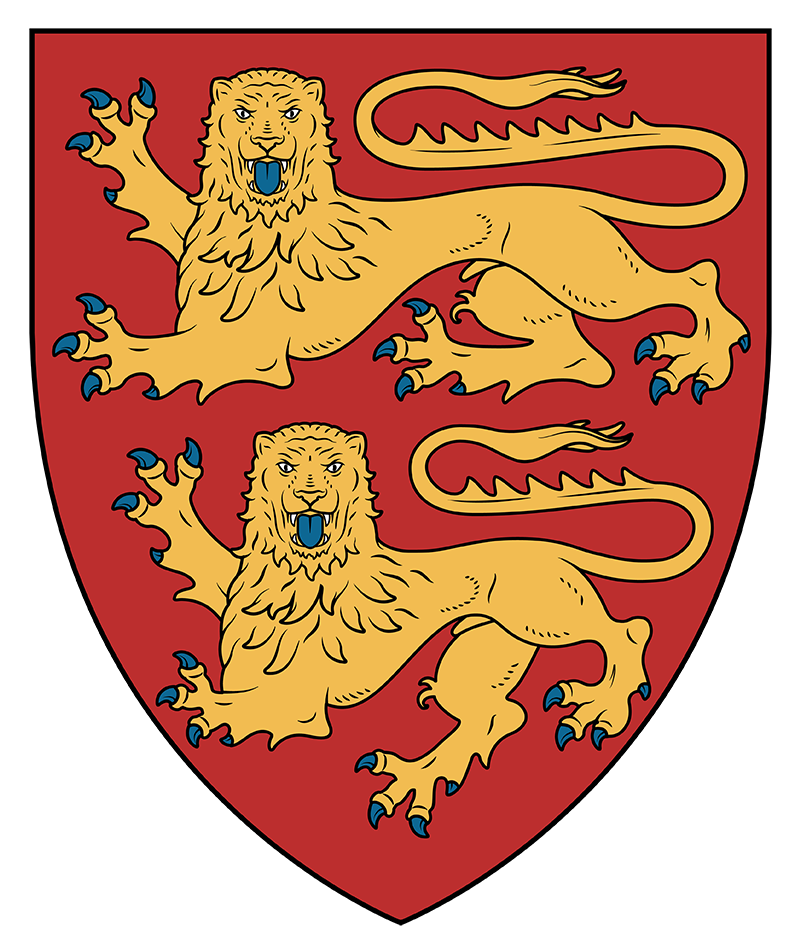
Henry I - King of England (1100-1135)
Henry Beauclerc
Henry I ruled England from 1100 to 1135 and became Duke of Normandy in 1106. The youngest of William the Conqueror's four sons, he reunited England and Normandy under one ruler, strengthened royal government, and earned a reputation as a stern but effective king. His reign ended in a succession crisis that led to the civil war known as the Anarchy.

Henry was born around 1068, probably at Selby in Yorkshire. He was the fourth and youngest son of William the Conqueror and Matilda of Flanders. He received an unusually good education for a prince, which earned him the nickname Beauclerc, meaning "fine scholar."
When his father died in 1087, Robert Curthose inherited Normandy and William Rufus inherited England. Henry received no lands, only a large sum of silver, which he used to build a following.
In 1088, Henry bought the Cotentin in western Normandy from Robert for 3,000 pounds, but Robert later took it back after his half-uncle Odo of Bayeux seized Henry and imprisoned him. In early 1091, Robert and William Rufus joined forces and besieged Henry at Mont-Saint-Michel, forcing him to give up the Cotentin again. Henry spent the next year wandering with a few followers, but by 1092 he had taken control of the town of Domfront and rebuilt his power. He made Domfront his main base in Normandy and built a stone castle there with a strong square keep, the first of several keeps of this type that he would build.
Henry was hunting in the New Forest on August 2nd, 1100, when William Rufus was killed by an arrow. Henry rode quickly to Winchester, took control of the castle and the royal treasury, and was crowned at Westminster Abbey on August 5th, just three days after his brother's death.
At his coronation, Henry issued the Charter of Liberties, promising to end the abuses of his brother's reign, including the seizure of church revenues and excessive payments demanded from the barons. It was meant to win support for a king whose claim to the throne was weaker than his brother Robert's. On November 11th, 1100, he married Matilda of Scotland at Westminster Abbey. She was descended from the Anglo-Saxon kings, which helped reconcile the English to Norman rule. They had two children, a daughter, Matilda, born in 1102, and a son, William Adelin, born in 1103.
In July 1101, Robert Curthose landed at Portsmouth with an army to claim the English throne. The two brothers negotiated rather than fight, and the Treaty of Alton ended the invasion. Robert recognized Henry as king, and Henry agreed to pay Robert 2,000 pounds a year. Over the next year, Henry turned on the barons who had supported Robert. The most powerful of them, Robert of Bellême, was besieged at Arundel Castle, defeated, and banished from England.
Henry also faced a long dispute with Anselm, Archbishop of Canterbury, over who had the right to appoint bishops. In 1105, they reached a compromise in which Henry gave up the right to invest bishops with the symbols of their office, but kept the right to receive their homage.
With England secure, Henry turned to Normandy. On September 28th, 1106, he defeated Robert Curthose at the Battle of Tinchebray. Robert was captured and spent the rest of his life imprisoned, first at Devizes Castle and then, from 1126, at Cardiff Castle, where he died in 1134. Henry took control of Normandy, though at first he avoided using the title of duke.
Much of the next decade was spent defending Normandy against King Louis VI of France and rebel Norman barons. In August 1119, Henry defeated Louis at the Battle of Brémule, and peace followed in 1120.
On November 25th, 1120, Henry's fortunes changed when the White Ship sank off Barfleur while carrying his son and heir, William Adelin, back to England. Almost everyone aboard drowned, including William, and Henry was left without a legitimate son.
Henry's wife Matilda had died in 1118, so in January 1121, he married Adeliza of Louvain at Windsor Castle. The marriage produced no children. Henry named his daughter Matilda, the widow of the Holy Roman Emperor, as his heir and made his barons swear to accept her. In 1128, he married her to Geoffrey of Anjou, but their relationship with Henry later became strained.
Henry was a keen builder of castles. He held court at Windsor Castle in 1110, and it became a royal residence. At Corfe Castle in Dorset, he erected a substantial stone keep around 1107 and turned the castle into a luxurious royal residence. The great stone keep at Norwich Castle, begun under William Rufus in 1094, was completed under Henry in 1121, and he is thought to have spent Christmas there that year. It was richly decorated in the Romanesque style. In Normandy, Henry added a square stone keep more than twenty meters high to the ducal castle at Caen around 1120, along with a great hall now known as the Exchequer Hall.
After the siege of 1102, Henry kept Arundel Castle in royal hands, and it later passed to Adeliza. His chamberlain, Geoffrey de Clinton, built Kenilworth Castle in the 1120s, and with Henry's permission, the archbishop of Canterbury built the great keep at Rochester Castle after 1126.
Henry was also a strong administrator. He relied on capable administrators of modest birth rather than great nobles, developed the royal exchequer, and sent officials around the country to judge cases. He had a reputation as a king of harsh but reliable justice, and was later called the Lion of Justice.
Henry had at least 22 illegitimate children. One of them, Robert, 1st Earl of Gloucester, became his daughter Matilda's most important supporter. Another, Reginald, became Earl of Cornwall.
In late November 1135, Henry fell ill at Lyons-la-Forêt in Normandy. The chronicler Henry of Huntingdon claimed that he made himself ill by eating lampreys against his doctors' advice. He died on December 1st, 1135. His body was brought back to England and buried at Reading Abbey, which he had founded in 1121.
Although Henry had made his barons swear to accept Matilda as queen, his nephew Stephen of Blois quickly seized the throne instead. The struggle between Stephen and Matilda became the Anarchy, a long civil war that tore England apart.