Windsor Castle
History
Windsor Castle, the world's oldest and largest occupied castle, has served as the home of 40 English monarchs. Built as part of a defensive ring of castles, each one a day's march from London, it was designed to protect the city's western approach.

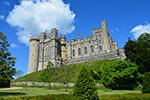
Around 1070, William the Conqueror selected the banks of the River Thames, at the edge of a Saxon hunting ground, as the site for Windsor Castle. Over 16 years, the wooden motte-and-bailey fortress rose, taking advantage of its proximity to a royal hunting forest to serve as an ideal royal residence. Remarkably, Windsor Castle features a motte and two baileys, a rare configuration also found at Arundel Castle.

The Round Tower stands on the mound William's men raised.
By 1110, Henry I was the first King to use Windsor Castle as a residence, establishing domestic quarters within its walls. Later, his grandson, Henry II, transformed the fortress into a royal palace, commissioning two sets of apartments and beginning the replacement of its wooden walls and towers with stone. By 1170, the Norman keep had been replaced with the Round Tower.
During the revolt of the English barons, King John relied on the castle as his negotiating base before signing the Magna Carta at nearby Runnymede in 1215. The following year, Windsor's strategic strength was confirmed when it withstood a siege in 1216. The successful defense reinforced the castle's reputation as a stronghold, prompting immediate repairs and, by 1221, further fortifications to prevent future breaches.
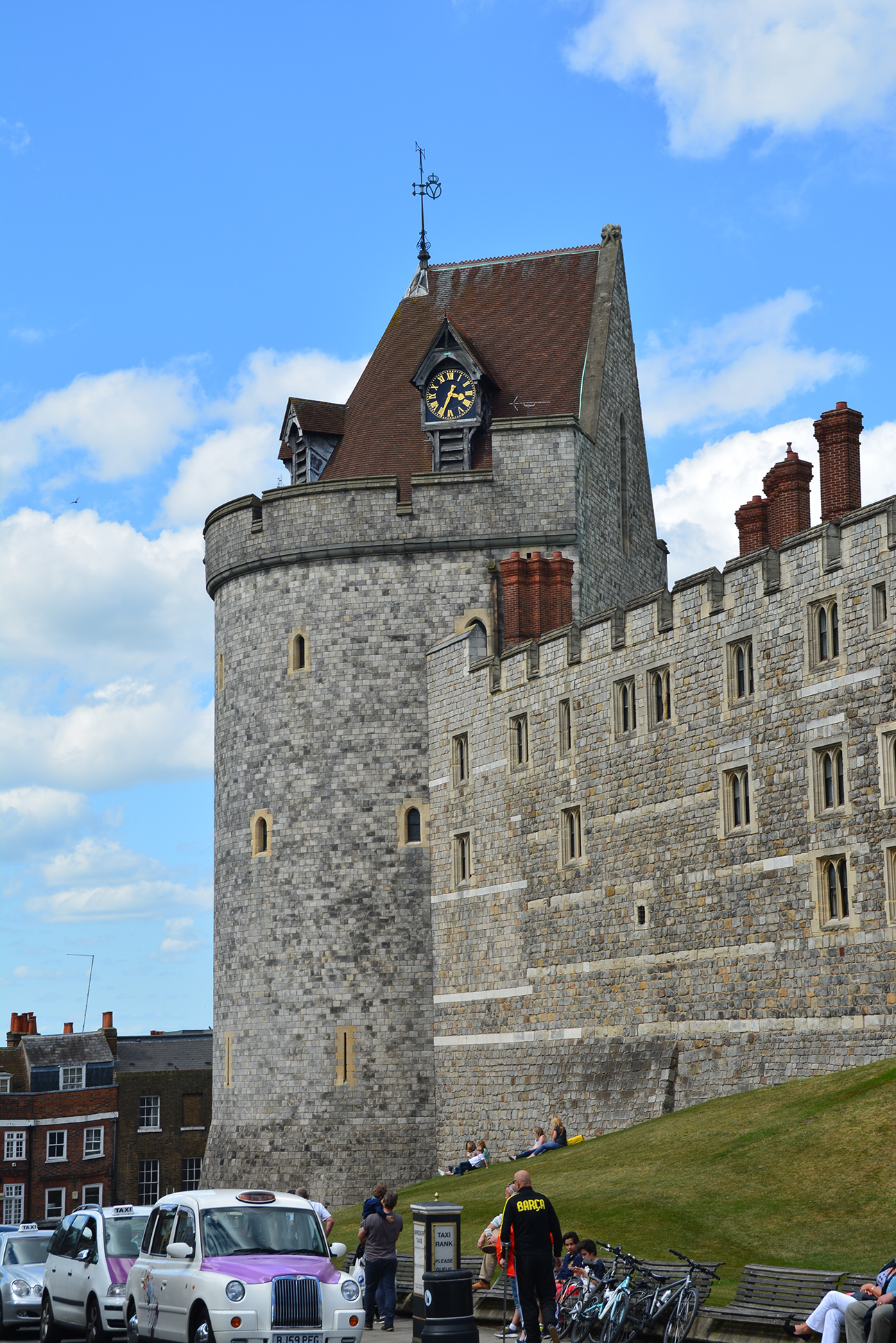
The Curfew Tower, one of the towers built under Henry III.
Rebuilding the castle in stone required 60 years. During this time, Henry III oversaw the reconstruction of buildings in the Lower Ward, including the addition of a chapel, a cloister, and a courtyard.
Edward III was born at Windsor Castle, and between 1350 and 1377, he turned the castle into a Gothic palace, spending over 50,000 pounds on the upgrades, which included an inner gatehouse with rounded towers leading to the Upper Ward and Royal Apartments with separate rooms for the king and his Queen, Philippa of Hainault. He had already founded the Order of the Garter here in 1348, and St George's Chapel was its home. The present chapel was begun in 1475 under Edward IV.
In 1357, French prisoners from the Battle of Poitiers, including John the Good (King John II of France), were held at Windsor Castle and ransomed for 3 million crowns.

The Edward III Tower.
Henry IV spent Christmas 1399 at Windsor. Supporters of the deposed Richard II, led by the Earls of Kent, Huntingdon, and Salisbury, plotted to assassinate the newly crowned king and his sons at a tournament planned for Twelfth Night. The plot was betrayed, and Henry left the castle for London on the night of 4 January. The next morning, about 500 rebel horsemen rode into Windsor Castle unopposed, searched the royal apartments and other buildings, found Henry gone, and withdrew. The rebels were later captured and executed.
Henry VI, known as Henry of Windsor, was born at Windsor Castle. He would become King at the age of nine months.
Toward the end of the 15th century, King Henry VII (Henry Tudor) constructed a narrow range west of the State Apartments. Shortly after ascending the throne, he hosted a grand feast for the Order of the Garter at the castle. In early 1506, storms forced Philip I of Castile, known as Philip the Handsome, to land in England, and his stay as Henry's guest included negotiations during a visit to Windsor. In exchange for being allowed to continue his journey, Philip agreed to hand over Edmund de la Pole, one of the surviving Yorkist claimants. Edmund was conveyed through London and committed to the Tower of London in late March 1506, where he stayed until his execution in 1513.
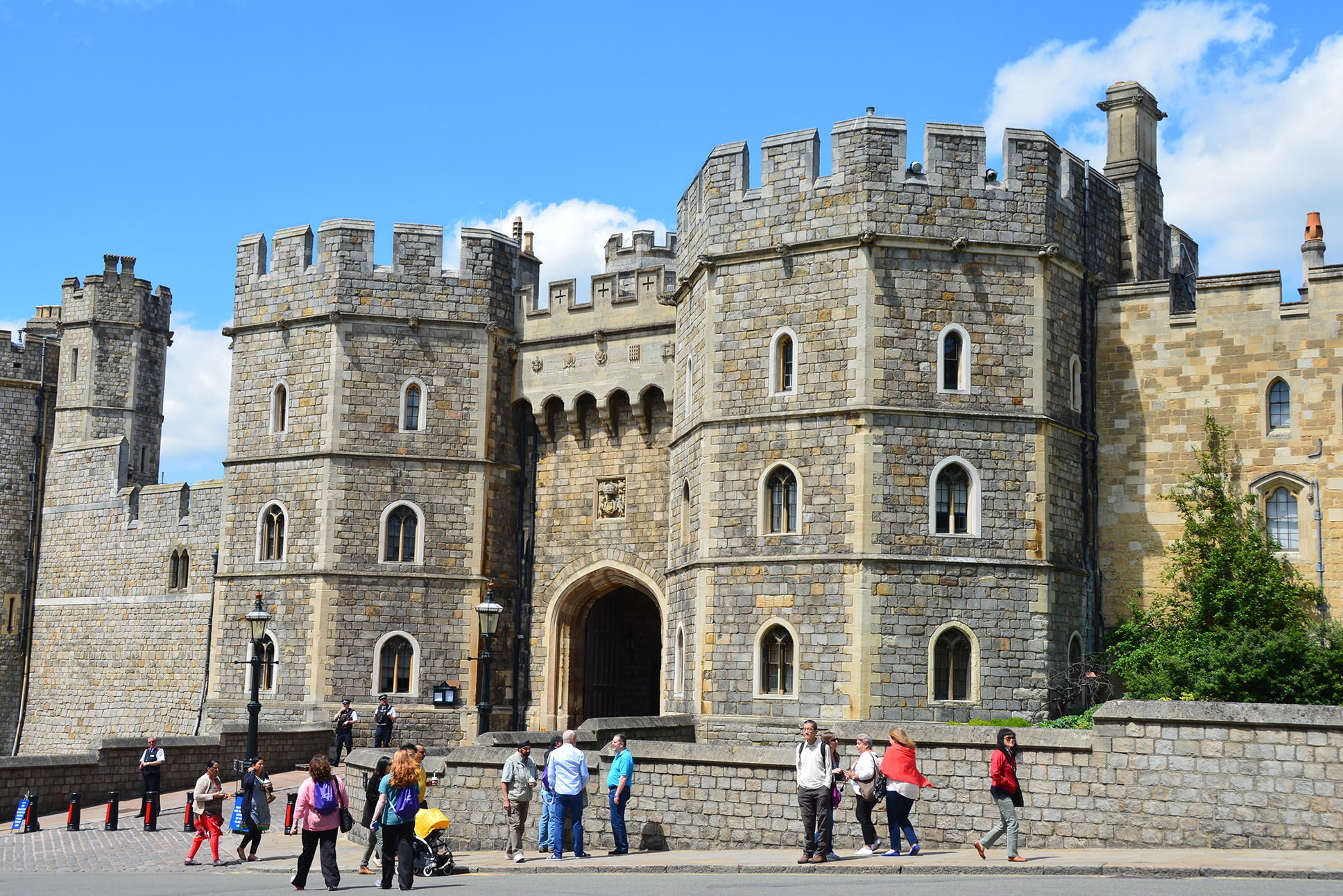
The Henry VIII Gate, the main entrance to the castle.
A gate at the bottom of the Lower Ward, named for Henry VIII, was added during his reign, along with a timber terrace on the north side of the Upper Ward, perfect for observing the hunt below. During the Pilgrimage of Grace in 1536, Henry VIII used the castle as a secure southern base to manage his military response. London outbreaks of plague turned the castle into a royal refuge as well.
The castle continued to evolve; in the 1570s, Elizabeth I took up residence at Windsor Castle and began extensive renovations. She also added a long gallery overlooking the North Terrace, which would later be incorporated into the Royal Library in the 19th century. Ten new brass cannons were also added for the castle's defense.
After the Battle of Edgehill in 1642, Windsor Castle became the military headquarters for Parliamentary forces during the English Civil War. In December 1648, it served as a prison for Charles I before his trial. Following his execution at Whitehall in 1649, his body was quietly interred in a vault beneath St George's Chapel at Windsor Castle, with no ceremony.

The Upper Ward, with the statue of Charles II on horseback.
When the monarchy was restored in 1660, Charles II reclaimed the throne and modernized the Royal Apartments. The result—England's grandest Baroque State Apartments—featured lavish textiles and tapestries.
As England moved into a new era, George III updated several rooms in the Neoclassical style and added a Music Room and a new Dining Room in the East Range of the Upper Ward near the end of the 18th century. The Queen's Stairs were also replaced with the Grand Stair, which rose in long straight flights north of the Great Gate.
George IV came to the throne in 1820 and, from 1824, had the architect Jeffry Wyatville remake the castle. The Round Tower was raised by about 30 feet, its exterior reclothed with massive masonry, and battlements and towers were added. The Grand Stair was demolished to create the Inner Hall, which provided an uninterrupted north-south view across the ground floor of the castle. The Waterloo Chamber was added, and St George's Hall was extended.
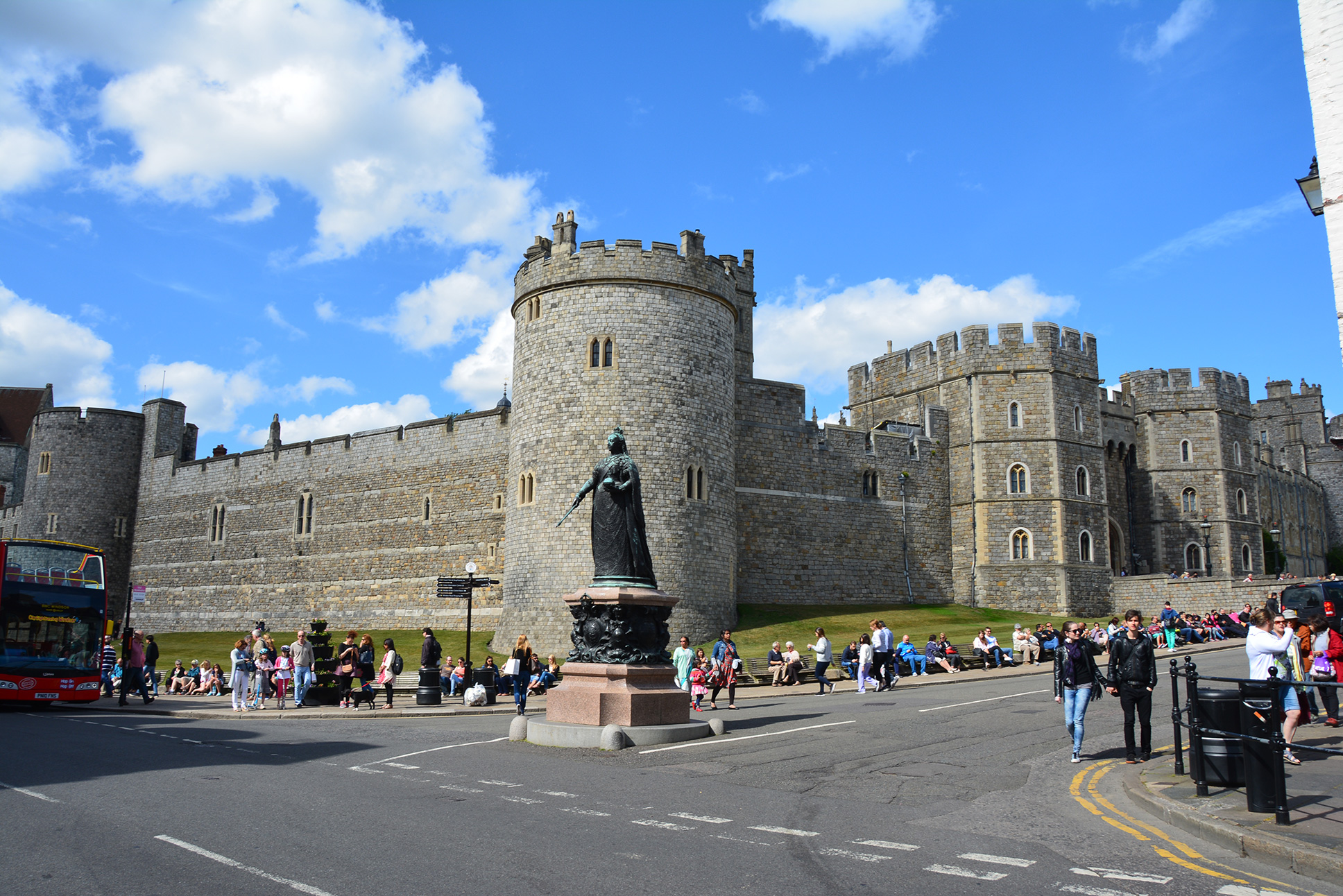
Queen Victoria's statue on Castle Hill.
During Queen Victoria's reign, a new private chapel was created at the east end of St George's Hall, as part of works that also included reconstructing the Grand Staircase. On December 14th, 1861, Prince Albert died at Windsor Castle. Victoria used the Inner Hall created under George IV for nearly 30 years. In 1866, she instructed the architect Anthony Salvin to close it off and create a new, smaller State Entrance Hall running east to west. The Inner Hall was then used as a storeroom for many years, and partly as a temporary display space from 1965, before it was restored and reopened to the public.
During World War I, anti-German feeling in England led the royal family to adopt the name 'House of Windsor' in 1917, closely associating the monarchy with Windsor Castle and British heritage. Later, in December 1936, King Edward VIII broadcast his abdication speech from Windsor Castle, further cementing its role as a site for key royal events.
Windsor again served its royal purpose in World War II, when King George VI used Windsor Castle as a refuge for the royal family from Luftwaffe bombing campaigns.
On November 20th, 1992, a fire in Queen Victoria's private chapel quickly engulfed large parts of Windsor Castle. The fire's destruction prompted a major restoration led by the Duke of Edinburgh, resulting in a redesigned St George's Hall in the modern Gothic style and the restoration of other damaged rooms to their historical standards. The process demonstrated the castle's resilience, with restoration completed exactly 5 years after the fire, strengthening its legacy as a living historical monument.
Restoration efforts persisted into the 21st century. In 2020, the Inner Hall was reopened, and a new route to the State Entrance Hall was completed.
Castle Highlights
Anyone fascinated by castles should visit Windsor Castle, which remains the residence of the Royal family. Expect airport-style security and large crowds, as this is a top tourist destination.
It is worth braving the extra security and crowds. While some rooms remain private, much of the castle is open for visitors and offers a rewarding experience.

Guards in bearskins march past St George's Chapel.
The soldiers of the Guard, in their red tunics and tall bearskin caps, are a common sight in the Lower Ward. They march past the chapel as part of the Changing of the Guard, and sentries stand at posts around the castle.
A highlight is exploring the State Apartments in the Upper Ward, where visitors can find Queen Mary's Doll's House and the Grand Staircase, flanked by knights on horseback. Medieval weapons and armor line the walls, adding to the imposing display.
Of all the impressive rooms, my favorite at Windsor Castle, or any castle, is St George's Hall. Rebuilt after the fire, it occupies the site of Edward III's great hall. It has an enormous hammer-beam roof with suits of armor adorning the wall below every other beam. At one end of the hall is the King's Champion, another suit of armor on horseback. Dedicated to the Order of the Garter, the ceiling tiles display the coats of arms for the Knights of the Order of the Garter. The hall looks like something from a movie scene from the days of King Arthur.

St George's Chapel in the Lower Ward.
Within the Lower Ward, St George's Chapel serves as the final resting place of eleven sovereigns, among them Henry VI, Henry VIII, Charles I, and Queen Elizabeth II. Dedicated to the Knights of the Order of the Garter, the chapel displays their banners beneath the choir's vaulted ceiling and stands as a fine example of Perpendicular Gothic architecture.
Windsor Castle can take a whole day to visit. The town of Windsor has many pubs just across the street from the castle to get some lunch or dinner, and shops to buy souvenirs if you cannot find something in the few gift shops within the castle.
Windsor Castle is also haunted.