Scarborough Castle
History
Scarborough Castle is perched on a massive promontory of rock overlooking the North Sea along England's northeastern coastline. For a millennium, the headland served as a natural fortress; in the late 4th century, the Romans built a signal station here as a lookout against Saxon raiders.
Centuries later, following his victory at the Battle of the Standard in 1138, William le Gros, Earl of Aumale, constructed a wooden castle on the site. Featuring a tower, chapel, moat, and curtain wall, this early fortification marked the first substantial use of the headland as a military stronghold.
In 1155, King Henry II took control of the castle from William le Gros to strengthen royal authority in northern England. Between 1157 and 1169, he replaced the wooden structures with the formidable three-story Great Tower and strong stone walls, thereby transforming the site into a major royal fortress.
In the early 13th century, King John invested heavily in the castle, visiting it four times and developing it as a royal residence alongside Knaresborough Castle. He added the wall surrounding the inner bailey, a hall in the inner bailey, and a new royal chamber block in the outer bailey.
Subsequent monarchs further improved Scarborough. Henry III added the Barbican Gate and bridge, and the castle was committed to Prince Edward, future King Edward I, who held court and council there in 1275 and 1280. In 1295, hostages from his campaign in Wales were held at the castle.
Over the following centuries, Scarborough Castle evolved into one of England's greatest strongholds, serving as both a royal residence and administrative center. Henry de Percy occupied the castle from 1308, commissioning a bakehouse, brewhouse, and kitchens in the inner bailey.
In April 1312, Edward II made Piers Gaveston the governor of Scarborough Castle, but his tenure would be short-lived. In May, the castle was besieged by Aymer de Valence, 2nd Earl of Pembroke, John de Warrenne, 7th Earl of Surrey, and Henry de Percy. The castle fell quickly, and Gaveston was promised safe escort from the castle, but on his journey south, he was captured by Guy de Beauchamp, 10th Earl of Warwick, and was killed.
Centuries later, in 1484, Richard III became the last King to stay at the castle while assembling a fleet to counter an expected invasion by Henry Tudor, later known as King Henry VII.
In the 16th century, Scarborough Castle faced conflict again. In October of 1536, the castle's constable, Sir Ralph Eure, declared his support for Henry VIII during the Pilgrimage of Grace and was besieged by Robert Aske. The castle was damaged by gunfire but held out against the attack.
In 1557, Thomas Stafford seized Scarborough Castle and held it for three days, believing he could start a revolt against Queen Mary. The castle was retaken, and Stafford and his accomplices were executed for high treason on Tower Hill in London.
In September 1642, Sir Hugh Cholmley was commissioned to hold the castle for Parliament during the English Civil War. After being persuaded by Royalist supporters in March 1643, he switched sides. While he visited King Charles I in York, his cousin Captain Browne Bushell and 40 seamen surprised the castle guard at night, seizing the fortress. Cholmley quickly returned to Scarborough and convinced Bushell to hand the castle back. For the next two years, it served as an important royal base.
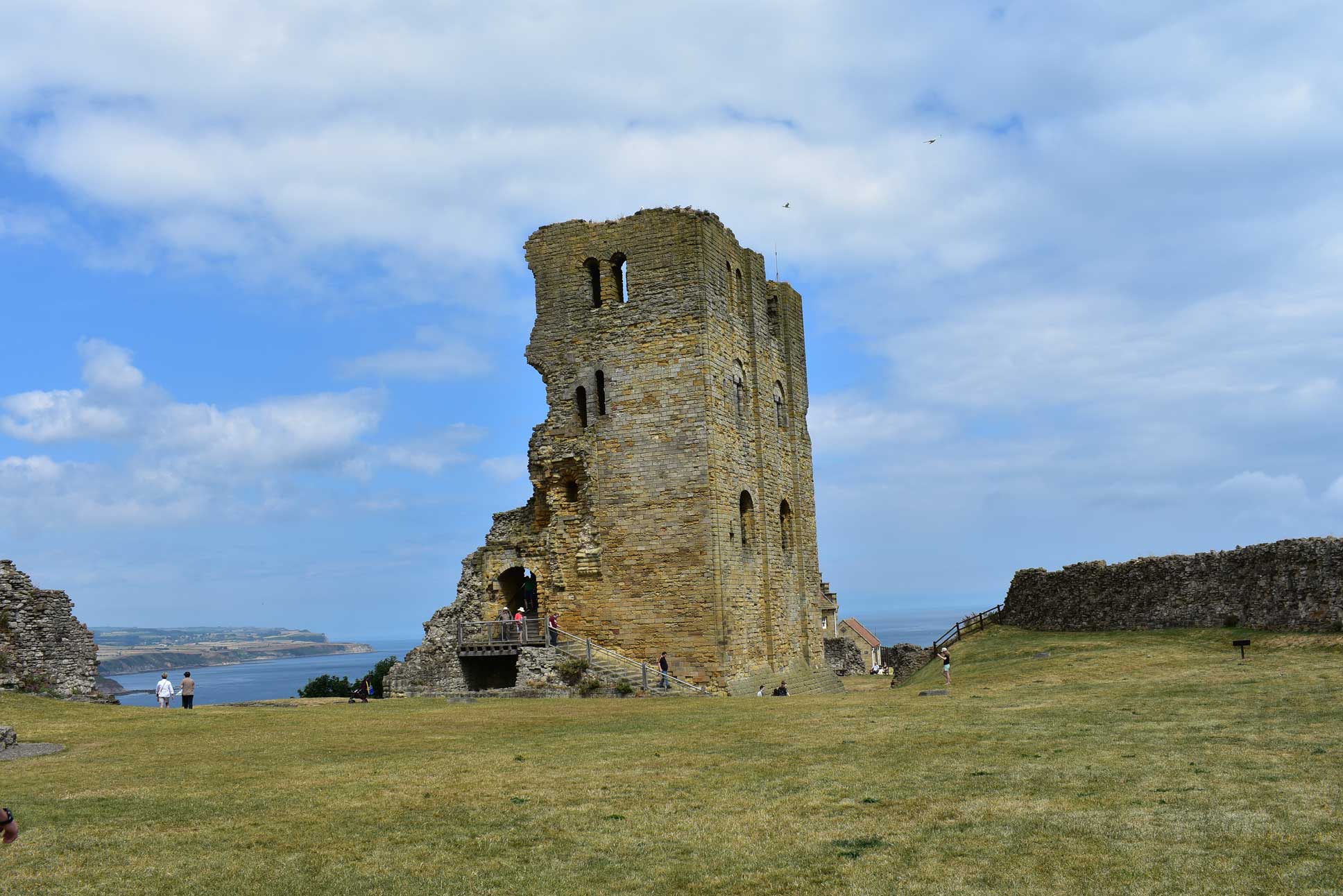
In 1645, Parliamentarian forces under John Meldrum surrounded Scarborough. After three weeks, Sir Hugh retreated from the town to the castle. There, he withstood a five-month siege, considered one of the bloodiest of the Civil War. The bombardment was so extreme that the Great Tower's western wall collapsed. After exhausting his supplies of gunpowder, money, and food, Cholmley surrendered the castle on July 25th, 1645.
On July 27th, 1648, the Parliamentarian garrison of 100 soldiers under Colonel Boynton turned against Parliament and declared support for the king after not being paid. The castle was besieged and, after months, Boynton surrendered. Orders to make the castle indefensible were stopped due to opposition from local townspeople, which saved the structure from more damage.
With its military importance diminished, Scarborough Castle was used as a prison in the mid-17th century. Among those held there was George Fox, founder of the Society of Friends (the Quakers).
Adapting to changing needs, a barracks block was added within King John's chamber block in response to the Jacobite Rebellion of 1745, remaining in use until the 19th century.
On December 16th, 1914, during the opening months of World War One, two German warships launched over 500 shells on the town and castle of Scarborough from the bay, killing seventeen people and seriously injuring eighty more. It so shocked the nation that “Remember Scarborough” became a rallying cry for a recruitment campaign.
In 1920, the castle was placed under state guardianship by the Ministry of Works, which demolished the 18th-century barracks block, which had been damaged by the German bombardment.
In 1963, a Royal Observer Corps monitoring post was built within the castle near the cliff edge to protect volunteers who would measure and plot the detonation of nuclear bombs if the Cold War escalated to conflict. The monitoring post was closed and buried by 1968.
Today, the castle is under the care of English Heritage and open to visitors, presenting centuries of history to those who explore its grounds.
Castle Highlights
Scarborough Castle sits proudly above the town. Parking nearby is scarce; at best, you may find a spot. For most visitors, parking at one of the car parks outside town and taking the bus is the best option, though reaching the castle still requires a bit of a walk. This distance is part of the castle's defenses, designed to discourage attack. Despite the trek, a visit is well worth it.
The most impressive part of the castle is the remains of the Great Tower, which was partially destroyed during the Siege of 1645. It still stands over 90 feet high and has walls that are 12 feet thick.
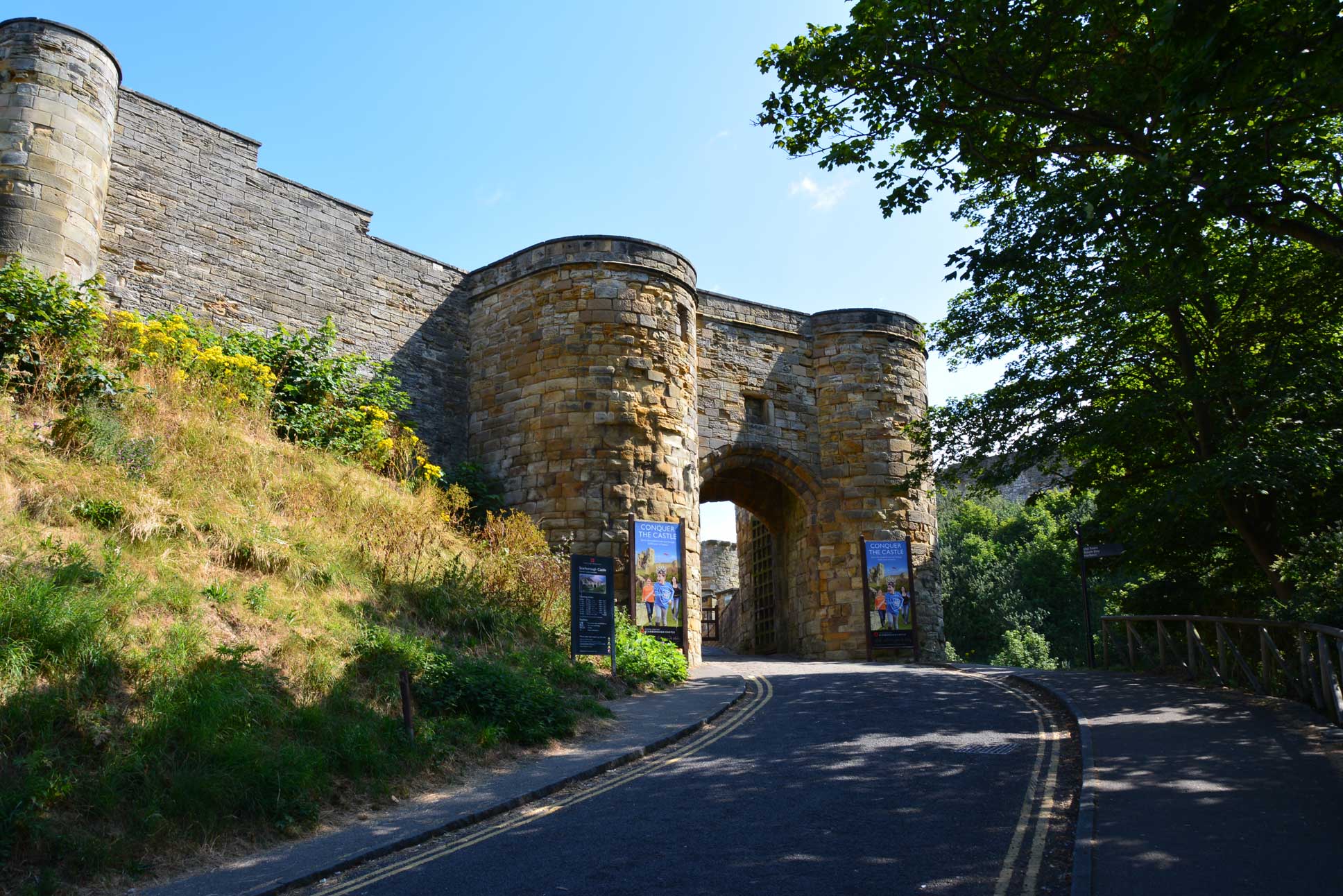
The gatehouse and barbican at the castle's entrance are still in place and have flanking round towers protecting the entrance. The entry from the barbican into the main castle enclosure is now lost, and an arched gateway exits to the right of the barbican.
The inner bailey now contains a 14th-century kitchen, brewhouse, and bakehouse, where King John's Hall once stood. There is also a well in the inner bailey that is over 46 meters deep.
The outer bailey contains King John's chamber block, the King's Hall, the Postern Gate, and a Sallyport. Along the cliff edges in the outer bailey are the remains of the Roman Signal Station and the medieval Chapel of Our Lady.
The castle can be explored in half a day. I recommend spending the other half in Scarborough, a seaside resort with nice places to eat and shop. If you really want to see more castles the same day, Pickering Castle is close enough to see the same day.
Scarborough Castle is also haunted.