Cardiff Castle / Castell Caerdydd
History
A defensive stronghold has stood on the site of Cardiff Castle for almost 2,000 years. From Roman soldiers to Victorian visionaries, the castle is layered in history.

Around the year 55 AD, the Romans built a fort beside the River Taff. Guarding a strategic river crossing with access to the sea, it also controlled the local Silures tribe. During the 3rd century, a larger stone fortification rose to defend against coastal pirate threats. The Romans stayed until the 5th century before beginning their withdrawal from Britain. After their departure, the local settlement endured and eventually became known as Caer-Taff, meaning "Fort on the Taff."
The old Roman walls of the 3rd-century fortification were used by the Normans. They built on them to form part of the castle's outer perimeter. The Normans also added an inner wall, creating inner and outer baileys. They placed a wooden Keep atop a forty-foot-high motte, surrounded by a thirty-foot-wide moat.
Following the Norman conquest in 1066, the Normans moved west into Wales, where they built motte-and-bailey castles and often reused old Roman fortifications, either building on them or incorporating them into new structures. The medieval Cardiff Castle was constructed during this period. Construction may have begun around 1081, when William the Conqueror returned from his pilgrimage to St. Davids, or perhaps around 1091, when Robert FitzHamon, lord of Gloucester, began his rule after invading the region in 1090. He used the castle as a base while consolidating control over southern Glamorgan in subsequent years.
Conquered lands in Glamorgan were granted in parcels called knights' fees. Holders of these lands were required to provide forces to protect Cardiff Castle. This arrangement was called a castle-guard system. Some knights had to maintain buildings called "houses" within the castle's outer bailey. Cardiff Castle was a Marcher Lord territory, with special privileges and independence from the English crown.
On September 28th, 1106, Robert FitzHamon was fatally injured at the Battle of Tinchebray and died soon after. King Henry I gave the castle to Robert FitzRoy, Earl of Gloucester, in 1122. He was the illegitimate son of Henry I and the husband of FitzHamon's daughter.
Robert Curthose, Duke of Normandy and Henry I's older brother, attempted to seize the English crown from Henry in a battle in Normandy at the Battle of Tinchebray. He failed and was imprisoned at Devizes Castle for 20 years. Later, he was moved to Cardiff Castle in 1126. Robert Curthose would spend the rest of his life imprisoned at Cardiff Castle. He died there on November 3rd, 1134.
Robert Curthose learned Welsh, and in his later years, he wrote a poem while imprisoned that included the line:
"Woe to him that is not old enough to die."
FitzRoy would hold the castle throughout the unstable period of the Anarchy and passed it on to his son, William FitzRobert.
In the 12th century, the wooden Keep on top of the motte was replaced with a stone shell Keep and defensive stone walls. This was in response to the threat of the Welsh uprising in 1136.
One of the castle's most famous incidents occurred in 1158. During a night raid, Ifor ap Bach scaled the Keep's walls and abducted William Fitz Robert, his wife, and their infant child. He held them for ransom, demanding the return of land to which he was entitled under Welsh law.
In 1183, the castle was attacked by the Welsh again. William died that same year. Of William's three daughters, Henry II made Isabel, Countess of Gloucester, the sole heir to the estate and castle. This decision was against English custom, but it enabled Henry II to marry his youngest son, Prince John (future King John), to Isabel, thereby giving John control over extensive lands.
The following year, stone walls were built around Cardiff, and a West Gate was added. It was constructed in the gap between the castle and the River Taff. John and Isabel later divorced. John kept the castle until 1214, when Isabel married Geoffrey de Mandeville.
In 1271, Isabel died, and Cardiff Castle passed to her sister's husband, Gilbert de Clare, who then held it as part of the Honor of Clare. Though this made the castle the center of the de Clare family's power in South Wales, the family actually preferred to live at Clare Castle and Tonbridge Castle.
Gilbert's son, Richard de Clare, 6th Earl of Gloucester, added the Black Tower beside the southern gateway in the late 13th century. He likely also rebuilt the northern and eastern castle walls in stone. The Exchequer Gate, which is f lanked by two towers, was also added to strengthen the castle due to the threat from Llywelyn ap Gruffudd, Prince of Wales.
In June 1314, Richard's grandson, Gilbert de Clare, 8th Earl of Gloucester, and last male de Clare, was killed at the Battle of Bannockburn. Cardiff Castle was then given to Hugh Despenser the Younger, a favorite of Edward II.
After harsh rule by Despenser and devastating weather ruined harvests, a Welsh rebellion led by Llywelyn Bren began in 1316. The rebellion was suppressed, and Llywelyn surrendered in March of that year before being taken to Cardiff Castle. Two years passed. In 1318, Llywelyn was sentenced as a traitor and hanged, drawn, and quartered at the castle, all on Hugh Despenser's orders. The brutality caused outrage in both England and Wales. Hugh arrested William Fleminge in 1321, using him as a scapegoat. Fleminge was imprisoned in the Black Tower and later executed on the castle grounds.
Conflict soon arose between the Barons and the Despensers, and Cardiff Castle was attacked and sacked in 1321 during the Despenser War. Although Hugh Despenser was executed for treason in 1326, the Despensers retained the castle and held it for the rest of the century.
In the 15th century, the Despensers made Caerphilly Castle their main residence rather than Cardiff. In 1401, a rebellion broke out in Wales, led by Owain Glyndŵr, and in 1404, the Welsh rebels took Cardiff Castle, causing damage to the Black Tower and the South Gate. In 1414, Richard le Despenser died, and the castle passed to his daughter Isabel and her husband, Richard de Beauchamp, the Earl of Worcester, and, upon his death, to Beauchamp's cousin, also named Richard de Beauchamp, 13th Earl of Warwick, in 1423.
The Earl of Warwick did not receive Caerphilly Castle as well, so he focused on restoring Cardiff Castle. He built a new tower beside the Black Tower in 1430, restored the gateway, and improved the motte defenses. Between 1425 and 1439, he added a new range of domestic buildings incorporated into the 13th century southwest wall, including an octagonal tower that stood 75 feet tall, similar to Guy's Tower at Warwick Castle, built around the same time.
Two generations later, Anne Beauchamp owned the castle, and when she died in 1449, it passed by marriage to Richard Neville, 16th Earl of Warwick and the Kingmaker. He held Cardiff Castle until his death at the Battle of Barnet on April 14th, 1471, during the Wars of the Roses.
Possession of Cardiff Castle bounced between the Yorkists and Lancastrians for a time before ending in Tudor hands. The Tudors were of Welsh origin, leading to a reduction in hostilities between Wales and England. In 1495, King Henry VII revoked Cardiff Castle's Marcher territory status and placed it under normal English law as part of the County of Glamorgan.
In 1513, the castle was leased to Charles Somerset, Earl of Worcester, who used it as a residence. The heretic, Thomas Capper, was burnt at the castle on orders of Henry VIII.
In 1550, William Herbert, later Earl of Pembroke, purchased the castle from Edward VI, and extensive work was carried out on buildings in the outer bailey. The Herberts also built an Elizabethan extension at the north end of the residential buildings, with large windows overlooking the garden.
Cardiff continued to be used to detain prisoners in the 16th century, with the Black Tower serving as a prison.
As during the Wars of the Roses, Cardiff Castle changed hands often during the English Civil War.
In 1642, the castle was owned by Philip Herbert, 4th Earl of Pembroke. During the English Civil War, Philip was a moderate Parliamentarian, and the castle was initially held by a pro-Royalist garrison. The castle was taken in a sneak attack using a secret passageway by Parliamentarian forces.
In turn, William Seymour, 2nd Duke of Somerset, took the castle during a surprise attack, and it was back in Royalist hands. Parliamentary forces then immediately besieged the castle, retaking it after a few hours of fighting, and reinstalled a Parliamentarian garrison.
In 1645, the High Sheriff rebelled against Parliament and seized the town of Cardiff. He could not, however, capture the castle. King Charles I sent forces from Oxford to assist Carne. Meanwhile, Parliament dispatched a naval force from the sea to support the castle garrison. A small battle broke out, and the Royalists eventually took the castle.
King Charles visited Cardiff Castle in July 1645 to meet with local leaders. Relations between his commander and the people of Glamorgan had gone sour, and when the king left the castle, he was confronted by a small force of angry locals who called themselves the Peaceable Army, who demanded to be given control of the castle. After negotiations, a compromise was reached in which the castle garrison would be replaced by a local Glamorgan force commanded by Richard Beaupré. In exchange, Charles received 800 pounds and a force of a thousand men to support him in the war.
In September, Charles returned to Wales and broke his agreement, disbanding the Peaceable Army. The Peaceable Army changed sides and forced the surrender of the castle to Parliament by mid-September.
In 1648, the Royalists were back with an army of 8,000 troops under Rowland Laugharne and Edward Stirling, with the intent of retaking Cardiff. Parliamentary forces under Thomas Horton moved quickly from Brecon to support the castle. Oliver Cromwell's Parliamentarian forces were also on their way from Gloucester to support the castle. So with time against the Royalist army, which attacked, leading to the Battle of St Fargans, just west of Cardiff, where the Royalists were defeated.
After the Civil War, Cardiff Castle was spared the normal act of slighting to make it indefensible, which became the fate of so many other castles.
The Herberts continued to own the castle during the Interregnum and after the restoration to Charles II. Lady Charlotte Herbert was the last of the family to control the castle. Her second husband was Thomas Windsor, 1st Viscount Windsor, and when she died in 1733, the castle passed to their son Hebert Windsor. Herbert's daughter, Charlotte Jane Windsor, married John, Lord Mount Stuart, in 1766, who would later become the Marquess of Bute in 1794.
Bute began to restore Cardiff Castle into a comfortable Georgian mansion. The grounds underwent major alterations by landscape architect Lancelot Capability Brown. The inner wall separating the inner and outer baileys was destroyed with gunpowder. The Knight's houses and Shire Hall in the outer bailey were removed, and the ground was flattened and laid with grass. The Herbert additions were also removed, and two new wings were built in a more contemporary design.
In 1814, John Crichton-Stuart, 2nd Marquess of Bute and Bute's grandson, inherited his title and Cardiff Castle. In 1825, the new Marquess began new investments in the Cardiff Docks, enabling Cardiff to become a major exporter of coal, transforming Bute's mining interests, making him one of the wealthiest men in the world. By 1900, the family estate had grown to 22,000 acres in Glamorgan.
The 2nd Marquess primarily lived on the Isle of Bute in Scotland and visited Cardiff infrequently. In 1831, violent protests broke out during the Merthyr Rising, and the Marquess based himself at Cardiff Castle and was kept informed of unfolding events. The government of Cardiff was reformed by an Act of Parliament in 1835, introducing a town council and a mayor, thereby breaking the link with the Constable of Cardiff Castle.
In 1848, John Patrick Crichton-Stuart, 3rd Marquess of Bute, inherited his father's title and castle when he was less than a year old. He grew up despising Cardiff Castle, believing it represented a mediocre attempt at Gothic style. He began remodeling the castle in 1868, adding the 132-foot-tall Clock Tower. Work continued on the 18th century range, including construction of the Guest Tower.
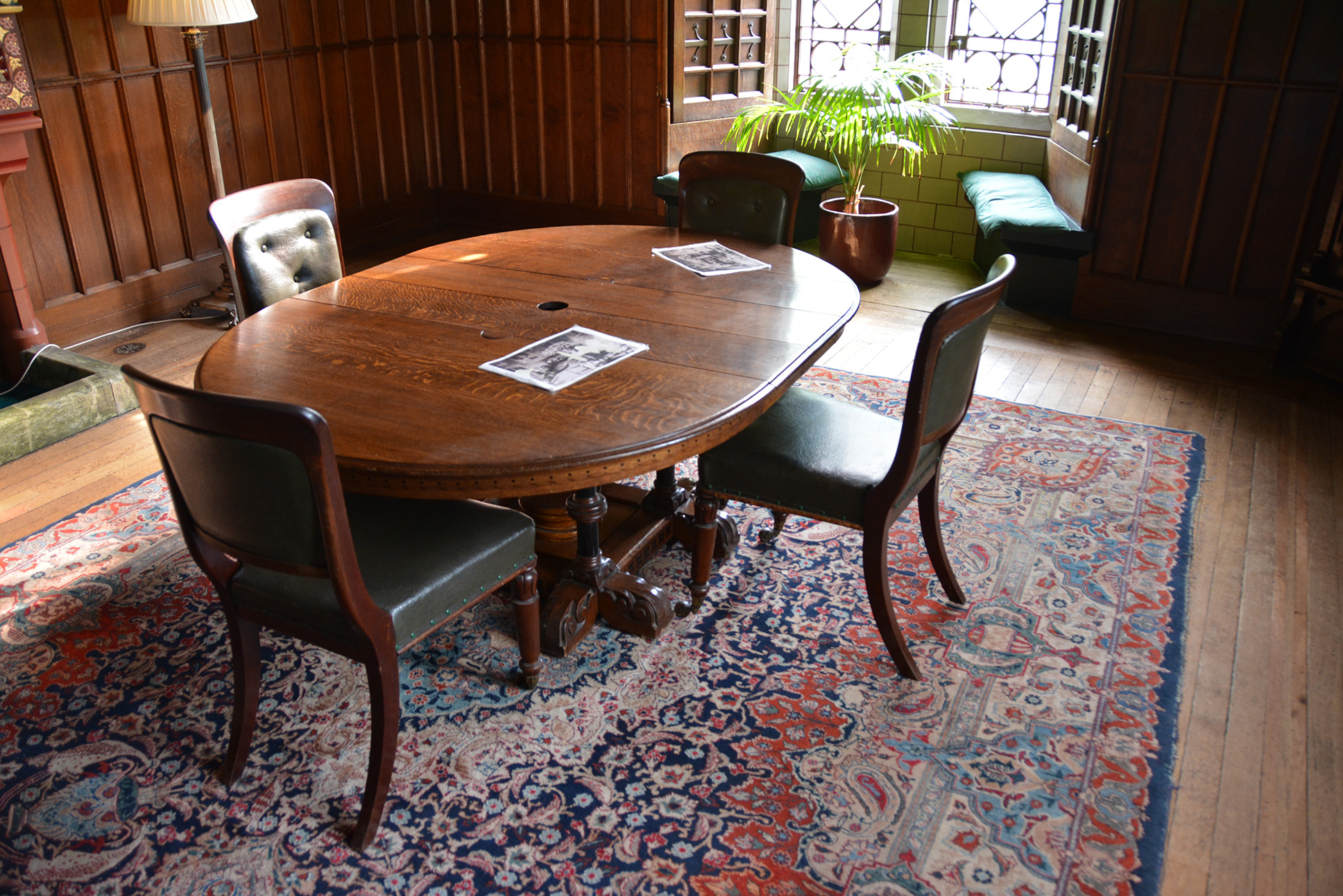
The castle upgrades also included the Arab Room, Banqueting Hall, Chaucer Room, Library, Nursery, Roof Garden, and Bedrooms. The new castle closely followed the plan of a Victorian country house.
John Crichton-Stuart, 4th Marquess of Bute, inherited the castle in 1900 on his father's death, and the family's estates began to shrink as the coal trade declined and industry suffered during the 1920s depression. Despite this, work on the castle continued in 1921 with the restoration of medieval masonry, rebuilding the South Gate and Barbican Tower, and reconstructing the West Gate and the town wall beside the castle. The Roman Walls portion of the castle underwent archaeological investigation in 1922 and 1923, leading to the redesigning of the Roman Gatehouse.
During World War II, the tunnels within the medieval walls were used as air-raid shelters, with eight different tunnels holding up to 1,800 people in total. The castle survived the Blitz.
In 1947, John Crichton-Stuart, 5th Marquess of Bute, inherited the castle upon his father's death. He sold the lands held in Cardiff and donated the castle and surrounding park to the city on behalf of the people of Cardiff.
Cardiff Castle is now run as a tourist attraction, one of the most popular sites in Cardiff. The castle also contains a regimental museum of the 1st The Queen's Dragoon Guards and the Royal Welsh.
Castle Highlights
Cardiff Castle is a wonderful place to visit, as it blends architecture from the Roman, Norman, Georgian, and Victorian periods. Most interiors have been redecorated in Victorian splendor, except for the medieval Keep.
Sections of the original old Roman wall can be seen in the castle's rampart walls, which are outlined by red sandstone. Above the Roman remains are the medieval walls.
The outside of the Clock Tower features seven elaborate statues representing Mercury, Mars, Venus, Jupiter, Saturn, the Moon, and the Sun. The tower also includes five shields depicting the coat of arms of the Marquess' family and those of other families that married into it: Stewart, Crichton, Herbert, Windsor, and Montagu.
On the interiors, the Butes spared no expense. The most impressive room is the Banqueting Hall, with murals on the walls that tell the story of the medieval castle, inspired by medieval churches that depict scenes from the Bible and echo the style of medieval manuscript illumination.
The Summer Smoking Room on top of the Clock Tower is covered from floor to ceiling in colorful gilded decorations. The ceiling depicts the four elements and constellations of stars.
The Day Nursery in the Guest Tower is where the children were looked after by their governess. Its walls depict scenes from children's literature featuring heroes and heroines.
Lord Bute's Bedroom features a biblical theme and a gilt-bronze figure of St John the Evangelist over the fireplace. Behind the bedroom is Lord Bute's bathroom. The walls are made of local pink alabaster, and the tub is said to be Roman antique.
Visiting Cardiff Castle can take at least half a day to a full day, with so much to explore, especially if you go along on one or more of the guided tours. Both Castell Coch and Caerphilly Castle are close enough to see on the same day. I suggest seeing Castell Coch as Caerphilly Castle can also take most of the day to visit.
Cardiff Castle is also haunted.