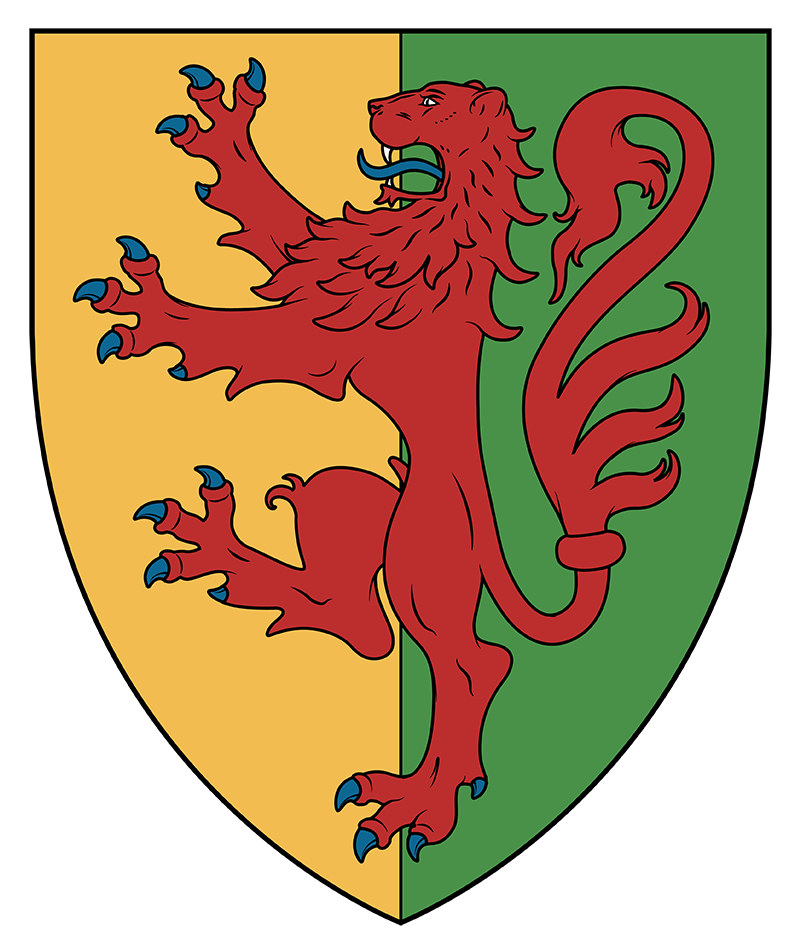
William Marshal - 1st Earl of Pembroke
England's Greatest Knight
William Marshal was an Anglo-Norman soldier and statesman who rose to prominence in the 1160s, served five English kings, and became one of the greatest knights in English history. Born the younger son of a minor baron, he made his name in tournaments, won an earldom and the hand of one of the richest heiresses in Europe, and in his seventies, he saved the crown for a nine-year-old king.
William was born around 1146 or 1147, probably in Wiltshire, where his family held estates in the Kennet Valley, and he was the fourth son of John Marshal and his second wife, Sybilla of Salisbury, whom John married around 1141 after divorcing his first wife. Sybilla was the daughter of Walter de Salisbury, the sheriff of Wiltshire, and the sister of Patrick, Earl of Salisbury. John Marshal held the hereditary office of marshal, the head of the king's security, and in the civil war between King Stephen and the Empress Matilda, he fought on Matilda's side. William's older brothers were John, who succeeded as marshal, Gilbert, and Walter, and he had a younger brother, Anselm, and a sister, Margaret. As a younger son in a family with limited landholdings, he had little prospect of an inheritance, which pointed him toward a career in arms. In 1152, when William was about five, Stephen besieged John's castle at Newbury, and John gave William as a hostage to win a truce, which he used to re-provision, fortify, and garrison the castle. When Stephen threatened to kill the boy, John replied that he did not care, since he still had the anvils and hammers to forge even finer children. Stephen considered hanging William, then launching him from a catapult over the castle walls, and then tying him to the wicker shelter that his troops carried up to the walls, but the castle's constable warned that he would drop a millstone on the shelter and flatten the boy like a pancake. William was so cheerful that he called out, "That's a new game! Dropping stones from the battlements!" and Stephen spared him. The two ended up playing soldiers, each with an army of plantain stalks.
At about thirteen, around 1159 or 1160, William was sent to Normandy to learn the ways of a knight in the household of William de Tancarville, the Chamberlain of Normandy, who was described as "a man noble in lineage, unique in war-craft, splendid in strength, father of knights." William gained a reputation there as a big eater and was nicknamed gaste-viande, or "Greedy-guts." He was knighted around 1166 and sent to Neufchâtel-en-Bray in Normandy, in Henry II's war against the counts of Flanders, Boulogne, and Ponthieu. After a skirmish in which he lost his horse, Tancarville warned him not to be so rash and gave him no replacement, so William sold his clothes to buy one and turned to tournaments. On his return to England, he went straight to his mother's brother, Patrick, Earl of Salisbury, and entered his household. In 1168, he went to Poitou with Patrick, who was escorting Queen Eleanor of Aquitaine when local nobles, including Guy of Lusignan, ambushed her party. Patrick and his troops, badly outnumbered, covered the queen's escape, and Patrick was killed. William charged in fury, was badly wounded when a lance went through his thigh, and was captured. While he was a prisoner, his leg had nearly healed when his captors held a contest to see who could throw a heavy stone the farthest. William, ever the competitor, joined in and won, but the effort burst his wound open again. Eleanor had heard of his ferocious courage, and she paid his ransom and took him into her household.
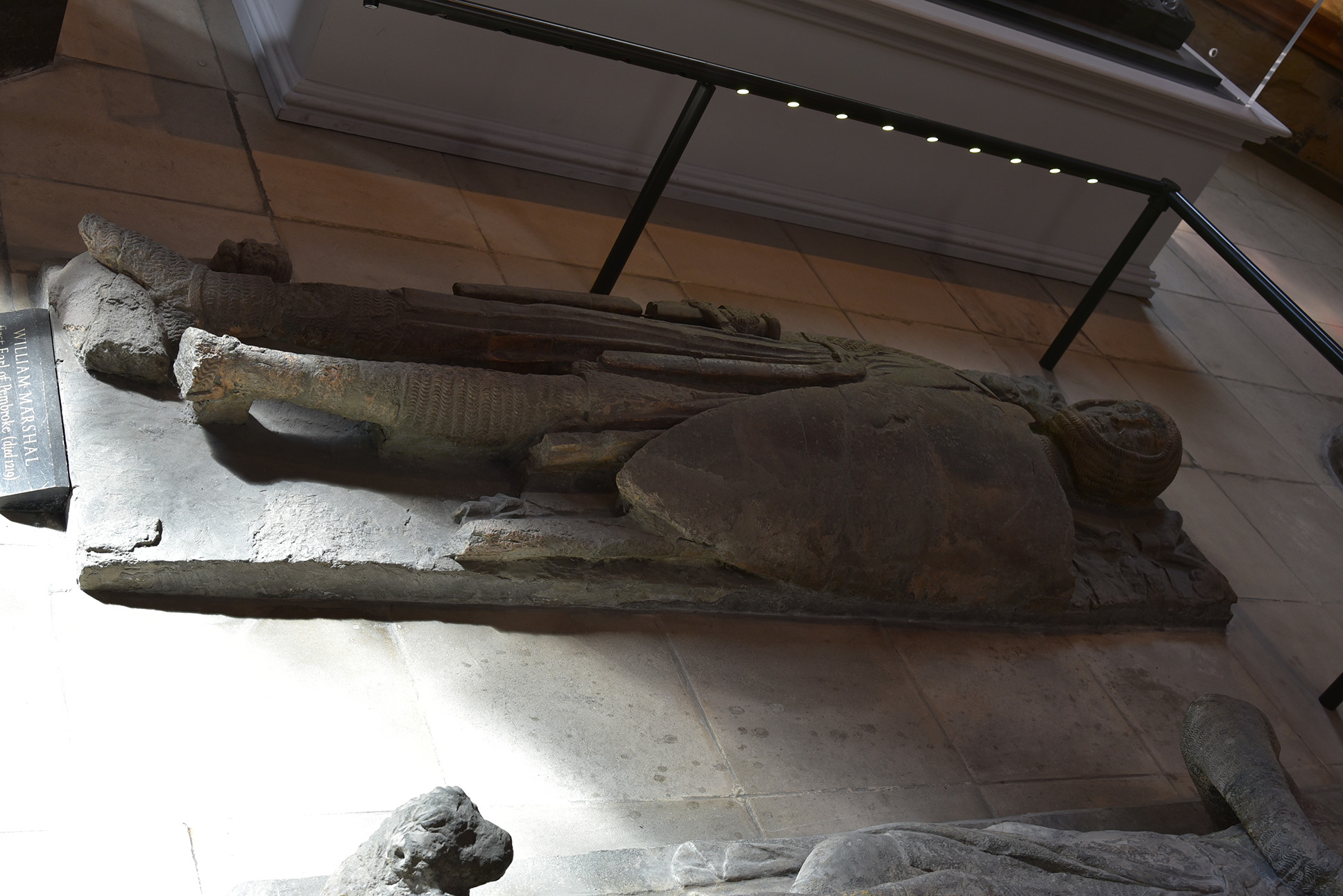
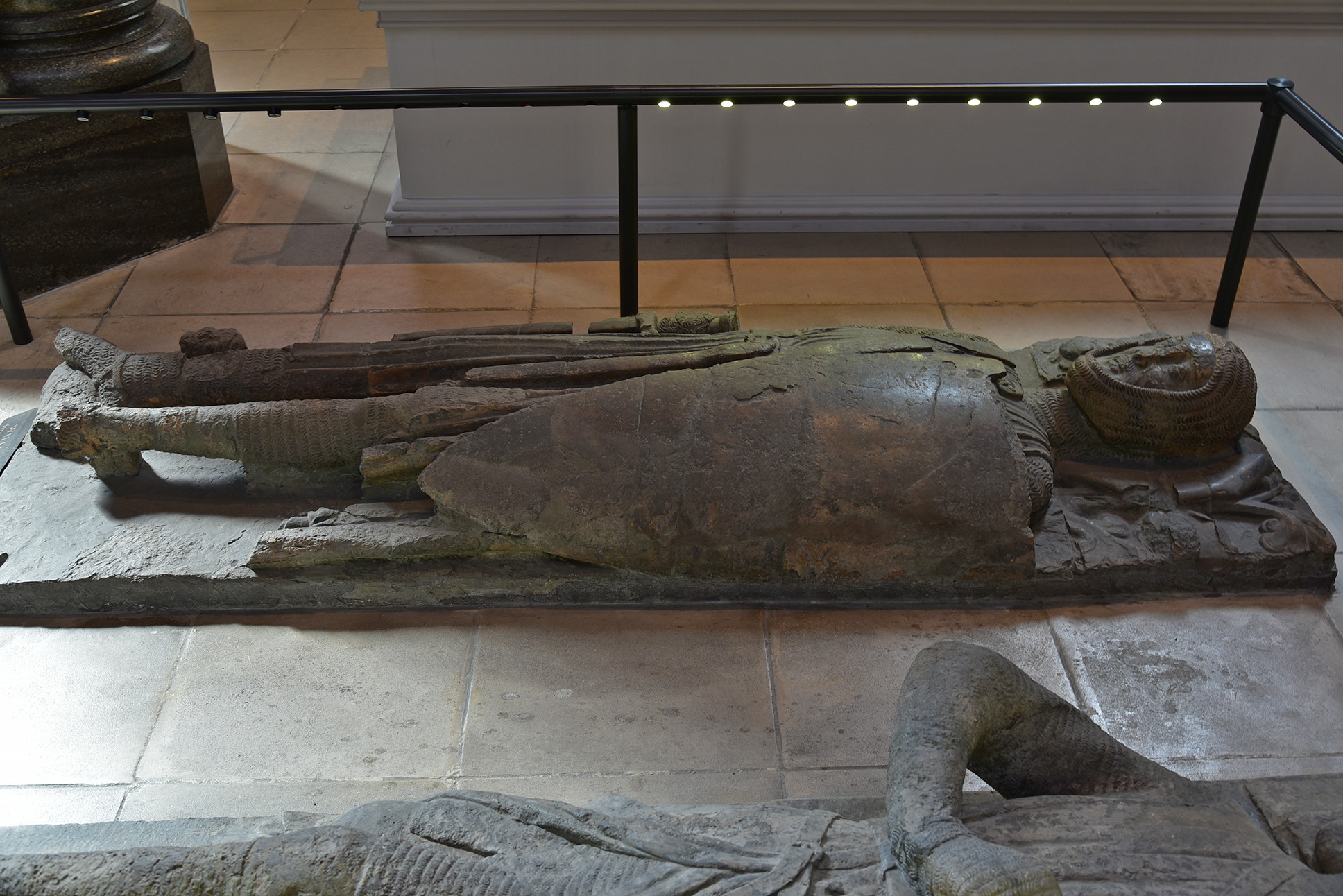
The effigy of William Marshal in the Temple Church, London.
In 1170, William joined the household of Henry the Young King, the eldest son of Henry II, who had been crowned in his father's lifetime, and Eleanor made him her son's tutor-in-arms. He remained the prince's close companion and a tournament leader throughout the 1170s. William became famed for his own fighting and for his leadership in tournaments, which at that time were staged battles fought across open countryside, where captured knights had to pay ransoms, and the best fighters grew rich. At his first tournament, he won four war-horses, a string of palfreys and packhorses, and a fine array of equipment. In early tournaments, he could be too rash, but he learned that discipline and a tight formation were vital if knights were to succeed. A herald-at-arms named Henry the Northerner was well known for shouting out in tournaments, "This way! Over here! God save the Marshal!" At one tournament, at Pleurs, William won great honor but no booty at all, until a noblewoman presented a pike to the tournament's leaders, and by general acclaim, it was passed on to the knight who had fought to best effect. That knight was William, who was found in the smithy having his dented helmet removed from his head by the blacksmith. The History records that over a period of nine months, William and his companion, Roger de Gaugi, captured 103 knights. He remained undefeated in tournaments for sixteen years, and on his deathbed, he claimed to have captured 500 knights in all. In 1182, William was accused of having an affair with the Young King's wife, Margaret of France. A second accusation, perhaps better founded, was that he had been tactless at best and seriously insubordinate at worst in adopting the great war cry of the Norman kings, "Dex aie li Mareschal," or "God help the Marshal!" William's response was typical. At Christmas 1182, he went to the Young King's court to clear his name and offered to fight his three accusers on three successive days, and, if the Young King so determined, to have a finger cut off his right hand before the fights. If he lost any of them, the Young King could hang him on the spot. No one took up his challenge, but William was banned from court. He returned and was reconciled with the Young King shortly before the Young King died of dysentery on June 11th, 1183, at Martel in Limousin, during a failed revolt against his father. The Young King had vowed to go on crusade, and on his deathbed, he entrusted William with his crusader's cloak and money to fulfill the vow to Jerusalem, and Henry II approved, so William discharged his lord's vow by going himself. He spent two years in the Holy Land, and while he was there, he entrusted his body, wherever he should die, to the Knights Templar, to be buried among them.
On his return, William served Henry II, and in the king's last war against his son Richard and Philip II of France, he showed the loyalty that defined his career. In early June 1189, Philip II and Richard captured Le Mans, and as Henry II retreated toward Chinon, William commanded the rearguard covering the king's flight. Near Ballan, he met Richard's forces in close combat and unhorsed Richard, and he could have killed him, but he killed Richard's horse instead. A month later, Henry II died at Chinon on July 6th, and William oversaw the transfer of his body to Fontevraud Abbey, where Richard came to see it. The new king, to save face, insisted that he had saved his own life in the encounter: "Marshal, the other day, you intended to kill me, and you would have if I had not deflected your lance with my arm." William bravely, or rashly, held his ground and replied, "I never intended to kill you. I am strong enough to aim my lance, and if I had wanted, I could have killed you." It was a tense moment, but William won Richard's respect.

Chepstow Castle, which came to Marshal with his marriage.
Richard rewarded William's loyalty with a bride, as the old king had promised. In August 1189, in London, William married Isabel de Clare, the daughter of Richard de Clare, "Strongbow," 2nd Earl of Pembroke, and Aoife of Leinster. Isabel, then about seventeen, was the heiress to the lordships of Pembroke in Wales, Striguil, with its castle at Chepstow, and Leinster in Ireland, as well as lands in England and Normandy, so William, who had begun with no inheritance, became one of the great barons of the realm. Isabel was known as the "Maid of Chepstow." In March 1194, his older brother John was killed defending Marlborough Castle for Richard's brother, Count John, and since John had no legitimate heirs, William succeeded him as hereditary Master Marshal of England. Richard allowed the succession, along with the family's paternal lands around Hamstead Marshall in Berkshire and Wiltshire, and it is why William came to be known simply as "the Marshal." The office later became the Earl Marshal.
Before leaving on crusade in 1190, Richard appointed William Longchamp as chief justiciar, with a small group of co-justiciars, including William, to share the governing of England. Longchamp's high-handed rule provoked opposition, and William joined the other magnates against him, and in October 1191, at a council at St Paul's, Walter de Coutances, Archbishop of Rouen, produced secret royal letters that replaced Longchamp and made Coutances head of the government, with William as one of his chief associates. William stayed active in government through the crises of 1191 to 1194. When news came that Richard had been captured on his way home from the Crusade, he helped resist the intrigues of Richard's brother, Count John, and in 1193, he took military action, including besieging Windsor with Welsh forces, to put down John's revolt. His role ended when Richard returned in March 1194 and reorganized the government, and William then fought for Richard in Normandy for the rest of the reign. When Richard died on April 6th, 1199, William supported John's claim to the throne against rivals such as Arthur of Brittany, which helped bring about a peaceful succession. John was crowned at Westminster Abbey on May 27th, and on the same day, he created William the 1st Earl of Pembroke, formalizing the status he had until then held only through his wife's inheritance. His own castle-building began about this time. At Chepstow, he began major rebuilding around 1190, including the east curtain wall with round towers and arrow slits, and the castle's original wooden doors, tree-ring dated to the 1190s, are among the oldest castle doors in Europe. At Pembroke, the head of his earldom, he strengthened the castle and built the great cylindrical keep, which still dominates it. He also fortified Usk Castle, adding towers and a rectangular walled inner ward, and in 1217, he captured Caerleon from Morgan ap Hywel and kept it.
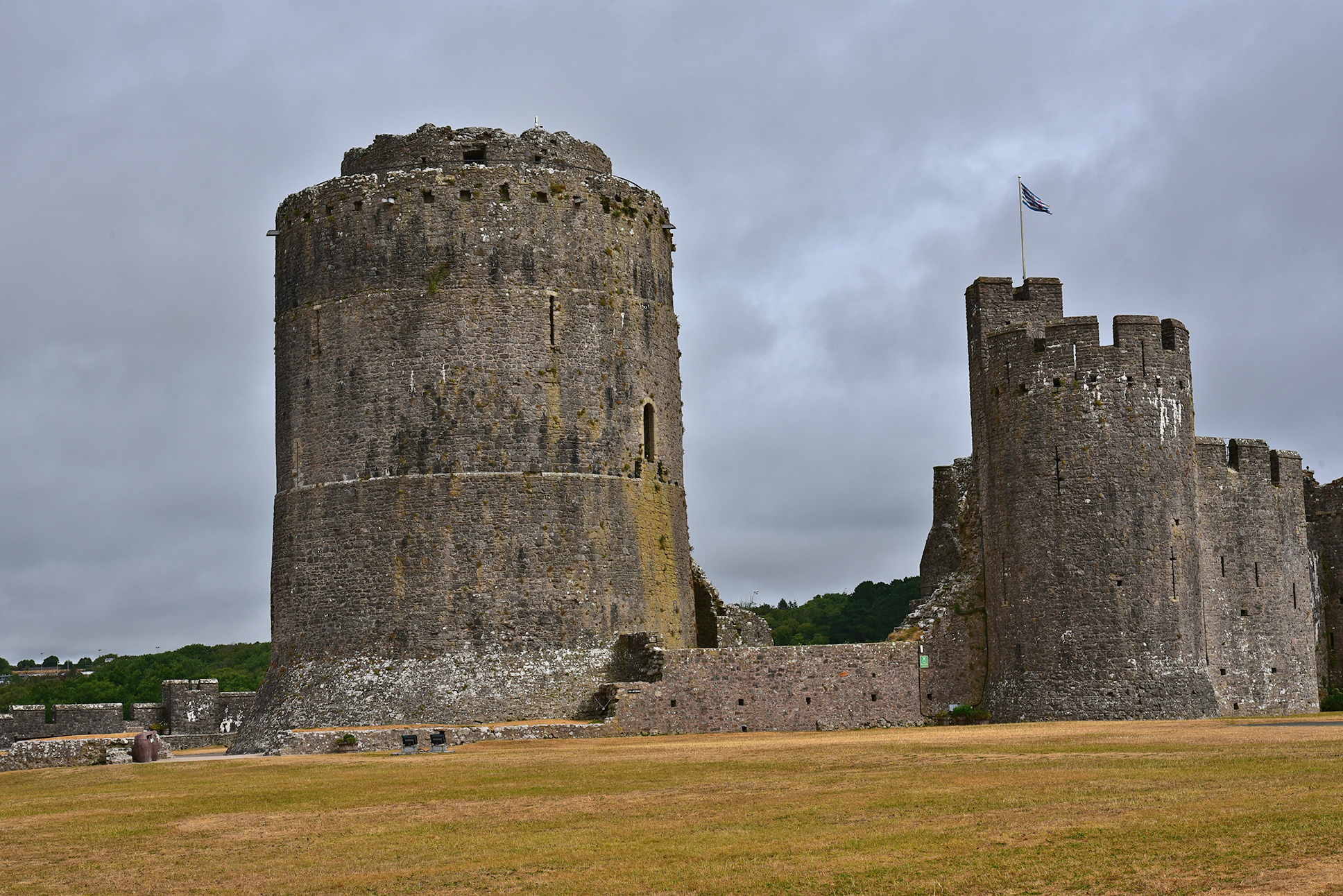
The Great Keep at Pembroke Castle.
The reign of John was the hardest period of William's life. After John lost Normandy to Philip II in 1204, William swore liege homage to Philip for his Norman estates, a practical step to protect them before they were forfeited, and in 1205, John accused him of treason. In June, William refused to join John's campaign in Poitou, citing prior commitments, which risked the king's displeasure. John seized William's eldest son, William the younger, as a hostage and held him for seven years to compel his father's loyalty.
In late 1206, William won the king's permission to go to Ireland to protect his lordship of Leinster, which he held through his wife, as John's agents increasingly encroached on the barons' autonomy there. In 1207 and 1208, John's justiciar, Meiler FitzHenry, campaigned against William's allies and tenants, and in early 1208, William's forces, led by his wife and his retainers, captured Meiler and forced a truce. John authorized further raids on William's Irish estates and spread exaggerated reports of the damage, but William's defenses held. In 1210, John invaded Ireland in person with about 700 ships and 800 knights, and William submitted to avoid total ruin, although he quietly supported his ally William de Braose against John's demands for huge fines. In Ireland, he built the stone castle at Kilkenny, where he also granted the town a charter, and the castle at Carlow. On his first visit, around 1200, he had founded the port of New Ross, which grew into the economic hub of his Irish lordship and had a bridge over the River Barrow, and Tintern Abbey in County Wexford, a Cistercian abbey that tradition says he vowed to found if he survived a storm at sea. He settled it with monks from Tintern Abbey in Wales, near his manor at Chepstow, and he also founded Duiske Abbey at Graiguenamanagh. By 1213, he was back in England, where he became John's most trusted counselor, advising restraint, and he took part in John's failed campaign against Philip II in 1214. When the barons rose against John in 1215, William stayed loyal. He acted as a royal negotiator and was among the king's advisers named at Runnymede in Magna Carta in June 1215, though his own son William had joined the barons by May and was elected one of the twenty-five barons charged with enforcing the charter if John failed to keep it.
King John died on October 18th, 1216, and the war with the rebels and their French ally, Prince Louis, was going badly. Nine-year-old Henry III was hastily crowned in Gloucester Cathedral on October 28th, before his father had been buried, and on November 11th, the royal council there, made up of the barons who had stayed loyal, unanimously appointed William, then about seventy, as regent and protector of the king, with the title "ruler of the king and kingdom." They chose him for his military experience, his loyalty, and his standing as the senior earl of the realm. William hesitated at first because of his age and the desperate situation, but once he accepted, he made a famous declaration to his men: "If everyone abandons the boy but me, do you know what I shall do? I will carry him on my back ... from island to island, from country to country, even if I have to beg for my bread." On November 12th, William and the papal legate Gualo sealed a revised Magna Carta that left out the clauses against royal officials and the security clauses aimed at former rebels but kept the main liberties on taxation, justice, and feudal rights, and it brought many barons back to the royal side. On May 20th, 1217, he led the royal army, personally leading the cavalry charge, against the French and rebels at the Battle of Lincoln, and on August 24th, the royal fleet under Hubert de Burgh defeated the French reinforcements at the Battle of Sandwich. Louis signed the Treaty of Lambeth in September and left England, and on November 6th, William and the papal legate Gualo sealed the Charter of the Forest and a reissue of Magna Carta on the king's behalf.
Toward the end of January 1219, William, who had enjoyed robust health throughout his long career, fell seriously ill, and as he grew worse, he withdrew to his manor at Caversham, near Reading, which was then in Oxfordshire and is now in Berkshire. Recognizing that he was dying, he settled his affairs. By March, he had resigned as regent, which let Hubert de Burgh take on greater authority, and he made a will with bequests to his household retainers, his family, and various religious institutions. He had already divided his lands among his five sons during his lifetime, with William the Younger receiving the earldom of Pembroke, so he left little movable wealth to bequeath. On his deathbed, he handed the care of the realm and the young king to the papal legate Pandulf. Fulfilling the vow he made on crusade, he was invested into the order of the Knights Templar on his deathbed and died peacefully at midday on May 14th, 1219, at about the age of 72, at his estate at Caversham, surrounded by family. He refused to let his robes go to the Church and gave them away to those close to him instead. He was buried in the Temple Church in London, where his tomb can still be seen, along with other Templars. At his funeral on May 20th, the Archbishop of Canterbury, Stephen Langton, called him "the greatest knight of the world."
William and Isabel had ten children, five sons and five daughters. Each of the five sons held the earldom in turn, and each died without an heir, and the last, Anselm, who succeeded his brother Walter when Walter died childless on November 27th, 1245, died at Chepstow Castle, probably on December 23rd, before he could pay homage to Henry III, which ended the male line. The estates were divided among the five daughters, and through them, the Marshal inheritance passed to other families. Chepstow went to the Bigods through Maud, who married Hugh Bigod, Earl of Norfolk, and later William de Warenne, Earl of Surrey. Joan married Warin de Munchensy, and their daughter Joan married William de Valence. Isabel, who married first Gilbert de Clare, Earl of Gloucester, and then Richard, Earl of Cornwall, was the mother of Henry of Almain. Sibyl married William de Ferrers, Earl of Derby, and Eva married William de Braose. All five daughters had children, so the Marshal bloodline continued through them. According to the chronicler Matthew Paris, the failure of the line was blamed on a curse. William had been excommunicated over manors in Ireland that Bishop Ailbe claimed, and after William's death, the bishop traveled to London and asked Henry III to return them, and was asked to absolve the dead earl. He went to William's tomb in the Temple Church, addressed the effigy, and refused to lift the excommunication unless the lands were restored. When William's sons, led by William the Younger, refused, the bishop confirmed the sentence and cursed the family: the male line would be extinguished in one generation, the sons would die without legitimate heirs, and the inheritance would be scattered.
The Temple Church, London, where William Marshal is buried.
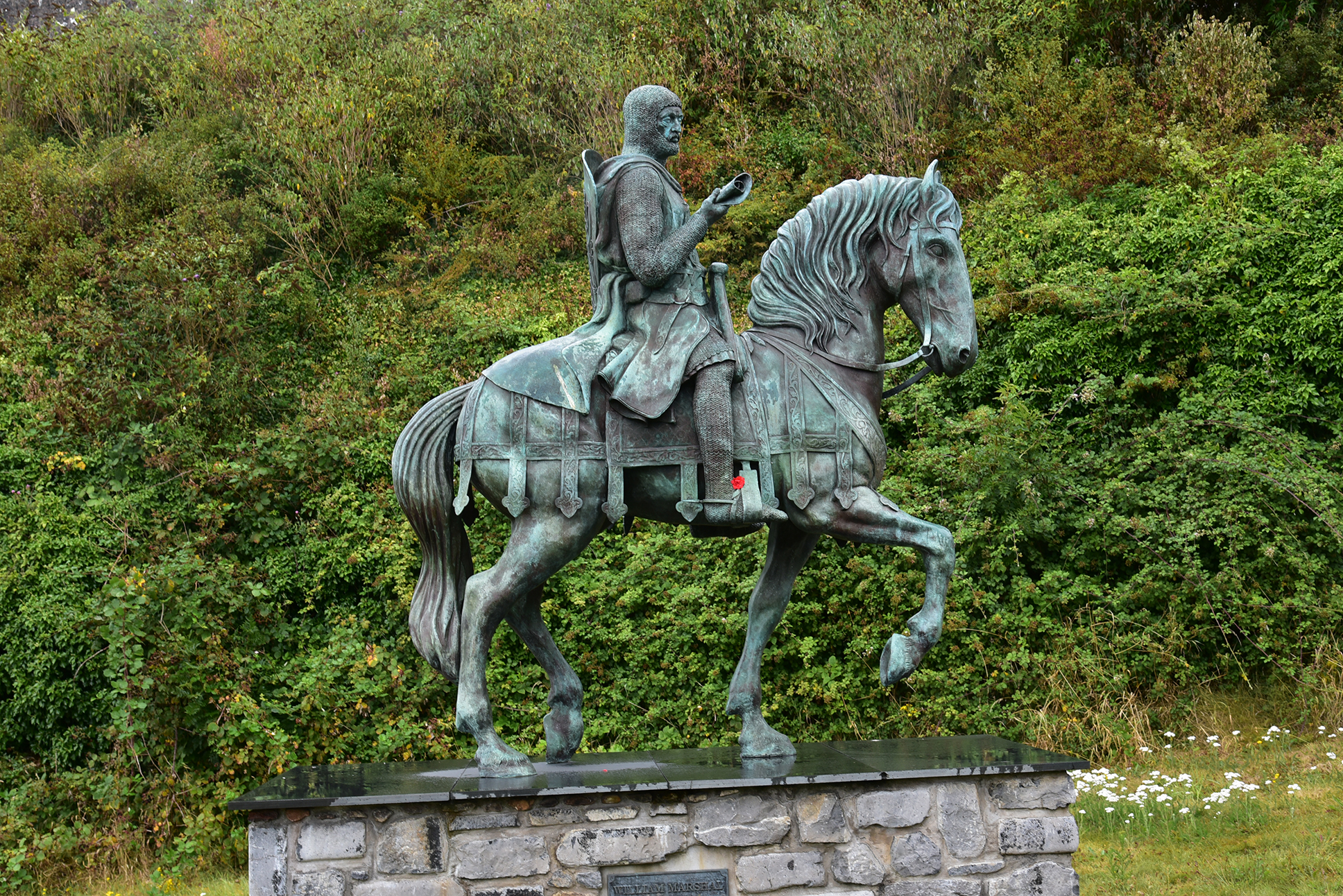
Much of what we know about William comes from the History of William Marshal, a biography of 19,214 lines of rhyming Anglo-Norman couplets, which most scholars date to between 1224 and 1226, a few years after his death, and which his eldest son, William the Younger, ordered to commemorate and glorify his father, "the best knight in the world." Its author was an otherwise unknown poet who names himself "Johans," or John, in the epilogue, and he was probably a professional trouvère from the old Angevin lands. He worked from family archives, written memoirs supplied by William's companions, and oral recollections, especially from John of Earley, a long-time member of William's household and his executor. It is the earliest substantial biography of a medieval layman to survive, and only one medieval manuscript of it survives, which is now in the Morgan Library in New York. Historians treat it carefully because it was written to honor him, but it remains the most important source for his life, and its account of tournaments and campaigns is full of detail. A bronze statue of William Marshal on horseback was unveiled on May 7th, 2022, just below the walls of Pembroke Castle, near Monkton Mill Bridge. It is the work of the sculptor Harriet Addyman of Narberth and was cast at the Castle Fine Arts Foundry near Oswestry. The Pembroke and Monkton Local History Society, with support from Pembroke Town Council, spent three years on the project, which began around 2019 to mark the 800th anniversary of his death.