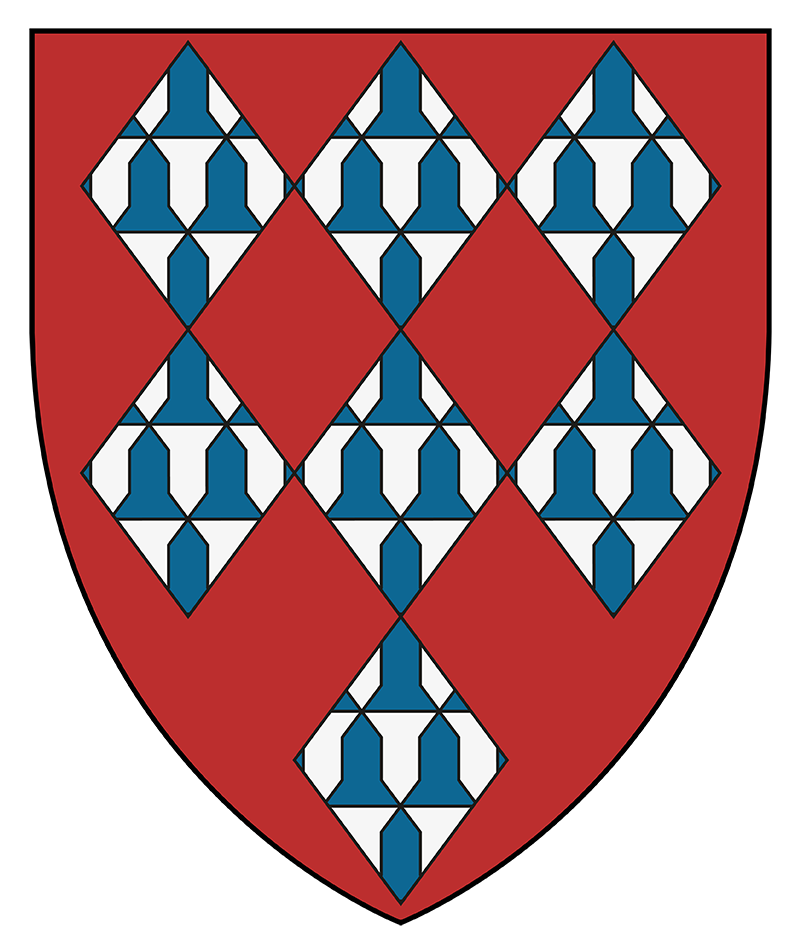
Hubert de Burgh - Earl of Kent
Hubert de Burgh was a powerful English Nobleman, soldier, and administrator who rose from knightly origins to become highly influential in 13th century England.

Hubert was born around 1170 in Burgh-next-Aylsham, Norfolk, England. He came from minor landowners in East Anglia. His father's name is lost to history, though some speculate it was Walter de Burgh. His mother is recorded as Alice in a 1230 charter Hubert signed, granting land for "the soul of my mother Alice".
Hubert de Burgh began to rise in prominence in 1198, when he entered the service of Prince John. He served as Chamberlain to John's household, Ambassador to Portugal, Sheriff of Dorset, Somerset, Berkshire, and Cornwall, and custodian of the castles of Dover, Launceston, Windsor, and Wallingford. He was granted manors, baronies, and castles, becoming a leading figure in King John's court.
In 1201, King John gave Hubert the "Three Castles"; White, Skenfrith, and Grosmont, in Wales. They changed hands several times over the years.
In 1202, Hubert went to France to help defend Poitou. He became custodian of Château Chinon in Touraine and was given charge of Château de Falaise in Normandy. There, he guarded the captured Prince Arthur I, John's nephew. Chronicler Ralph of Coggeshall claims John ordered Arthur blinded and castrated, but de Burgh refused. Fearing reprisals from John, de Burgh spread news of Arthur's natural death. The following year, Arthur was moved to Rouen under William de Braose and vanished in April 1203.
After almost all of Poitou fell to King Philip, de Burgh held the castle for an entire year until it was stormed in 1205, and he was captured. He remained a prisoner until 1207, during which time his royal appointments were given to others. On returning to England after 1207, de Burgh acquired additional offices and lands and rose again as an important English Baron.
Around 1211, Hubert married Beatrice de Warenne, Lady of Wormegay, with whom he had two sons, John and Hubert.
In 1212, he returned to France as seneschal of Poitou, serving John in attempts to recover territories until a truce with Philip was signed.
When tensions grew between John and his barons, de Burgh stayed loyal to the King. John sent de Burgh and the Bishop of Coventry to London in an unsuccessful attempt to command the people of London to resist the Baron's military advance.
In 1215, Hubert de Burgh was one of the advisers at Runnymede who urged the King to sign Magna Carta. He was also named to act for the King if he left the country. Soon after Magna Carta was sealed, de Burgh became Chief Justiciar of England and Ireland.
In late 1215, King John was besieging Rochester Castle, where William d'Aubigny and other nobles and rebels had taken refuge. The castle held out from almost around-the-clock bombardment of stones and other projectiles being launched at its walls. At the same time, John had miners digging tunnels under the castle to try to cause the walls to collapse. On November 25th, he sent a writ to Hubert de Burgh asking him to "send with all speed by day and night, forty of the fattest pigs of the sort less good for eating to bring fire underneath the tower."" The pig's fat worked, and the fire in the mine caused the southeast tower of Rochestr Castle's Keep to collapse. A few days later, d'Aubigny and the castle garrison surrendered, and d'Aubigny and other nobles were taken and held prisoner at Corfe Castle.
After 1215, de Burgh began building Hadleigh Castle in Essex on land granted by King John. A license to crenelate was granted retrospectively in 1230, when the castle was completed.
During the First Baron's War, de Burgh stayed loyal to the King and served John as sheriff of Kent and Surrey, as well as Constable of Canterbury Castle and Dover Castle. At Dover, he defended the castle against a siege that lasted until John died in October of 1216, and King Henry III was crowned. De Burgh prevented Prince Louis from taking possession of Dover Castle that same year.
Hubert married again after Beatrice's death. His second wife was Isabella, Countess of Gloucester and widow of King John; they had no children. Isabella died not long after their wedding.
On August 24th, 1217, a French fleet arrived off the coast of Sandwich to provide Prince Louis of France with soldiers, siege engines, and supplies as he was plundering England. De Burgh claimed command of the English fleet and intercepted the French fleet at the Battle of Sandwich. The French fleet scattered, and de Burgh captured their flagship, the Great Ship of Bayonne, under the command of Eustace the Monk, who was then executed. When the news reached Louis, he entered into new peace negotiations with England, signing the Treaty of Lambeth on September 20th.
In 1219, Hubert regained power and took back the Three Castles during Henry III's reign, visiting them several times between 1220 and 1222.
In 1221, Hubert married his third wife, Princess Margaret of Scotland, the sister of King Alexander II. Hubert and Margaret had one daughter, Margaret.
In 1227, Hubert de Burgh was created Earl of Kent (third creation) by John's son and successor, King Henry III, and appointed Governor of Rochester Castle and Lord of Montgomery Castle in the Welsh Marches. In 1228, he was named Justiciar for life.
In 1232, Hubert was imprisoned at Devizes Castle by his enemies. Richard Marshal, 3rd Earl of Pembroke, rebelled against the King in 1233, and the men holding de Burgh captive released him.
After 1232, de Burgh fell out with Henry III and lost Hadleigh Castle. He was imprisoned for treason, pardoned in 1234, and reconciled with the king. He spent his later years managing estates and served as Constable of the Tower of London.
Hubert de Burgh died on May 5th, 1243, at his manor of Banstead, in Surrey. He was buried in the Church of the Friars Preachers, today known as Blackfriars, in London, England.
The Earldom of Kent did not pass to his sons; only descendants from Hubert and Princess Margaret could inherit, perhaps because Henry granted the Earldom while Hubert was married to her.