Battle of Sandwich (1217)
Background
On August 24th, 1217, an English fleet commanded by Hubert de Burgh destroyed a French fleet carrying reinforcements to Prince Louis of France off Sandwich, Kent. It was the decisive battle of the First Barons' War, and the death of the French admiral, Eustace the Monk, ended Louis's hopes of becoming king of England.
Prince Louis had been in England since 1216, invited by the rebel barons to take the crown from King John. John's death in October 1216 changed the war, because many barons preferred his young son, Henry III, and the regent, William Marshal. In May 1217, the Marshal's army defeated the French and rebels at the Battle of Lincoln, and Louis lifted the second siege of Dover Castle and withdrew to London. He began peace negotiations, but they collapsed when he learned that reinforcements were on their way from France.
The relief fleet gathered at Calais. It had about 80 vessels, of which only about ten were large fighting ships, and the rest were supply and transport ships carrying soldiers, siege engines, and supplies. Robert of Courtenay commanded the expedition as a whole, and the fleet was led by Eustace the Monk. Eustace was born around 1170 near Boulogne, the younger son of a local lord, and became a Benedictine monk at the abbey of St Samer before leaving the cloister to serve the Count of Boulogne. After a quarrel with the count over his stewardship, he was declared an outlaw, and he turned to piracy. King John employed him for years as a mercenary, and Eustace held the Channel Islands for him, but in 1212, he went over to the French. In 1216, he ferried Prince Louis across the Channel, and he had since helped the French control the Cinque Ports. His flagship was the Great Ship of Bayonne, which carried 36 knights, including Ralph de la Tournelle and William des Barres, who were third and fourth in command. Other French leaders, including Mikius de Harnes, William V of Saint-Omer, and the mayor of Boulogne, commanded the troop ships.

Dover Castle, Hubert de Burgh's base.
The English defense rested on Hubert de Burgh, the justiciar and constable of Dover Castle, which had resisted both of Louis's sieges. With Hubert were Philip d'Aubigny, an experienced naval captain and the warden of the Cinque Ports, and Richard FitzRoy, also called Richard of Chilham, an illegitimate son of King John. William Marshal, the regent, organized the muster of the Cinque Ports ships and provided a large cog, but he stayed ashore with the young King Henry III. The English gathered about sixteen to eighteen large ships and about twenty smaller vessels in all.
Battle
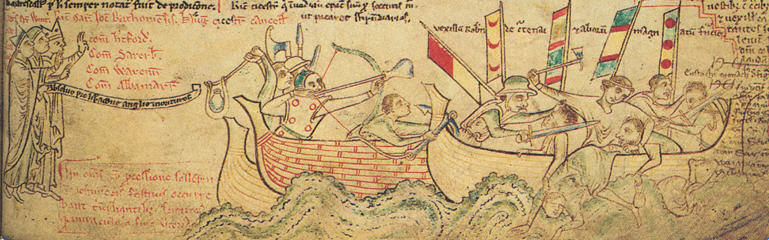
Hubert sailed out from Dover with his fleet and stood out to sea as though he were making for Calais, and he let the French fleet pass Sandwich. Eustace and Robert of Courtenay took the movement for a retreat and followed. The English then turned back and gained the weather gauge, meaning the wind was at their backs, which carried their ships toward the French and gave them the advantage. Hubert is credited with the decision to attack the French from the rear.

English and French ships grappling, in a 19th-century engraving by M. W. Ridley.
From the windward side, the English archers and crossbowmen shot into the crowded French ships. They also threw pots of quicklime that burst and blew into the French faces, blinding them. English ships then closed with the enemy, grappled the French vessels, and boarded them. Two ships, the Earl of Pembroke's cog and FitzRoy's ship, grappled the Great Ship of Bayonne at the same time and attacked it from both sides. After fierce fighting, the flagship was captured. Robert of Courtenay, Ralph de la Tournelle, William des Barres, and the other French knights were taken for ransom, but the common soldiers on board were killed.
Eustace the Monk was found hiding in the bilge of his flagship. He offered the English 10,000 marks for his life, but they refused because he was a traitor to King John. Stephen Crabbe beheaded him on the spot, and his head was later displayed on a pole around the coastal towns he had previously terrorized. Only nine of the French ships escaped to Calais, and the English captured most of the supply vessels.
Aftermath

The Great Tower at Dover Castle.
When the news reached Louis in London, he abandoned his campaign. He signed the Treaty of Lambeth with the Marshal and the regency council, gave up his claim to the English throne, and received 10,000 marks. He left England from Dover before the end of September, and the First Barons' War was over.
Hubert de Burgh's victory made his name, and he went on to become justiciar and, later, Earl of Kent. Part of the loot from the battle paid for the Hospital of St Bartholomew at Sandwich. Dover Castle, which had held out against two sieges, remained in royal hands.

 Eustace the Monk †