Rochester Castle
History
Rochester Castle stands above the River Medway in Kent, right beside Rochester Cathedral. The Romans founded a walled town here, Durobrivae, where Watling Street crossed the river, and whoever held the crossing controlled the main road from London to Dover and the Channel ports. The castle's long history is a record of kings, archbishops, and rebels fighting over that bridge.
After the Norman Conquest, William the Conqueror gave Kent to his half-brother Odo, Bishop of Bayeux, who held Rochester with a timber castle. When William died in 1087, Odo backed Robert Curthose against the new king, William Rufus, and Rochester became a rebel stronghold. Rufus besieged the castle in 1088, and the garrison surrendered after disease and hardship set in. Odo was banished to Normandy for life.

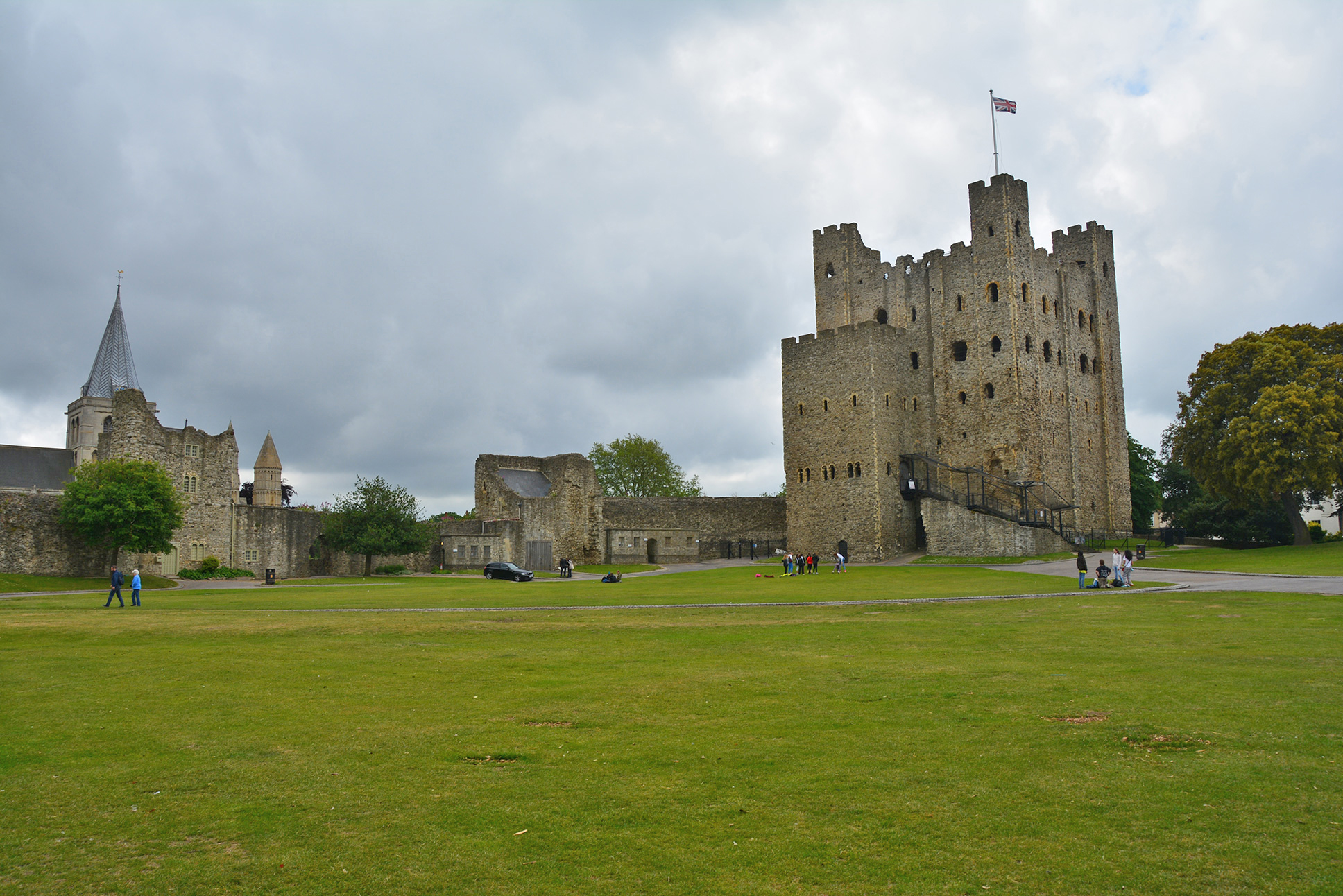
The keep from the bailey, with the stair to its first-floor entrance at the right.
Between about 1087 and 1089, Rufus commissioned Gundulf, Bishop of Rochester, to rebuild the defenses in stone on the present site. Gundulf set his new curtain wall on the foundations of the old Roman town wall at the south-west corner of the city. Gundulf was a skilled builder who also built the White Tower at the Tower of London, and he is linked to Rochester Cathedral as well. Part of his west curtain wall still stands at Rochester, including some early herringbone masonry.
In 1127, Henry I granted the castle in perpetuity to William de Corbeil, Archbishop of Canterbury, on the condition that he strengthen it. This led to the building of the great keep, which was completed by the early 1140s. Soaring to 113 feet, it is the tallest surviving keep in England. Archbishops of Canterbury held the castle for much of the 12th century. During the Anarchy, Robert, Earl of Gloucester, King Stephen's chief rival, was held prisoner at Rochester in 1141 after his capture at Winchester.

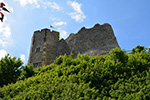
The keep, where King John's miners did their work in 1215.
The castle's greatest test came in 1215. Rebel barons seized Rochester from Archbishop Stephen Langton's constable, and King John arrived that October to take it back. After pulling down Rochester Bridge to cut off a relief force from London, John battered the castle with five siege engines and then undermined the keep. His miners dug beneath the south-east corner, filled the tunnel with the fat of forty pigs, and set it on fire, bringing the tower crashing down. The garrison held out behind the keep's cross wall until hunger forced them to surrender on November 30th. The siege lasted almost two months, the longest in England up to that point. You can read the full story of the Siege of Rochester Castle in 1215. The following year, Prince Louis of France took the castle for the rebels, but it returned to the crown after the war ended.
Under Henry III, the castle was repaired and became a royal residence. Between 1217 and 1237, about £680 was spent on repairs, and £530 of it went to the keep. The ruined south-east tower was rebuilt with a rounded corner, which is harder to undermine than a square one. Henry also built a hall, royal chambers, and a chapel in the bailey. He added a second chapel in 1244, then stables, an almonry, and a new gatehouse in the late 1240s. The drum towers along the east curtain wall date from his reign.
In April 1264, during the Second Barons' War, Rochester was besieged again. Roger de Leybourne held the castle for Henry III against Simon de Montfort and Gilbert de Clare. The rebels crossed the Medway under cover of burning fireships, took the bailey, and burned the royal hall, but the keep held until Henry marched to the rescue and the besiegers withdrew. The Siege of Rochester Castle in 1264 left such severe damage that the hall and royal chambers were never rebuilt. In 1281, the owner was permitted to demolish the burnt-out remains.

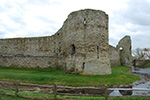
A ruined section of wall beside the north-west bastion, facing the River Medway.
The 14th century brought more decay and more repairs. In March 1314, Edward II moved Elizabeth de Burgh, the captive wife of Robert the Bruce, from the Tower of London to Rochester. He ordered the constable to give her a chamber fitting her rank and 20 shillings a week for her expenses. A survey in 1340 reported damage across the whole castle and estimated the cost of repairs at about £600. Between 1367 and 1370, Edward III spent £2,262 on a much larger repair program, including two new towers along the east wall. A new tower at the north-west corner of the bailey, begun under Edward III, was completed in 1383, during the reign of Richard II. In 1381, rebels from the Peasants' Revolt under Robert Baker broke into the castle and released a prisoner, the last time the castle was attacked. The bridge over the Medway also collapsed during Richard's reign.

Edward III's Towers.
Rochester then slid slowly into ruin. No building work is recorded in the 15th century, and by the late 16th century the castle was obsolete. Elizabeth I allowed stone from its walls to be used to build Upnor Castle, a few miles downriver, to guard the royal fleet. Fire eventually gutted the keep, stripping it of its roof and floors, and the diarist Samuel Pepys and later Charles Dickens described its vast hollow interior. Dickens, who grew up nearby, featured the castle in The Pickwick Papers. In the 18th century, owners sold off stone from the outer walls, and in 1780, Colonel Hugh Debbieg, commander of the Royal Engineers at Chatham, proposed converting the ruins into army barracks. The owners, the Child family, never agreed, and the plan did not go ahead.
In 1870, Victor Child Villiers, the 7th Earl of Jersey, leased the castle to the Corporation of Rochester for use as a public park, and the grounds opened to the public in 1872. The city bought the castle outright in 1884 for £6,572. Responsibility for the castle passed to the Ministry of Public Building and Works in 1965 and to English Heritage in 1984. Since 1995, Medway Council has run it day to day, while English Heritage keeps overall guardianship. Rochester Castle is a Grade I listed building and a scheduled monument.
Castle Highlights
Rochester's keep is the reason most visitors come. It is about 70 feet (21 meters) square and rises to roughly 113 feet (34 meters), with corner turrets that reach about 125 feet (38 meters). The walls are up to about 12 feet (3.7 meters) thick at the base, built of local Kentish ragstone and faced with imported Caen stone around the doors and windows. All four corner towers were originally square, but King John's miners brought down the south-east tower in 1215. It was rebuilt round, and the mismatch with the other three is still plain to see.
The keep was designed for defense and for comfort. The entrance sits at first-floor level in a forebuilding on the north side. Anyone entering climbed an outside stair and crossed a drawbridge over a gap about 9 feet (2.7 meters) wide, then waited in the forebuilding before passing through an inner door protected by a portcullis, whose grooves can still be seen. A massive cross wall divides the interior from top to bottom, and it carried the shaft of a well that served every floor. Storerooms filled the ground floor, and the three floors above held the great hall, the great chamber, and the private apartments. At great hall level, the cross wall opens into a four-bay arcade of round columns, scalloped capitals, and round-headed arches carved with chevrons. This floor is unusually tall, about 27 feet (8.2 meters) high. Spiral stairs in the north-east and south-west corner towers connected the floors, and there were two chapels, one in the forebuilding and one on the second floor of the keep. Decoration elsewhere is sparse. Visitors can go inside the keep today. The floors are long gone, so it is a hollow shell, but staircases built into the walls still lead up to the different levels.

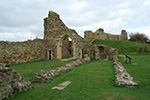
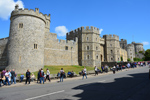
Gundulf's crenellated 11th-century curtain wall on the western edge of the bailey.
Around the keep, the bailey is enclosed by a curtain wall that follows the line of the Roman town wall on the west side. Gundulf's late 11th-century work survives there, altered in the 13th century. At the east end, the drum towers of Henry III and Edward III still stand. Little remains of Henry III's royal chamber block today, only a taller stretch of the curtain wall, but it is a reminder that this was once a comfortable royal residence and not only a fortress. Beside the castle rises Rochester Cathedral, which Gundulf also rebuilt, and the two together make one of the most striking sights in Kent.
Rochester Castle is also haunted.