Prudhoe Castle
History
Prudhoe Castle is an 11th-century stronghold overlooking the River Tyne, in Northumberland, England. It is remembered as one of the strongest border castles and the only medieval fortification in Northumberland to never fall to the Scots despite repeated attacks.

The first castle at this location was a Norman motte-and-bailey castle built in the late 11th century, shortly after the Norman Conquest. It was built of timber to control a key crossing of the River Tyne and north-south routes through England.
The Umfraville family was granted land here by William the Conqueror and built the castle. Robert d'Umfraville was granted the barony of Prudhoe by King Henry I. He likely replaced the wooden castle with stone and constructed the curtain wall and gatehouse around 1150.
In 1173, King William the Lion of Scotland invaded northern England to claim the Earldom of Northumberland, during the Revolt of 1173-1174 between Henry II and his three sons. Odinel II d'Umfraville owned Prudhoe Castle at that time. Odinel was partly raised at the Scottish court but was loyal to King Henry II of England and refused to support William the Lion. The Scots attacked Prudhoe Castle but withdrew without a prolonged siege.
In 1174, William the Lion returned and besieged Prudhoe Castle for several days. The well-prepared garrison held firm, and Odinel escaped to gather support. The Scots damaged the orchards and fields around the castle but failed to take it or force its surrender. William the Lion was later captured at the Battle of Alnwick. After the siege, Odinel improved the castle's defenses and added the stone keep and great hall.
In 1182, Odinel d'Umfraville died and was succeeded by his son Richard. Richard was one of the northern barons who stood against King John and had his estates forfeited to the crown. They remained in the crown's possession until 1217, the year after King John died, when Richard made peace with King Henry III.
The Umfraville family continued to make improvements to the castle, adding towers and a barbican in the 13th and 14th centuries. At times, the castle served as a prison for Scottish prisoners.
In 1381, Gilbert III d'Umfraville died and with him, the male line of the Umfraville family. Prudhoe Castle passed to the Percy family by marriage, who added a new great hall.
Henry Percy, 1st Earl of Northumberland, rose against King Henry IV, culminating in the Battle of Shrewsbury, where his son Henry "Hotspur" Percy was killed. Percy's estates, including Prudhoe Castle, were forfeited to the crown in 1405. Later that year, the castle was granted to John, the future Duke of Bedford, a son of King Henry IV, who held it until his death in 1435, after which it reverted to the crown.
Five years later, the castle was restored to the Percys after a long legal battle. In 1461, Henry Percy, 3rd Earl of Northumberland, was killed at the Battle of Towton. In 1462, King Edward IV granted the castle to his younger brother George, Duke of Clarence. Shortly after, the king granted the castle to Lord Montague.
In 1470, the castle was restored to Henry Percy, 4th Earl of Northumberland. The Percy principal seat was Alnwick Castle, and Prudhoe was let out to tenants. However, in 1528, Henry Percy, 6th earl of Northumberland, resided at Prudhoe Castle, as did his brother, Thomas Percy. Thomas was involved in the Pilgrimage of Grace in 1536 and was convicted of treason and executed, while Henry remained loyal to the crown and died in 1537.
By the late 16th century, it had become more of a farming estate, and the castle had fallen into ruin by the 1700s. Sometime between 1808 and 1818, Hugh Percy, 2nd Duke of Northumberland, restored parts of the curtain walls and the keep, and added a Georgian Gothic Revival manor house inside the castle.
Since 1966, Prudhoe Castle has been in the care of English Heritage while still owned by the Percy Family.
Castle Highlights
Prudhoe Castle is worth a visit, but it tends to attract fewer visitors than other castles. The grounds and outer ward are free to visit and open year-round. The inner ward and main portions of the castle, such as the keep, chapel, and gatehouse, are open on the first Sunday of each month.
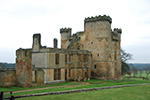
With the keep being mostly a ruin, the most impressive part of the medieval castle to see is the gatehouse. The gatehouse was built by 1150 and originally stood two stories high. The north face of the gatehouse looks out over the inner bailey. Two 13th-century lancet windows above the gatehouse are part of the chapel. In the 14th century, an additional floor was added to the gatehouse, and the chimney and rooftop battlements were added in the 15th century.
The East Tower is still intact but not open to the public. The Georgian manor house is now used as a museum and the gift shop.
Prudhoe Castle can be thoroughly explored in two hours. Tynemouth Castle or Belsay Castle are close enough to visit on the same day. Not a castle, but Hadrian's Wall is also close by.
Prudhoe Castle is also haunted.