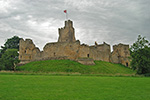
Belsay Castle
History
Belsay Castle is a three-story medieval pele tower house built in the 14th century in Northumberland, England. This style of castle was common in the border region with Scotland.

The Middleton family is first recorded at Belsay in 1270, when Richard de Middleton, Lord Chancellor to King Henry III, owned the estate. By 1298, a high-status house stood there when King Edward I visited while hunting in the area.
In 1317, Richard de Middleton's grandson and heir, John, joined a local rebellion led by a cousin, Gilbert de Middleton. Both were eventually captured and executed, and the Belsay estate was forfeited before it was returned to the Middleton family by marriage in 1391.
The pele tower we see today, with rounded turrets and rooftop battlements, was built around 1370. It served both as a defensive stronghold against border raids and a statement of wealth and status.
The Union of the Crowns in 1603, under King James I, brought relative peace to the border region. In 1614, Thomas Middleton II attached a new manor house to the tower, shifting the castle from defense toward comfort. Thomas was a staunch Presbyterian who supported Parliament during the English Civil War.
In the 1670s, William Middleton, a baronet, moved into the castle with his wife, Elizabeth. Finding it in great disrepair, he restored it, and a west wing was added in 1711.
Charles Monck began building Belsay Hall on the same estate in 1807, inspired by the Greek architecture he had seen in Greece. Work was completed towards the end of 1817, and on Christmas Day, Charles and his family moved from the castle to Belsay Hall. Most of the castle's interiors were removed, and it then served as a ready-made folly for garden parties and other entertainment.
When Charles Monck died in 1867, he was succeeded by his grandson Arthur, who changed his surname back from Monck to Middleton. After Charles had demolished parts of the old castle complex, Arthur rebuilt the 1614 manor house to provide additional accommodation for the staff. He also reroofed the Pele tower and restored it in 1897 to its medieval form.
During World War II, Belsay Hall was occupied by the Army, and the gardens were not maintained while the kitchen garden was used to grow provisions. Later in the war, Belsay Hall became a divisional headquarters, and Nissan huts were erected in the service yard to accommodate additional troops.
Since 1980, English Heritage has managed Belsay Hall and Belsay Castle on behalf of the Middleton family, who still own the wider estate. A program of repairs was carried out at the hall and the castle to address dampness, and the formal gardens were restored to their appearance in the 1920s and 1930s.
Castle Highlights
Belsay Castle is one of the best surviving examples of a 14th-century pele tower in England. Though it is a ruin today, the tower is massive. With the restoration of the round turrets at each corner and battlements along the roof, it retains its medieval charm.
The tower stands seventy feet high and is built of local sandstone. The Middleton coat of arms is carved in the stone above the porch entrance door.
Nothing is known today for certain about the original function of the tower's interior. It contains three principal rooms connected by a broad spiral staircase. There are also five smaller chambers on the southwest angle of the building. The large room on the top floor was probably a chapel. The room on the ground floor has a barrel-vaulted ceiling, a huge fireplace, and a deep well, likely to have functioned as the castle's kitchen. The 17th-century wing provided more comfortable living spaces.
Just north of the castle, but not attached to it, are outbuildings used for stables and kennels.
The Belsay estate includes thirty acres of gardens, including Picturesque-style landscaping and quarry gardens designed by Charles Monck in the 19th century. The gardens include exotic plants, conifers, and terraces, allowing species to flourish that are usually not found this far north.
Belsay Hall is also open to visitors, but it is unfurnished. The Greek-style pillars inside the hall are impressive, but you will have to use your imagination to figure out how the rooms may have looked when furnished.
Belsay Castle, Hall, and gardens can be explored in 2 hours to half a day. Tynemouth Castle and Prudhoe Castle are close enough to visit the same day, but keep in mind Prudhoe Castle's interior is only open on the first Sunday of each month.
Belsay Castle is also haunted.