Château de Langeais
History
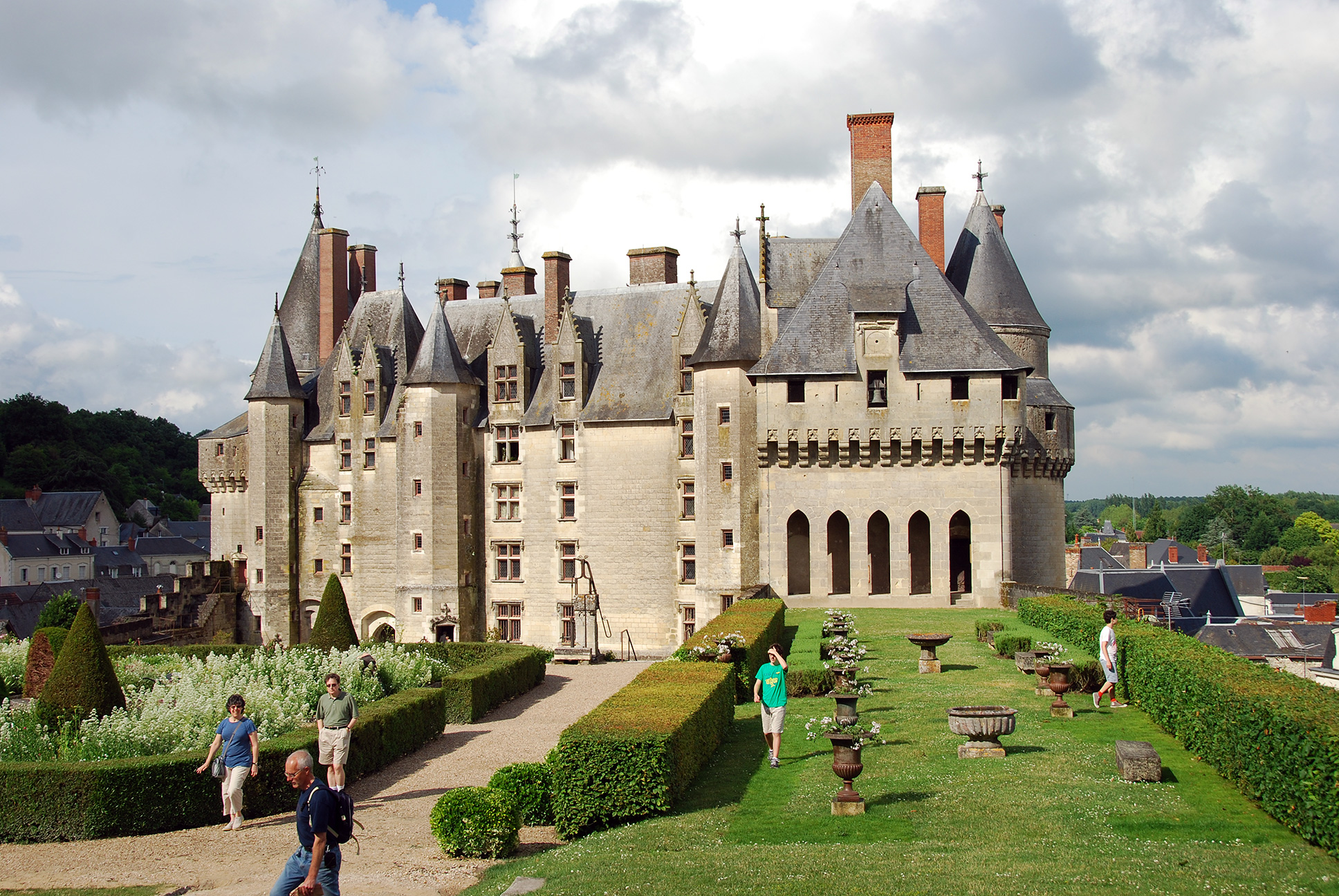
Château de Langeais stands above the Loire River in Indre-et-Loire, France, between Tours and Saumur. It is really two castles in one. The ruins of a 10th-century stone keep, one of the oldest in France, stand in its park, and a late 15th-century château built by King Louis XI towers over the town. In 1491, King Charles VIII married Anne of Brittany here.
Around 992, Fulk Nerra, Count of Anjou, built a wooden motte-and-bailey castle at Langeais, on a rocky spur between the Loire and Tours, the territory of his rival, Odo I, Count of Blois. Odo discovered the new castle and tried to destroy it, but failed, so Fulk replaced it with a stone keep by 994. It was built in a hurry, with thin walls and shallow foundations. The keep stood about 16 meters high, with walls 17.5 meters long and 10 meters wide, which makes it one of the earliest datable stone keeps in France. Fulk is said to have built about 100 castles and abbeys in the Loire Valley, beginning with Langeais. The fortress at Brissac was another.
In the spring of 994, Odo laid siege to Langeais with Norman, Flemish, and Aquitanian allies. Fulk appealed to Hugh Capet, King of the Franks, who was ill but promised help, and Odo withdrew when Hugh's forces approached. Odo came back in 995 and besieged the castle for about a year until he died in March 996. The fighting between Anjou and Blois resumed in 1016, and Langeais changed hands several times. It was lost in 1016, regained in 1032, and lost again, and Fulk failed to retake it in the winter of 1037 and 1038.
Later, the castle belonged to the Plantagenets, and Richard the Lionheart fortified it. In 1206, King Philip II Augustus of France took Langeais and added it to the royal lands. During the Hundred Years' War, armed bands occupied the castle. King Charles VII bought it in 1422 and had it demolished to keep it out of enemy hands. Only one wall of the old keep was left standing.
In 1465, King Louis XI decided to build a new château on the site. He put his treasurer, Jean Bourré, who also built Plessis-Bourré, and Jean Briçonnet, the mayor of Tours, in charge, and the work was completed rapidly, by about 1469. In 1466, Louis ceded the château to his cousin François, the son of Jean de Dunois, the companion of Joan of Arc. The new building is a double-faced design. From the town it looks like a fortress, with big towers, a working drawbridge, and a parapet with machicolations. From the courtyard, it is a comfortable residence with fine windows.
The most famous event at Langeais took place at dawn on December 6th, 1491. After the surrender of Rennes, Anne, Duchess of Brittany, who was then fourteen, agreed to marry the 21-year-old Charles VIII, Louis XI's son and king of France. In one of the château's great halls, the couple were married before a small gathering, in a private ceremony, since the Pope's permission had not yet arrived. The marriage brought Brittany into the French crown, and the contract said that if Charles died, Anne would marry his successor. After Charles died in 1498, she married Louis XII in 1499. Wax figures in period costume recreate the wedding in the château today.
Langeais remained royal property until the reign of Louis XIII, and the Crown sometimes gave it to noble families as a reward or in compensation. It received little maintenance and was abandoned during the French Revolution. In 1886, the businessman Jacques Siegfried bought the ruined château and spent about twenty years restoring it. He furnished it as a late 15th-century residence, with fine furniture and a collection of 15th and 16th-century tapestries, and he laid out terraced gardens. In 1904, Siegfried bequeathed Langeais to the Institut de France, which still owns it and runs it as a museum. In 1961, the gardens were redesigned based on the illuminations in the Book of Hours of Anne of Brittany.
Castle Highlights

The ruined keep of Fulk Nerra stands on a grassy mound at the end of the gardens, a short walk from the château. Little more than the walls survive, with their windows and doorways, but they date from about the year 994. From the park, visitors can also see the château's pointed slate roofs and tall chimneys, and its terraces overlooking the town.
The château is entered by a working drawbridge, and its rooms recreate the life of a late medieval household, with large stone fireplaces, beamed ceilings, and tiled floors. They include the Banquet Room, with its long tables, the Wedding Room with its wax figures, the Lady's Room and its bed, the Children's Room, and the Salle des Preux, hung with tapestries. A display of 15th-century armour from northern Italy is also on show. One of the most remarkable tapestries is a 15th-century millefleurs ("thousand flowers") tapestry in the Lady's Room.
Langeais is a short drive from Azay-le-Rideau, Villandry, and Ussé, and Chinon, where Charles VII held his court, is within an hour's drive. The railway station is a five-minute walk from the château. Check the château's website for opening times.