Château d'Amboise
Castle of Kings
History
The Château d'Amboise, an iconic 15th century stronghold, commands the River Loire in Indre-et-Loire, France, and reflects a blend of medieval and early Renaissance architecture, having served as a favored royal residence.

Amboise occupies a strategic defensive site that has been recognized for millennia. Before the castle's construction, the Gauls established an Iron Age settlement here, setting a precedent for its later importance to successive local rulers.
In 987, Amboise and its castle passed to Fulk III, Fulk Nerra. He fortified Amboise as part of his castle network, securing Anjou's eastern edge against rivals like the Counts of Blois.
During this era, Odo I, Count of Blois, was in near-constant conflict with Fulk, seeking to isolate Amboise and Loches through raids. Odo began the construction of the castles of Chaumont and Montsoreau, and the garrisoning of Saint-Aignan.
During the 11th and 12th centuries, the Château d'Amboise was reinforced and expanded, evolving from a wooden fortress to a substantial stone fortress.
During the 13th and 14th centuries, Amboise's fortifications expanded under the Lords of Amboise, who exercised local independence while maintaining allegiances to wider dynastic networks.
In 1431, Louis d'Amboise, Viscount of Thouars, was implicated in a plot against the Crown. Although initially condemned and later pardoned, on September 4, 1434, King Charles VII confiscated Château d'Amboise, adding it to the crown's holdings. Thereafter, the castle became a favored residence of French Kings, from Louis XI through Francis I.
King Charles VIII, born at Amboise in 1470, rebuilt the castle beginning in 1492 in a French Gothic style; after 1495, he employed two Italian masons who introduced some of the first Renaissance decorative motifs in France. On April 7th, 1498, Charles VIII died at Château d'Amboise after striking his head on a low door lintel while heading to a tennis match (jeu de paume) in the moat of the old castle. His successor, Louis XII, continued to improve the castle, including the addition of a gallery around the terrace.
Louis XII was followed by Francis I, who was raised at Amboise and elevated the castle to its greatest glory. Under Francis, artists and intellectuals, including Leonardo Da Vinci, arrived. In 1516, Leonardo came, bringing the Mona Lisa and settling nearby at Château du Clos Lucé, connected to Amboise by an underground tunnel. Da Vinci aided Francis as architect and engineer, contributing to the design of Chambord. Leonardo died in 1519, originally buried at Amboise's Chapel of Saint-Florentin; after its demolition in the late 18th century, his remains are now traditionally associated with the Chapel of Saint Hubert at Château d'Amboise. Anne Boleyn reportedly served as a lady-in-waiting to Queen Claude at Amboise from 1514 to 1522.
Henri II and Catherine de' Medici raised their children at Amboise, including Mary Stuart (Mary, Queen of Scots). Catherine occupied the Louis XII wing and later added extensions that were later demolished. Henri and his children stayed in a parallel wing.
On June 30th, 1559, Henri suffered a fatal injury during a jousting match when Gabriel Montgomery's lance pierced his eye. Henri died of sepsis on July 10th, leaving his wife, Catherine, as regent to their young son, Francis II.
In 1560, with tensions from the French Wars of Religion, a conspiracy by the Protestant Huguenot House of Bourbon against the House of Guise was uncovered by Francis, Duke of Guise. The failed plot ended with mass executions, and 1,200 Protestants were hanged and displayed from the castle's walls, causing the royal court to leave due to the foul smell. To restore peace, the Edict of Amboise was signed in 1563 by Louis I, Prince of Condé, and Catherine de' Medici.
Following these events, the Château d'Amboise declined in popularity as a preferred royal residence. It later passed to Gaston, Duke of Orléans, and served as a prison before being partially demolished by Roger Ducos, who was gifted the castle by Napoleon Bonaparte.
Restoration efforts took place in the 19th century under Louis-Philippe and architect Eugène Viollet-le-Duc.
In 1940, the French government sought refuge on the Loire. Château d'Amboise was defended by Senegalese infantrymen, who fought without retreat. The castle suffered Nazi artillery damage, shattering the Saint Hubert Chapel's stained glass during the German invasion.
Today, the Château d'Amboise is maintained by the Count of Paris, who oversees the site through the Foundation Saint-Louis.
Castle Highlights
Today, Château d'Amboise captivates visitors with its enduring presence above the Loire, though only remnants of the medieval fortress remain.
Amboise was among the first to adopt the Renaissance style, influencing many Loire castles. The most impressive room is the Grand Salle, where the King's Council met as jurists, treasurer, and chancellor. Its central pillars and Loire-facing windows are adorned with fleurs-de-lis.
The Henri II Chamber features a four-poster bed and tapestries from Brussels and Tournai, dating to the 16th and 17th centuries. It also contains a large wooden jewelry box with a false bottom.
The Chapel of Saint Hubert stands across the courtyard from the main castle. Once, buildings bridged the gap, but they no longer exist. Inside, Leonardo Da Vinci's tomb features a medallion sculpted by Jean Cardot.
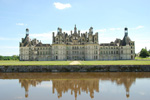
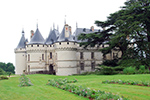
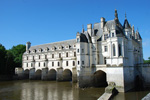
Visiting Château d'Amboise, including the formal gardens, takes at least half a day. If you have more time, nearby castles include Chambord, Chaumont, and Chenonceau.