Château de l’Islette
History
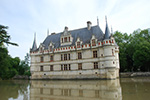
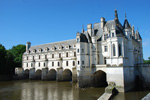
The Château de l'Islette resides in France on a small island formed where the River Indre forks, in the village of Cheillé, near Azay-le-Rideau. The name l'Islette means "small island." Although the river forms a natural border and affords an excellent strategic location from attackers, no historical records indicate the castle was ever utilized for defensive purposes.

The Maillé family held the fief from 1350. The Château de l'Islette was built around 1530 by René de Maillé, baron of Touraine, who used workers who had labored at the Château d'Azay-le-Rideau, and who built on an earlier 15th-century building that was probably unfinished. The architect is unknown. Charles de Maillé completed the castle around 1535, and the park gate with its two pavilions dates to 1638.

The Barjot de Roncée arms over the entrance.
In 1706, possession of the castle passed through marriage to the Tiercelin d'Appelvoisin and Barjot de Roncée families. During the French Revolution, the château was owned by Charles Gabriel Tiercelin d'Appelvoisin, who served as a member of the 1789 Estates-General government and was guillotined in 1793. After the Napoleonic era, the château was sold, and around 1830-1840, a later owner, Jean-Baptiste Dupuy, removed the dormer gables, truncated the roofs of the towers, filled in the moat, and added his own coat of arms.

The chapel, with its painted walls and star-decorated vault.
A century after the Revolution, in the 1890s, the château was a romantic setting for famous sculptors Rodin and Camille Claudel, who stayed at the castle during the summers of 1890 to 1892 for secret getaways, as the lovers were unmarried. Camille later produced one of her most famous sculptures, La Petite Châtelaine de l'Islette. The granddaughter of the château owners at the time, six-year-old Marguerite Boyer, served as the model for it.
The interior of the château was listed as a monument historique in 1946. Eventually, in the mid-1960s, the Château de l'Islette underwent major restoration by Pierre and Madeleine Michaud, the parents of the current owners, whose family still owns and resides there today. The chapel was restored in 2012, and the castle has been open to the public since 2010.
Castle Highlights
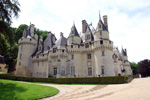
The Château de l'Islette was built from freestone, a soft white stone. Despite its delicate texture, the structure has survived intact for centuries. It resembles the Château d'Azay-le-Rideau, which was constructed down the road at approximately the same time and by some of the same workers. They were even more similar in design before the 19th century, when the Château de l'Islette was surrounded by a water-filled moat and included tall cone-shaped roofs on the corner turrets. Dupuy, who was allegedly attempting to reduce costs, removed the cone-shaped roofs and dormer windows. Despite these alterations, the Château de l'Islette is still very charming. Even though the castle does not receive the attention of its more grandiose neighbors, it has just as much to offer when visiting. The castle can be explored on your own or on a guided tour of the interior. While the tours are in French, handouts describing each room are available in English.

The Grande Salle.
The owners' occupancy within the château lends to a unique style combining renaissance and modern conveniences. For instance, the two-meter (approximately 6.6 feet) thick walls of the bedroom were structurally modified near the window to accommodate a shower and water basin. The most impressive room within the Château de l'Islette is the Grande Salle or "Great Hall," 15 meters (approximately 49 feet) in length and 9 meters wide, and decorated in a 17th-century style, with early 17th-century painted decoration covering the ceiling and the monumental fireplace and a frieze showing the wedding rings of the Maillé and Carman families. It is adorned with decorative portraits. The dining room, less formal than the Grande Salle, offers a more comfortable feel as it contains the only fireplace regularly used in the château. It is here current family members tend to migrate and socialize.

The old mill, covered in ivy, by the bridge over the Indre.
The château grounds, park, and surrounding waters provide a tranquil setting for a picnic or boat ride. The old mill, covered in ivy, stands by the bridge. Boats are available for rental and are kept beside it. The château should not require an entire day to visit unless you picnic or relax along the river. A visit to either the Château d'Azay-le-Rideau or Château de Langeais is highly recommended to fill the remainder of your day. Both castles are a very short drive from the Château de l'Islette.