Battle of Tinchebray
Henry I and Robert Curthose
Background
On September 28th, 1106, at Tinchebray in Normandy, King Henry I of England defeated his elder brother, Robert Curthose, Duke of Normandy, and took the duchy for the English crown. It was a short, hard-fought battle between the two surviving sons of William the Conqueror, and later writers pointed out that it fell forty years to the day after their father landed at Pevensey.
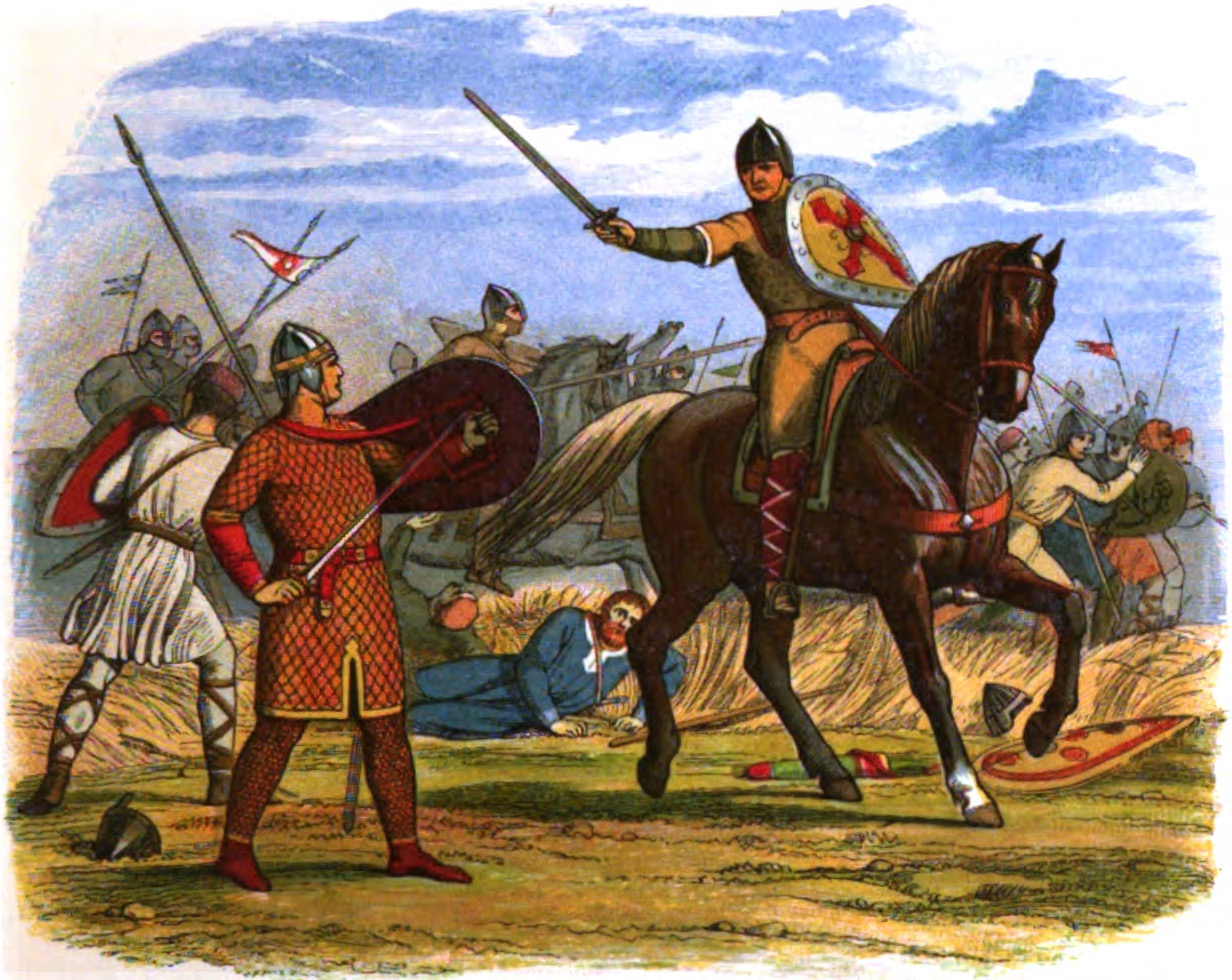
Robert taken prisoner by the clerk Baudri (the chaplain Waldric). Illustration by James William Edmund Doyle from A Chronicle of England, 1864. Public domain, Wikimedia Commons.
When William the Conqueror died in 1087, the eldest son, Robert Curthose, inherited Normandy, and the younger sons shared the rest. Henry I, the youngest, bought the Cotentin from Robert in 1088, and he became King of England in 1100, when his brother William Rufus died. Robert, an easy-going and unreliable ruler, let Normandy slide into disorder, and the Norman barons fought each other and turned to Henry for help. In 1105, Henry crossed to Normandy with an army, and the next summer he laid siege to Tinchebray, a castle held by William, Count of Mortain, who was Robert's ally. Robert marched to relieve it.
Battle
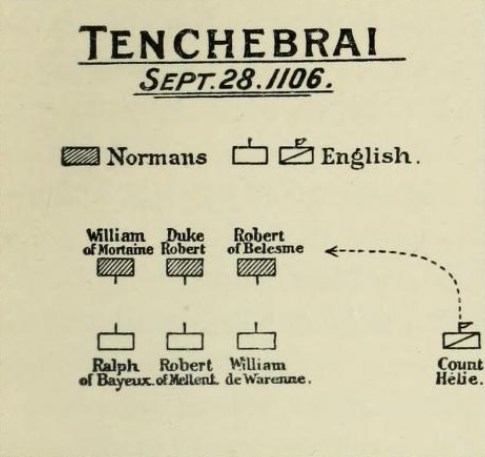
The lines at Tinchebray, from Charles Oman's A History of the Art of War: The Middle Ages, 1898, with Count Hélie (Helias of Maine) coming in on the flank. Public domain, Wikimedia Commons.
Robert had about 6,700 men, mostly infantry, with about 700 cavalry, and Henry's army was about the same size, with more cavalry and about a thousand Bretons under Count Alan IV. Robert's army was led by Robert himself, William of Mortain, and the powerful and cruel Robert of Bellême, Earl of Shrewsbury. The Earl of Surrey, William de Warenne, and Robert de Beaumont, Count of Meulan, later Earl of Leicester, fought for Henry, along with Ranulf of Bayeux and William of Évreux.
Henry did something unusual for a Norman commander. He had most of his knights dismount to fight on foot alongside his infantry in close ranks, as he did himself, and he kept a force of mounted knights under Count Helias of Maine, out of sight, on the flank. Robert's cavalry charged and was beaten off by the dismounted line, and the English then advanced and routed Robert's infantry. At the critical moment, Helias and the reserve struck the flank, and the Norman army collapsed. Robert of Bellême, who commanded the rear guard, rode away without fighting, and Robert's army was left to fall apart.
The chronicler Orderic Vitalis says that a royal chaplain, Waldric, took Duke Robert prisoner. The Anglo-Saxon Chronicle records that the Earl of Mortain was also captured, along with Edgar Ætheling, the last of the old English royal house, who had recently gone over to Robert's side. According to the chronicle, Henry afterward let Edgar go unpunished. The casualty figures disagree, and the Norman side may have lost about 250 to 300 infantry and 60 knights killed, with about 400 nobles captured, against Henry's claim that he lost only two knights.
Aftermath

Pevensey Castle, where William the Conqueror landed forty years earlier.
Henry I now held both England and Normandy. Most of the prisoners were released, but Robert Curthose was never freed. He was taken to England and held at Devizes Castle, and later in Wales at Cardiff Castle, where he died in 1134, after about 28 years in captivity. William of Mortain also spent the rest of his life as a prisoner. Robert's young son, William Clito, grew up as a rival claimant to the duchy, and his cause led to the revolts that ended at the Battle of Brémule in 1119.

The Norman shell keep at Cardiff Castle, where Robert Curthose died a prisoner.
The battle is sometimes called the second Norman Conquest, because it reunited England and Normandy under one ruler for the first time since 1087. It also showed Henry's careful, practical style of war, which put dismounted knights and infantry in close ranks and kept a reserve ready for the right moment.