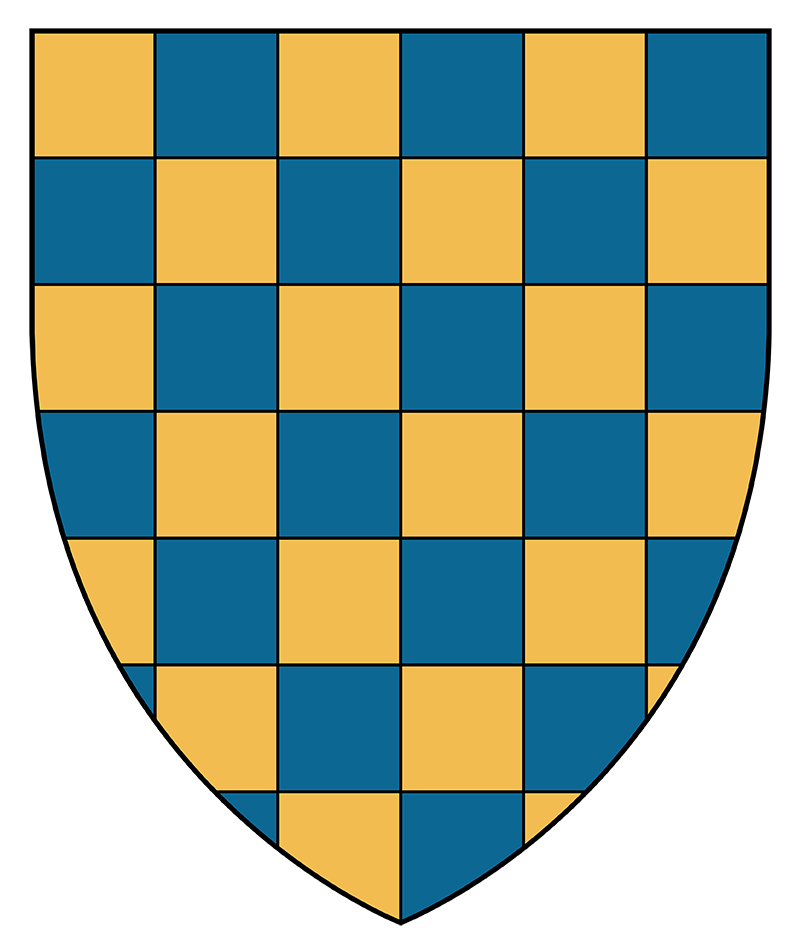
William de Warenne - 5th Earl of Surrey
William de Warenne, 5th Earl of Surrey, was an Anglo-Norman Nobleman who served three English kings. He stayed loyal to his cousin, King John, through most of the First Barons' War and later helped guide the kingdom under Henry III.

William was born around 1166, the eldest son of Hamelin de Warenne and Isabel de Warenne, Countess of Surrey. Isabel was the heiress of the great Warenne family, and her husband, Hamelin, was an illegitimate half-brother of King Henry II. That made William a first cousin of King Richard I and King John. He grew up in Normandy, and in 1194, he took part in the tournaments that Richard held after his return from captivity. William's father built the great round keep at Conisbrough Castle in Yorkshire, a key northern residence of the family. After he became earl in 1202, William added more buildings there, including the Great Hall and service buildings in the inner bailey.
William attended John's coronation on May 27th, 1199, and he became Earl of Surrey in 1202, when his father died. The same year, John appointed him lieutenant of Gascony. In 1204, France conquered Normandy, and William lost his Norman lands, but the king made up for it by giving him the lordships of Grantham and Stamford. He served John as Lord Warden of the Cinque Ports in 1204 to 1206 and again in 1214, as Warden of the Welsh Marches from 1208, and as High Sheriff of Surrey from 1200 to 1208. In 1212, when the barons began to grow restless, John trusted him with the custody of the northern shires.
When most of the barons turned against John in 1215, William remained loyal. He is named among the king's counselors in Magna Carta, which John sealed at Runnymede in June of that year.
The war soon turned against the king. In 1216, after Prince Louis of France landed in England, William was one of four earls who arrived during the Siege of Winchester. They defected to Louis, along with William Longespée, Earl of Salisbury, William d'Aubigny, Earl of Arundel, and William de Forz, Earl of Ablemarle, and received their lands back from their new lord. King John died in October, and in March 1217, William returned to the royal side, now led by the boy king, Henry III. He was High Sheriff of Surrey again from 1217 to 1226.
On October 13th, 1225, William married Maud Marshal, the daughter of William Marshal and the widow of Hugh Bigod, 3rd Earl of Norfolk. They had a son, John, born in 1231, and a daughter, Isabel, who married Hugh d'Aubigny, 5th Earl of Arundel.
Under Henry III, William continued in administrative roles, but after 1227, his relations with the king became strained, and he grew critical of Henry's favorites. In 1232, when Hubert de Burgh lost his office as justiciar, William protected him. By 1238, he was seen as a leader of the baronial opposition, and he was appointed one of the treasurers to oversee a royal subsidy.
William died in London on May 27th, 1240, and was buried at Lewes Priory in Sussex, the great monastery founded by his ancestor, William de Warenne, 1st Earl of Surrey. His son John became the 6th Earl of Surrey and, as a commander for Edward I, won the Battle of Dunbar in 1296.