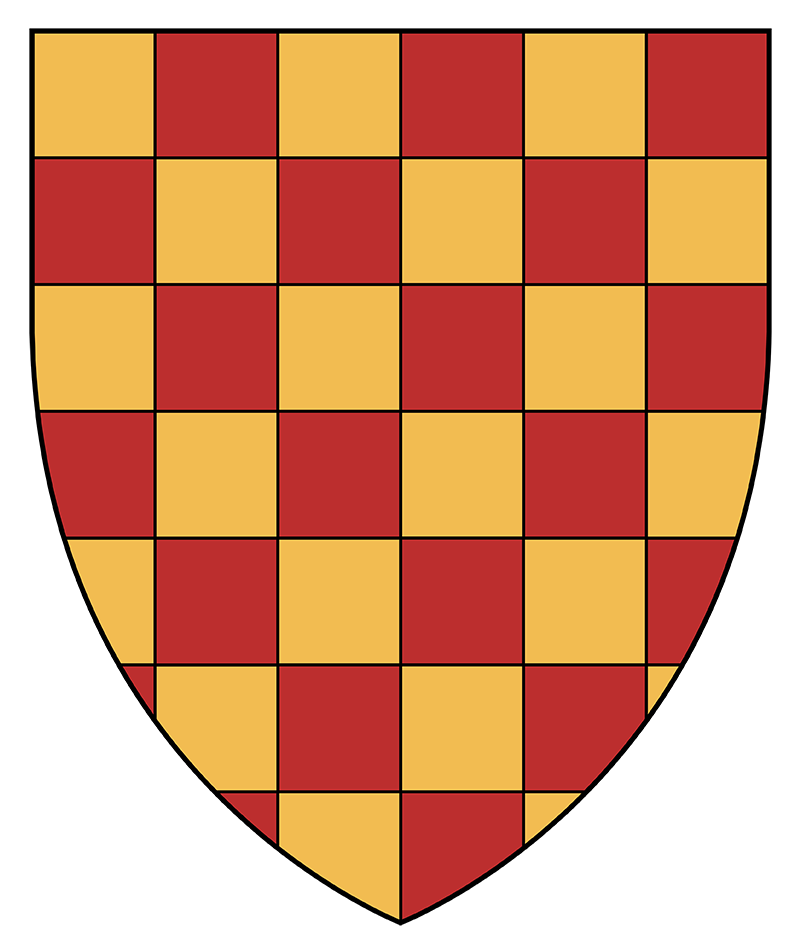
Robert de Beaumont - 1st Earl of Leicester
Count of Meulan
Robert de Beaumont was a Norman Nobleman who fought at the Battle of Hastings as a teenager and went on to become the most trusted adviser of two kings of England. Chroniclers of the day called him one of the wisest men of his age.

Warwick Castle across the River Avon. Robert's younger brother Henry became the first Earl of Warwick.
Robert was born between about 1040 and 1050, the eldest son of Roger de Beaumont and Adeline of Meulan, who was the daughter of Waleran III, Count of Meulan. Roger's Norman lordship had its seat at Beaumont-le-Roger. Robert had a younger brother, Henry, who was later entrusted with Warwick Castle and became the first Earl of Warwick.
Robert crossed to England with William the Conqueror's army in 1066. According to William of Poitiers, he led infantry on the Norman right wing at the Battle of Hastings and was in battle for the first time that day. He is said to have been the last of the Norman nobles who fought at Hastings to die. For his service, Robert received dozens of manors confiscated from English landowners, and they are listed in the Domesday Book of 1086.
When his mother died in 1081, Robert inherited the county of Meulan, on the Seine west of Paris, along with the title of viscount of Ivry. As Count of Meulan, he paid homage to King Philip I of France and sat among the French peers. After his father died in 1094, Robert also succeeded to the major part of his lands in Normandy, which made him a powerful lord on both sides of the Channel.
Around 1096, when he was about 47, Robert married Isabel de Vermandois, who was only about 11. Isabel was the daughter of Hugh I, Count of Vermandois, a younger son of King Henry I of France, which made her a niece of King Philip I and a great-granddaughter of Hugh Capet.

The east front of Warwick Castle above the Avon.
On August 2nd, 1100, Robert and Henry were both in the royal hunting party in the New Forest when William Rufus was killed by an arrow. Robert pledged his loyalty to Rufus's younger brother, Henry I, at once, and he soon became the king's chief adviser. His loyalty came at a price. William of Évreux and Ralph de Conches raided his Norman estates after the king's death, saying that his advice to Rufus had harmed them.
Robert and Isabel had several children, including twin sons born in 1104: Waleran, who inherited Meulan and his Norman lands, and Robert, who became the 2nd Earl of Leicester and was nicknamed Le Bossu. Their younger son, Hugh, later became Earl of Bedford, and the family also included several daughters.
Henry of Huntingdon described Robert as "the wisest man between this and Jerusalem," and later writers noted that three kings had valued his counsel. His advice was not always popular. In the dispute over who had the right to choose bishops, Robert counseled Henry to keep appointing them himself, and Pope Paschal II excommunicated him on March 26th, 1105. Archbishop Anselm had the sentence lifted in 1106, and Robert helped to broker the compromise between the king and the church, which was settled at Bec that year.

The gatehouse and barbican at Warwick Castle.
In September 1106, Robert was one of Henry's commanders at the Battle of Tinchebray, where the king defeated his older brother, Robert Curthose, and took control of Normandy. The victory made Robert's position even stronger. In 1107, Henry gave him the town and castle of Leicester, which became the head of his English estates and was well placed to control the central trade and military routes. He is counted as the first Earl of Leicester, although he remained better known as the Count of Meulan, and some historians doubt that he ever used the English title.
At Leicester, Robert carried out major building work in the castle bailey, and he founded a college of priests to serve a chantry in the castle chapel, now the church of St Mary de Castro.
Robert's French lands brought him into conflict with the French crown. In 1110, King Louis VI of France, known as Louis the Fat, besieged him at Meulan and took the castle by storm. Robert struck back the following year by plundering Paris. He destroyed the bridges over the Seine, which kept Louis from coming to the city's relief and allowed Robert to retreat safely with his booty.
Robert died on June 5th, 1118, and was buried at the abbey of Saint-Pierre de Préaux in Normandy, where his father was also buried. Henry of Huntingdon claimed that he died of shame after a certain earl carried off the lady he had married. That same year, his widow Isabel married William de Warenne, the 2nd Earl of Surrey and the son of William de Warenne, the 1st Earl. Robert's grandson, Robert de Beaumont, the 3rd Earl of Leicester, would rebel against Henry II in 1173.