Battle of Hastings
Background
In January 1066, King Edward the Confessor died childless. On his deathbed, according to Harold Godwinson, Edward named him successor. Soon after Edward's death, Harold was crowned king of England.
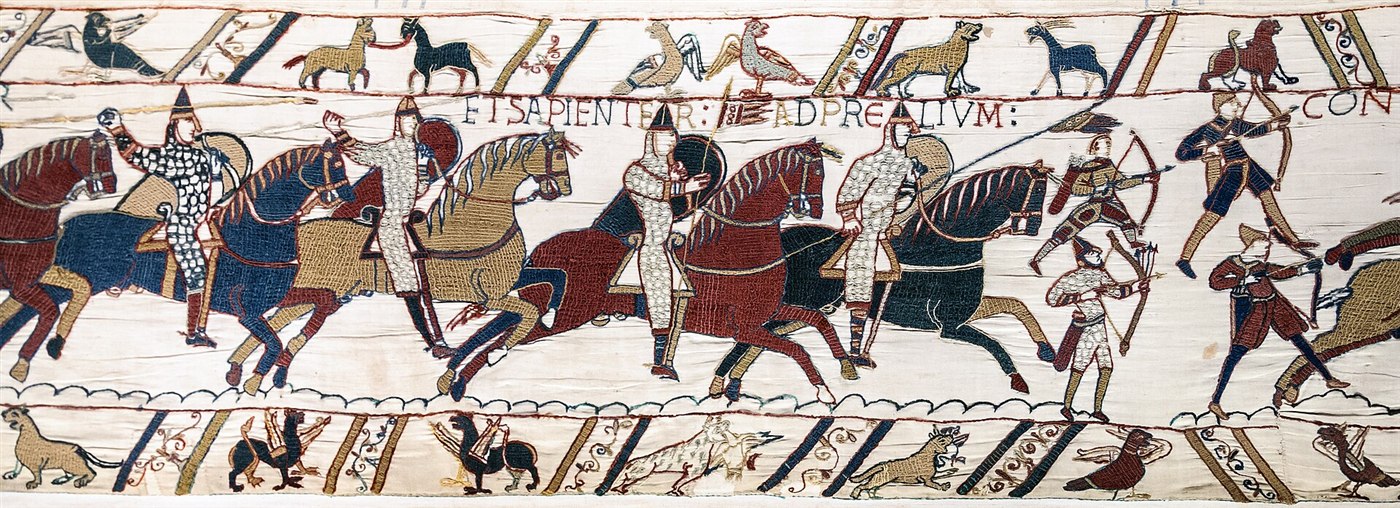
Norman knights and archers at the Battle of Hastings. Bayeux Tapestry, 1070s. Photo by Myrabella, Wikimedia Commons, public domain.
William, Duke of Normandy, claimed Edward promised him the throne. The Normans stated that, during a 1064 visit to Normandy, Harold Godwinson swore an oath to support William's claim.
In the spring of 1066, Halley's Comet, a hairy star, was seen in England. It was interpreted as a bad omen by the English, God's angry reaction to King Harold for breaking his Oath to William, assuming the throne. In the Anglo-Saxon Chronicle, it was recorded by Malmesbury:
Not long after, a comet, portending (they say) a change in governments, appeared, trailing its long, flaming hair through the empty sky: concerning which there was a fine saying of a monk of our monastery called Æthelmær. Crouching in terror at the sight of the gleaming star, "You've come a long way, have you?", he said. "You've come, you source of tears to many mothers. It is long since I saw you, but as I see you now, you are much more terrible, for I see you brandishing the downfall of my country."
Norwegian King Harald Hardrada, supported by Harold Godwinson's brother Tostig, claimed the English crown. Hardrada and Tostig invaded England in the fall of 1066. They defeated an English army led by Earls Morcar of Northumbria and Edwin of Mercia at the Battle of Fulford on 20 September 1066.
After their Fulford victory, Hardrada and Tostig stayed near York to rest, awaiting promised English resources in exchange for sparing the city. Meanwhile, events unfolded elsewhere in England.
King Harold waited in Southern England for an invasion by William, Duke of Normandy, that never came. Learning of Hardrada and Tostig's arrival in Northern England, Harold and his army quickly marched north to York, catching them by surprise. The English defeated the Norwegians on September 25, 1066, at the Battle of Stamford Bridge near York. Hardrada and Harold's brother, Tostig Godwinson, were killed in the battle.
Harold Godwinson's victory at Stamford Bridge was short-lived. Three days later, William, Duke of Normandy, landed unopposed at Pevensey Bay with his Norman army on September 28, 1066. William brought knights, horses, and timber for palisade walls in Norman transport ships.
At Pevensey, within the Roman fort of Anderitum, William erected a wooden motte and bailey-style castle. Two weeks later, the group marched to Hastings and constructed a second wooden castle.
Harold led his troops on a forced 200-mile march from Stamford Bridge to intercept the Norman army. His army was about 7,000 strong, mainly infantry with a few archers, but no cavalry. Recent research suggests Harold and his men may have used both land and sea routes. They camped at Caldbec Hill on October 13th, 1066, near a "hoar-apple tree," about 8 miles from William's camp and castle at Hastings.
William's army, comprising 4,000 to 12,000 cavalry, archers, and infantry from Normandy, Brittany, Flanders, and northern France, began its advance north from Hastings toward Harold's army.
Battle
At dawn on October 14th, 1066, the two armies assembled near Senlac Hill. The battle commenced at 9am and raged until dusk.
Harold's men held the high ground, forming a shield wall on the ridge with flanks protected by woods and marsh in front to neutralize William's cavalry.
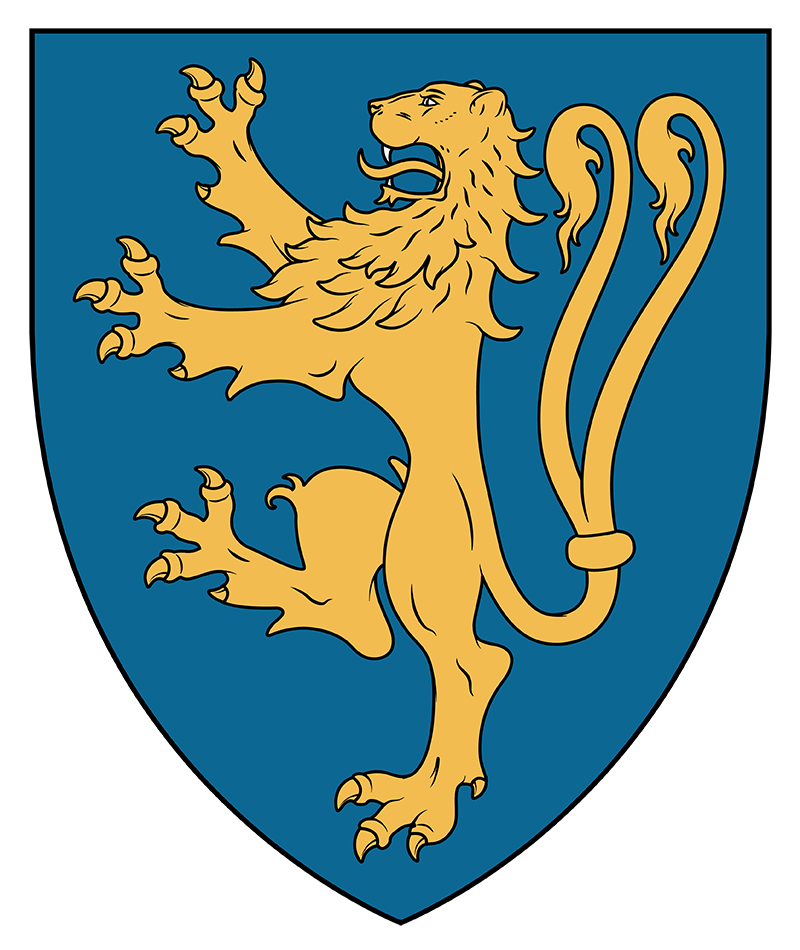
The Normans were arranged in three groups. The left flank included Bretons and soldiers from Anjou, Poitou, and Maine, led by Alan the Red. The center was composed of Normans led by Duke William. The right flank consisted of Frenchmen, with those from Picardy, Boulogne, and Flanders under William FitzOsbern and Count Eustace II. The cavalry was held in reserve.
William began the battle with archers firing at Harold's front lines, aiming to weaken the enemy. Next came a wall of spearmen who attacked the shield wall in close combat. Spears, axes, and stones met the Normans as they advanced. Though the spearmen pressed on, they did little to weaken the defense. Even the cavalry, which attacked afterward, had little success.
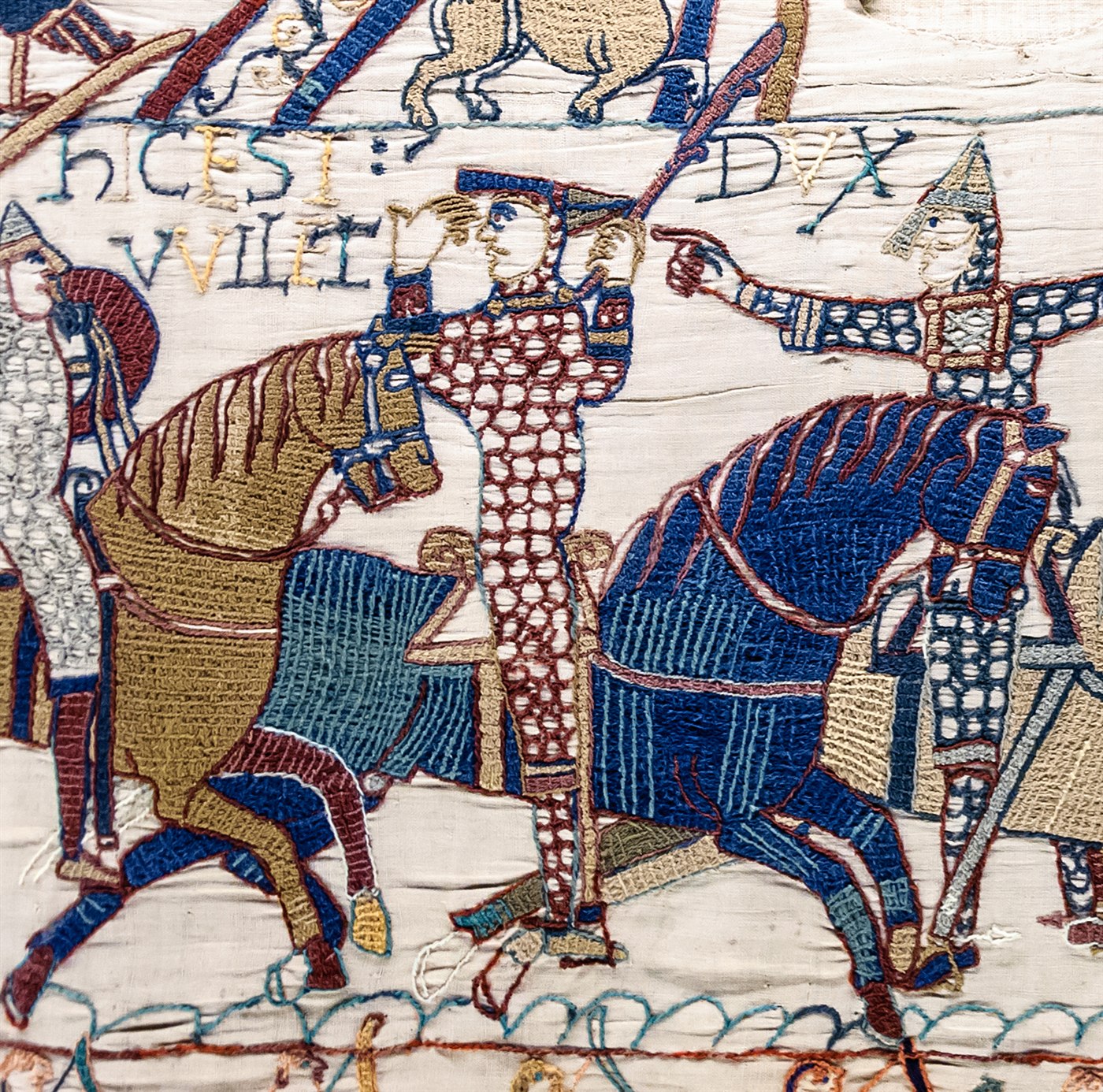
Duke William lifts his helmet to show he is alive. Bayeux Tapestry, 1070s. Photo by Myrabella, Wikimedia Commons, public domain.
A retreat began in the Breton division on the left flank. A rumor spread quickly: William had been killed. Confusion grew. As the Normans retreated, the English pursued. William rode through his forces to show he was alive. This led to a Norman counterattack against the pursuing English. Some English soldiers rallied before being overwhelmed.
Harold's younger brothers, Gyrth and Leofwine, were killed, possibly while leading the pursuit of the retreating Normans.
By early afternoon, the fighting likely paused for rest and food. William may have used this time to plan a new strategy. If cavalry feigned retreat and lured the English into pursuit, it could weaken Harold's shield wall. This tactic worked somewhat. Experienced men were drawn out, but others took their place and held the line.
The Normans again used archers to weaken the shield wall before and after the cavalry charge. William then led an infantry charge. During the battle, two, perhaps even three, of his horses were killed beneath him.
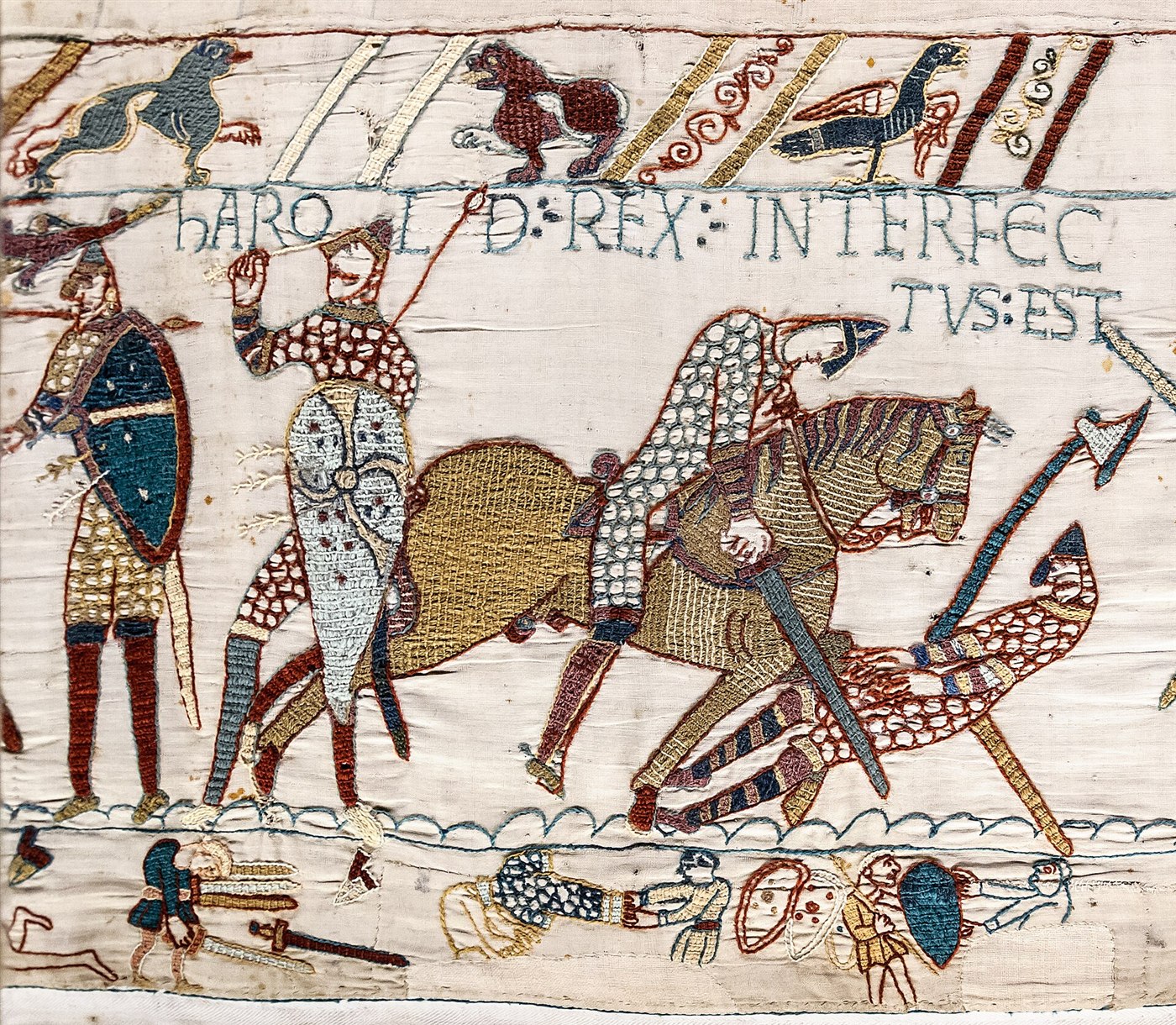
The death of King Harold. Bayeux Tapestry, 1070s. Photo by Myrabella, Wikimedia Commons, public domain.
Late in the battle, King Harold was killed. There is debate about whether an arrow struck his eye or if a swordsman cut him down. Contemporary chroniclers support both causes. The Bayeux Tapestry shows both scenes with the phrase "Here King Harold has been killed." Perhaps it was a combination of blows. Either way, Harold's death left the English leaderless. They began to collapse and flee. Members of Harold's household gathered around his body and fought to the end. The Normans pursued the fleeing English, and the battle ended except for a rearguard action at "Malfosse", where Eustace of Boulogne was wounded.
Harold Godwinson's army fought valiantly. Forced to face invasions at Stamford Bridge and Hastings in quick succession, Harold's rapid march south without gathering reinforcements likely led to their defeat.
William was the more experienced military leader. The English lack of cavalry limited Harold's tactical options. If the English had maintained their shield wall instead of pursuing the Normans, the battle might have ended differently.
Aftermath
The day after the Battle of Hastings, Harold's body was identified, either by his armor or marks on his body. His wife, Edith the Fair, could not recognize his face but was said to have identified him by personal marks.
Harold's personal standard was presented to William and later sent to the pope. The English dead were left on the battlefield, but later removed by relatives. The English lost up to fifty percent of their forces. The Normans' dead were buried in a large communal grave. One-seventh of the Nobles on the Norman side died, with likely a higher rate among common soldiers.
One story says Harold's mother, Gytha, offered his weight in gold for the return of his body, but was refused. William ordered Harold's body thrown into the sea, but it is uncertain if that occurred. Some think Harold was later buried at Waltham Abbey, which he founded. Other legends claim Harold survived and became a hermit in Chester.
William expected to receive the submission of the remaining English Nobles after his victory. Instead, 15 year-old Edgar Ætheling was declared King of England, supported by Earls Edwin and Morcar and the Archbishops of Canterbury and York.
After William's victory at Hastings, he marched north toward London but faced resistance, so he took a circular route around the city. In December 1066, the leading English Nobles surrendered to him at Berkhamsted, including Edgar Ætheling, Earl Edwin of Northumbria, Earl Morcar of Mercia, and the Archbishops of Canterbury and York.
This paved the way for William's coronation at Westminster Abbey on Christmas Day.
William's conquest of England would require more than victory at Hastings.
In 1070, William founded Battle Abbey at the battle site. The high altar was placed where Harold had died. This was likely ordered by Pope Alexander II as penance for the Norman conquest.

 Alan Rufus