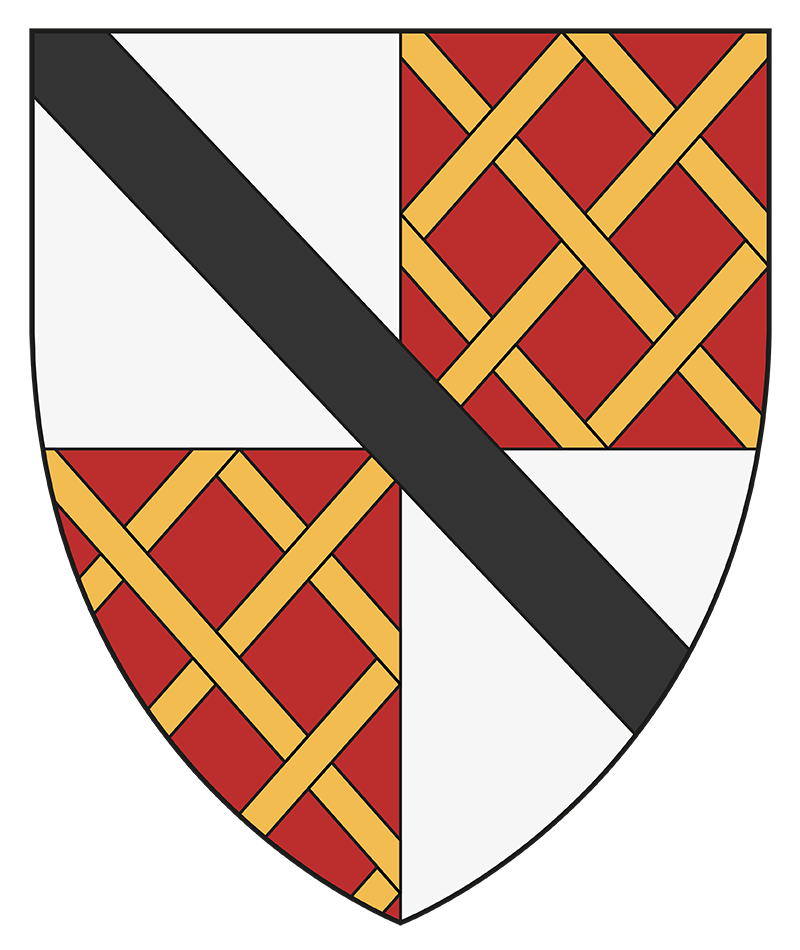
Hugh Despenser the Younger
The Younger Despenser
Hugh Despenser the Younger was a powerful English Nobleman, the royal chamberlain, and the most hated favorite of King Edward II. He was born around 1287, the son of Hugh Despenser, 1st Earl of Winchester, and Isabella de Beauchamp, daughter of William de Beauchamp, 9th Earl of Warwick.

Hugh was knighted at the Feast of the Swans at Westminster Abbey in May 1306, alongside the future Edward II. That summer, he married Eleanor de Clare, a daughter of Gilbert de Clare, 7th Earl of Gloucester, and a granddaughter of Edward I.

The great hall at Caerphilly Castle, rebuilt by Hugh with tall windows.
Everything changed in 1314, when Eleanor's brother, Gilbert de Clare, 8th Earl of Gloucester, was killed at the Battle of Bannockburn. Eleanor became a co-heiress to the earldom, and Hugh gained the lordship of Glamorgan and other properties through her, including Caerphilly Castle and Cardiff Castle. That same year, he was summoned to Parliament as Baron le Despenser, and he called himself "Lord of Glamorgan." At Caerphilly, Hugh rebuilt the great hall with tall windows and a roof resting on finely carved capitals with portrait busts.
Edward II had lost his earlier favorite, Piers Gaveston, in 1312, and by 1318, Hugh had displaced Roger d'Amory as the king's closest favorite. He became royal chamberlain that year. The Lords Ordainers, who had drafted the Ordinances of 1311 to limit the king's power, despised the Despensers for their influence, and Hugh made enemies at every level of society, from the barons to the common people.
Despenser's rule in Glamorgan was harsh. In 1316, a Welsh rebellion led by Llywelyn Bren attacked Caerphilly Castle before it was suppressed, and Llywelyn surrendered in March. Two years later, in 1318, while in Despenser's custody, he was hanged, drawn, and quartered at Cardiff Castle. The Welsh blamed Despenser, although the killing may have been done on the king's command. The brutality caused outrage in both England and Wales.

The Black Tower at Cardiff Castle.
Hugh used his power over the king to seize land. He took lands belonging to his brothers-in-law, cheated Elizabeth de Clare out of Gower and Usk, and forced Alice de Lacy, Countess of Lincoln, to surrender her lands. In 1321, he arrested William Fleminge, used him as a scapegoat, and imprisoned him in the Black Tower at Cardiff Castle, where he was later executed on the castle grounds.
The barons' resentment boiled over in the Despenser War. In May 1321, Roger Mortimer and Humphrey de Bohun, 4th Earl of Hereford, attacked the Despenser lands in South Wales in the first phase of the war. During an eight-day campaign, they took Newport, Cardiff, Swansea, and Neath Castle. However, Caerphilly Castle, the principal Despenser stronghold, held out under its constable, Sir John de Felton. Mortimer and Bohun then pillaged Glamorgan and Gloucestershire before joining Thomas of Lancaster, 2nd Earl of Lancaster, at Pontefract Castle.
In August 1321, the barons forced Hugh and his father into exile, with Queen Isabella urging the king to agree. Hugh then turned pirate in the English Channel and was accused of robbing two great ships worth £60,000.
Edward found it difficult to rule without the Despensers, and Hugh returned in early 1322 while the barons were busy elsewhere. That year, the king's forces crushed the baronial opposition at the Battle of Boroughbridge, and Thomas of Lancaster was executed. Hugh's father was created Earl of Winchester. For the next four years, the Despensers dominated the government, and their maladministration made them more hated than ever. Hugh even kidnapped Elizabeth Comyn, the heiress of Goodrich Castle, and held her prisoner at Goodrich until she signed the castle and other lands over to the Despensers in April 1325. Her husband, Richard Talbot, 2nd Baron Talbot, seized the castle back in 1326, shortly before Queen Isabella landed in England.

The outer gatehouse at Caerphilly Castle, the main Despenser stronghold.
In September 1326, Queen Isabella and Roger Mortimer invaded England with about 1,500 mercenaries, and the nobility rallied to them. Edward and Hugh fled west toward Wales, seeking refuge in Caerphilly Castle and then at Neath, while Hugh's father was captured at Bristol and hanged on October 27th, 1326. In mid-November, the king and Hugh were captured near Neath.
On November 24th, 1326, Hugh was tried in the market square at Hereford before Mortimer, Isabella, and the Lancastrian lords. The charges included breaking the terms of his exile, breaching Magna Carta and the Ordinances of 1311, killing and imprisoning nobles, causing the Scottish wars, and usurping royal authority. He was sentenced to be hanged for theft and drawn and quartered for treason.
The execution was meant to humiliate him. Hugh was roped to four horses, rather than the usual two, and dragged through Hereford to the walls of his own castle, where he was hanged from a gallows 50 feet high. According to the chronicler Froissart, he was castrated, his entrails were removed, and his heart was burned because it was false and traitorous. His head was displayed above the gates of London, and the other parts of his body were sent to Newcastle, York, Dover, and Bristol.
His widow, Eleanor, was granted permission to gather his remains in December 1330, but only his head, a thigh bone, and some vertebrae were returned. His son, also named Hugh, was among the garrison that defended Caerphilly Castle against a siege led by William la Zouche. The castle did not surrender until March 1327, on the condition that the younger Hugh was pardoned. In 2006, BBC History magazine named Hugh Despenser the Younger the worst Briton of the 14th century.