Caerlaverock Castle
History
Caerlaverock Castle stands beside the Solway Firth, about eight miles south of Dumfries in Dumfries and Galloway, Scotland. It is a moated castle with a triangular plan and a double-towered gatehouse, and it is the only triangular castle in Britain. For most of its history, it was the stronghold of the Maxwell family.

Around 1220, King Alexander II granted the barony of Caerlaverock to Sir John Maxwell, Warden of
the West March. Soon after, John ordered the construction of the first Caerlaverock Castle. It stood at the head of a tidal inlet on the Solway, and it was one of the
first stone castles built in Scotland. The site was wet and muddy, and the buildings began to
collapse, so the Maxwells decided to build a new castle about 200 meters to the north.
 Tree-ring dating of timbers from the bridge suggests the move happened around 1277. The new
castle was begun by Sir Aymer Maxwell, and the triangular plan, the moat, and the twin drum
towers of the gatehouse date from this time. It was built of red sandstone from a nearby quarry.
Tree-ring dating of timbers from the bridge suggests the move happened around 1277. The new
castle was begun by Sir Aymer Maxwell, and the triangular plan, the moat, and the twin drum
towers of the gatehouse date from this time. It was built of red sandstone from a nearby quarry.
In 1299, a Scottish garrison from Caerlaverock attacked the nearby English-held Lochmaben Castle.
The castle's most famous moment came in July 1300. During the Wars of Scottish Independence, King Edward I marched north with an army of about 3,000 men, including 87 barons, to punish Scotland and take control of Nithsdale. Among them were Henry de Lacy, Earl of Lincoln, John of Brittany, Earl of Richmond, Humphrey de Bohun, Earl of Hereford, Thomas and Henry of Lancaster, Robert de Clifford, and Henry de Tyeys.
Against this army, Eustace de Maxwell held the castle with only 60 men. They drove back several English attacks, but the siege engines finally breached the walls, and the garrison surrendered. The English were astonished to find how few men had defended the castle. One of Edward's heralds wrote a poem in Old French about the siege called the Roll of Caerlaverock, which names the knights who were present and describes their coats of arms. See the Siege of Caerlaverock for the full story.
In the years that followed, the castle changed hands several times. Eustace Maxwell eventually switched his support to Robert the Bruce and dismantled the castle to stop the English from using it. By 1337, it was inhabited again, and around 1355, Sir Roger Kirkpatrick captured it for King David II of Scotland and partly dismantled it again. Sir Robert Maxwell rebuilt much of the castle between 1373 and 1410. In the middle of the 15th century, Robert, 2nd Lord Maxwell, carried out more work that probably included rebuilding the gatehouse, and around 1500, a new west range was added.
In 1513, the Maxwells suffered a heavy loss at the Battle of Flodden, where John, 4th Lord Maxwell, and three of his brothers were killed. The family recovered, and in 1536, his son Robert, 5th Lord Maxwell, became a member of the Council of Regency that governed Scotland while King James V was away in France. James V visited Caerlaverock in 1542, shortly before the Battle of Solway Moss. The Scots were defeated in the battle, and Robert, 5th Lord Maxwell, was taken prisoner by the English.
The castle came under attack again after Mary, Queen of Scots, was forced to abdicate in 1567. The Catholic Maxwells supported her, and in 1570, an English force led by the Earl of Sussex besieged Caerlaverock, partly demolished it, and destroyed the gatehouse with gunpowder. In 1593, John, 8th Lord Maxwell, was repairing the castle and strengthening the gatehouse against the neighboring Johnstones of Annandale, who killed him in the fighting at Dryfe Sands that year.
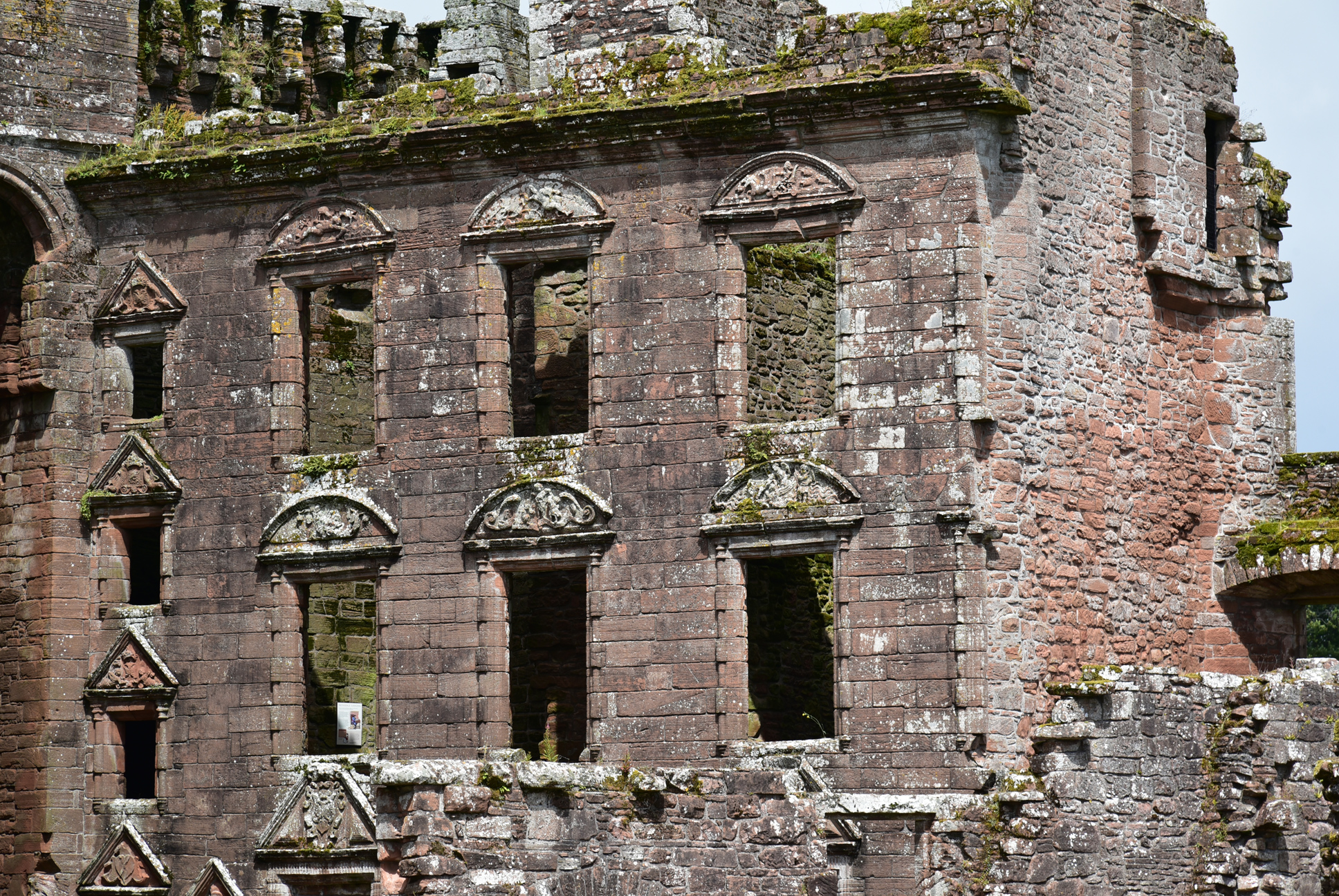
The castle's last great change came after Robert, 10th Lord Maxwell, became Earl of Nithsdale around 1620. He built the elegant south and east ranges inside the old walls, known as the Nithsdale Lodging, which were completed around 1634. With its carved pediments over the windows, it is one of the earliest and most ambitious examples of Renaissance classical architecture in a Scottish home.
Only a few years later, in 1640, a Covenanter army besieged Caerlaverock for 13 weeks and forced it to surrender. The south wall and a tower were demolished, and the castle was never repaired or lived in again. Today, Historic Environment Scotland cares for it.
Castle Highlights
Caerlaverock's famous triangular shape is easy to see from the grass outside the moat. The twin towers of the gatehouse rise about 50 feet above the drawbridge and still have their machicolations, the projecting parapets that once let defenders drop things on attackers. Inside the walls, the best sight is the Renaissance front of the Nithsdale Lodging, with its carved pediments over the windows. The older west range from around 1500 is also inside.
Outside the castle, a short walk through the woods leads to the site of the first Caerlaverock Castle, where only the foundations remain. Information panels explain how the Maxwells built it and why they gave it up. The castle is also on the edge of the Caerlaverock National Nature Reserve, which is internationally important for wintering waterfowl, including barnacle geese.
Before you go, check the Historic Environment Scotland website for opening times and any access restrictions. Conservation work has recently closed some parts of the castle, including the west range and two of the towers. The castle has a visitor centre with a shop and tearoom, and there is a car park about 100 meters from the visitor centre.
Plan on about half a day to see Caerlaverock Castle. Threave Castle is close enough to visit on the same day.
Caerlaverock Castle is also haunted.