Drumlanrig Castle
The Pink Palace
History
Drumlanrig Castle spans over 600 years of Douglas and later Buccleuch history. Initially a 14th-century stronghold, it became a 17th century Renaissance-style mansion, known as the “Pink Palace.” Drumlanrig comes from Cumbric or Gaelic, likely meaning "Long Ridge."
The barony of Drumlanrig was held by James Douglas, 2nd Earl of Douglas and Mar. He died at the Battle of Otterburn in 1388. The estate then passed to his illegitimate son, William Douglas, 1st Laird of Drumlanrig.
The Douglas family built the first tower-house-style castle here after 1357, on the site of an earlier stronghold overlooking the Nith Valley. They received the land in Nithsdale as a grant from King Robert the Bruce. A Roman fort also stood about 350 yards southeast of the castle. Aerial photography revealed it in 1984, and the television program Time Team partly excavated it in 2004.
In 1548 (sometimes dated 1549), during the Rough Wooing, English forces under Sir Henry Wharton, son of Thomas Wharton, Warden of the West Marches, raided Upper Nithsdale. Thomas Wharton and the Earl of Lennox sent Henry ahead to burn Drumlanrig and Durisdeer, and he was knighted for the expedition. After James Douglas refused to align with the English, they attacked the castle and seized 480 oxen and cows from Douglas as part of the broader raids.

The pink sandstone walls of Drumlanrig Castle.
The Douglases supported Mary, Queen of Scots, when she stayed at the castle in 1563. However, in 1567, James Douglas joined the Lords who drove Mary out of Scotland, though the family mostly continued to support her. Because they backed the queen, forces under the Earl of Morton and others destroyed the castle in 1575, in the aftermath of the Marian Civil War.
After these events, builders reconstructed the castle in a courtyard style before King James VI, Mary's son, visited in 1617, reaffirming the royal bond.
After the Battle of Dunbar in September 1650, hardline Scottish Covenanters known as the Remonstrators, who opposed both Charles II and the more moderate Engagers, attacked the castle in October. Led by Colonel Gilbert Ker, Archibald Johnston of Wariston, Sir John Chieslie, and others, they besieged the castle, burned the gates, and plundered the land. They took or destroyed corn, cattle, and other items belonging to James Douglas, 2nd Earl of Queensberry, and his tenants. In 1661-62, the earl petitioned the Scottish Parliament, which ordered the attackers to pay him compensation of about £2,000. A separate Cromwellian force also occupied the castle in 1650.

The entrance front, with its corner towers and turrets.
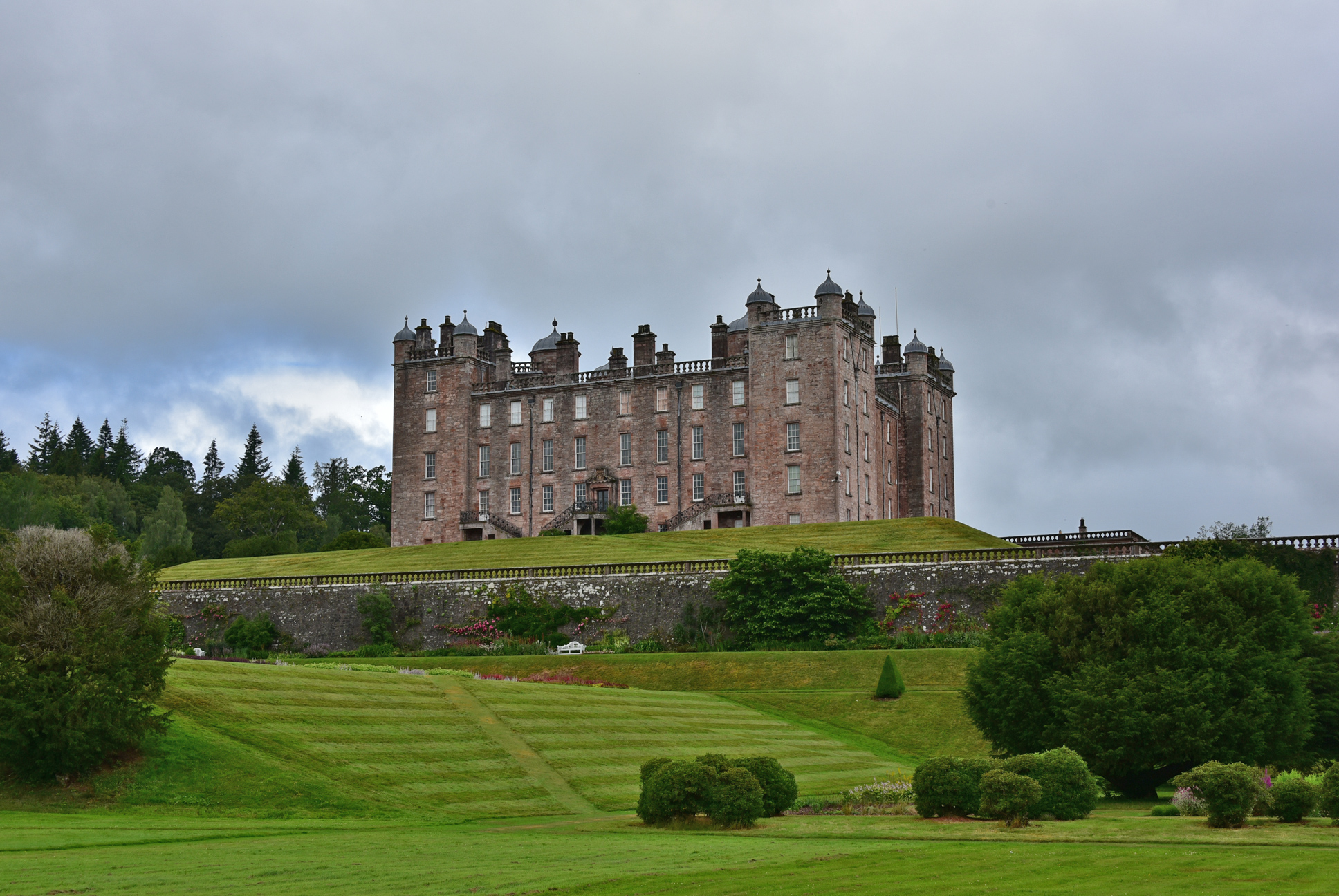
Between 1679 and 1691, William Douglas, 3rd Earl of Queensberry, built a new castle on the site of the medieval castle, incorporating the cellars of the earlier building. In 1684, he became the 1st Duke of Queensberry for supporting King Charles II. The castle, in the Renaissance style, features pink sandstone and Scottish baronial elements: four ranges around an open courtyard, with corner towers and pepper-pot turrets. The architects Sir William Bruce and Robert Mylne are thought to have been involved in the design. The Douglas arms, hearts and stars, decorate the window and door frames, and the winged heart recalls Sir James Douglas carrying the heart of Robert the Bruce on crusade.
The duke reportedly spent only one night in the castle and disliked it. He returned to Sanquhar Castle, where he died in 1695. His son James, 2nd Duke of Queensberry, moved his seat to Drumlanrig, leaving Sanquhar to decay into ruins.
On December 22nd, 1745, Charles Edward Stuart (Bonnie Prince Charlie) and his men stayed at Drumlanrig Castle during their retreat from Derby. During their stay, his forces damaged the building and slashed a portrait of William of Orange. As the 18th century progressed, the castle fell into neglect.

The castle seen across its terrace wall.
In 1810, William, 4th Duke of Queensberry (Old Q), died without an heir. As a result, Henry, 3rd Duke of Buccleuch, inherited Drumlanrig and the Queensberry titles and estates, uniting the Douglas and Scott lines into the Montagu-Douglas-Scott family.
The name Buccleuch dates back to the 10th century. Legend says King Kenneth III was hunting in a deep ravine, or “cleuch,” when a young buck charged him. John Scott seized the buck by the antlers and wrestled it down, saving the king's life. From that day, the Scotts were called Buck Cleuch, the buck from the ravine, and were rewarded for their bravery.
A few years later, in 1827, the castle was restored after it passed to the Scott Dukes of Buccleuch. During this restoration, the architect William Burn added the service wings.
In the 20th century, the castle operated as an auxiliary hospital during World War I and housed the girls of St Denis School, evacuated from Edinburgh, between 1939 and 1945. In 2003, thieves stole Leonardo da Vinci's Madonna of the Yarnwinder from the castle, and it was recovered in Glasgow in 2007.
Castle Highlights
Drumlanrig Castle is regarded as one of the finest examples of 17th-century architecture in Scotland, with breathtaking views across Nithsdale near Thornhill. It has 120 rooms, 17 turrets, and four towers.
The castle is still home to the Duke of Buccleuch and Queensberry, the Montagu-Douglas-Scott family. The only way to see inside is on a guided tour. Tours run on Easter weekend, May bank holiday weekends, and Friday to Monday in July and August, and they sell out quickly, so booking in advance is highly recommended. Private tours are available year-round by appointment.
The castle is a courtyard castle, square in shape, with a courtyard at its center. It stands four stories high and features seventeen turrets and four corner towers.

The gardens, with the castle beyond.
The castle houses the Buccleuch Art Collection, with works by Rembrandt, Holbein, Gainsborough, Reynolds, and others, including Rembrandt's An Old Woman Reading. The collection also includes tapestries, furniture, silver, and the Drumlanrig Jewel.
The castle's formal gardens, about forty acres, are among Scotland's finest. The estate also offers an adventure playground for kids, walking trails, parkland, and woodland. The gardens and playground are open daily from the end of February to October.
The castle was used as a filming location for Bellhurst Manor in season two of Outlander.
Drumlanrig Castle is also haunted.