Sudeley Castle
History
Sudeley Castle, located in the Cotswolds in Gloucestershire, England, is a 15th century castle built on a site with even older fortifications. The castle's name, Sudeley, comes from the Anglo-Saxon "Sudeleagh", which means a southern clearing or pasture in a forest.

The story begins in 969, when Oswald, Bishop of Worcester, compelled the secular clerks at Winchcombe to withdraw during the Benedictine revival. He placed monks in their place to keep the rule of St. Benedict. After King Edgar died, the people of Mercia favored the priests who had been ousted. The monks placed there by Oswald were expelled and returned to the monastery at Ramsey.
At the beginning of the 11th century, King Æthelred II (Æthelred the Unready) gave the Saxon manor house at Sudeleagh to his daughter Goda after she married Walter de Maunt. Their son, Ralf de Mederatinus, became Earl of Hereford.
The Norman Conquest in 1066 led most Anglo-Saxons to lose their lands, which were given to Norman noblemen. Although Harold, the son of the Anglo-Saxon Ralf, was permitted to keep Sudeley, he lost the earldom on William the Conqueror's orders.
During the Anarchy and King Stephen's reign, John de Sudeley fortified the manor house into an adulterine castle (a castle built in the 12th century without the King's permission) and revolted against the King, joining Empress Matilda in her attempt to gain the English Crown.
In 1139, Robert FitzRoy, Earl of Gloucester, led Matilda's forces to sack Winchcombe. In response, Waleran de Beaumont, Earl of Worcester, attacked and captured Sudeley and Tewkesbury. Stephen seized Sudeley and made it a royal garrison.
In 1165, Ralph de Sudeley possessed Sudeley Castle and granted Toddington to his brother William, who took their mother's surname, Tracy. William de Tracy became an ancestor of the Tracy family. He was also one of the four knights who murdered Thomas Becket at Canterbury Cathedral.
In 1367, John, 9th Lord de Sudeley, became Lord Chamberlain to King Edward III. He was killed fighting in Spain under Edward of Woodstock, the Black Prince, and Sudeley passed to the Boteler family through John's sister, Margaret, who inherited the estate.
In 1440, Ralph Boteler, a descendant through the Boteler line, was a commander and member of the King's Household under Henry V and Henry VI. He was made a Knight of the Garter, and in recognition of his status, Henry VI created him Baron Sudeley.
Ralph Boteler built the current Sudeley Castle in 1442. He used his spoils from the Hundred Years' War with France to do so. The castle's design follows a double-courtyard plan, surrounded by a moat. The first courtyard held quarters for soldiers and servants. State and family lodgings were arranged around the second courtyard. Ralph also added the Chapel (now St Mary's Chapel) and the Tithe Barn. The following year, Boteler was appointed Treasurer of the Exchequer and High Treasurer of England. He also built the Portmore Tower, the Dungeon Tower, and Banqueting Hall.
During the Wars of the Roses, Boteler backed the Lancastrians. When Edward IV came to power, Boteler was forced to sell the castle to the King. Edward gave the castle to his brother, Richard, Duke of Gloucester, in 1469. Richard held Sudeley for nine years, using it during the Battle of Tewkesbury.
In 1478, Richard, Duke of Gloucester, exchanged ownership of Sudeley Castle for Richmond Castle in North Yorkshire, but Sudeley remained Royal property. When Richard later became King Richard III, he again took personal ownership of Sudeley Castle.
During this period, the Banqueting Hall, oriel windows, and state rooms were built in place of the Eastern range of Boteler's inner court.
In 1486, King Henry VII granted Sudeley Castle to his uncle, Jasper Tudor, Duke of Bedford, who held it till his death in 1495. He had no heirs, so the castle passed back to the crown.
In 1535, King Henry VIII and Anne Boleyn stayed at the castle from July 21st-26th, while Henry met with Thomas Cromwell at Winchcombe to plan the dissolution of the monasteries.
When Henry VIII died in 1547, his son, King Edward VI, granted Sudeley Castle to his uncle, Thomas Seymour, who was the brother of Edward's late mother, Jane Seymour. Thomas Seymour was appointed Lord High Admiral of England and became Baron Seymour of Sudeley. He married Katherine Parr, Henry VIII's sixth and final wife, with whom he had a relationship prior to her marriage to Henry.
Seymour and Katherine Parr moved to Sudeley Castle, which Thomas refurbished for his bride. They were accompanied by Lady Jane Grey, Katherine's ward, and Miles Coverdale, later Bishop of Exeter. A full retinue—including maids-of-honor, gentlewomen, and more than 120 gentlemen of the household and Yeoman of the Guard—joined them.
On August 30th, 1548, Katherine gave birth to a daughter, Mary, but then Katherine died of puerperal fever less than a week later, on September 5th. She was buried in the Chapel of St Mary at Sudeley Castle, making her the only Queen of England to be laid to rest in a private castle. What became of Katherine's daughter, Mary, is lost to time.

Thomas Seymour then attempted to convince Princess Elizabeth, future Queen Elizabeth I, and stepdaughter to Katherine Parr, to marry him, but this led to his downfall. On March 20, 1549, Thomas was executed at Tower Hill, Tower of London, after being charged with 33 counts of treason and other offenses against the King and Crown. His brother Edward Seymour, then Lord Protector, signed his death warrant. On hearing of his death, Elizabeth remarked: "This day died a man with much wit and very little judgment."
Sudeley Castle was inherited by Thomas Seymour's brother, William Seymour, after Thomas's execution. William held it until 1553 when, facing accusations of treason himself, the castle was seized by the crown.
In 1554, Queen Mary I granted Sudeley Castle to Sir John Brydges, who had attended Lady Jane Grey on the scaffold as Lieutenant of the Tower. Mary created him Baron Chandos of Sudeley. His descendants—the Chandos family—would hold Sudeley Castle for the next 100 years. In 1572, Edmund, 2nd Baron Chandos and John's son, made extensive alterations to the castle.
Queen Elizabeth I visited Sudeley Castle three times. The first was in 1574, when she visited her friend Dorothy Bray, Baroness of Chandos, the wife of Edmund, 2nd Baron Chandos, and the mother of Giles Brydges. Her second visit occurred in 1575 during the Royal Progress, when Robert Dudley threw a lavish party at Kenilworth Castle. The third was in 1592, when she stayed at Sudeley with Giles Brydges, 3rd Baron Chandos, during her summer progress to celebrate the anniversary of the defeat of the Spanish Armada. The three-day-long celebration was notable for being one of the longest parties in history, featuring bull and bear baiting, mummers, jousting, and banqueting.
On August 22nd, 1642, King Charles I raised his standard at Nottingham and rallied his supporters. George, 6th Baron Chandos, declared his support for the King, armed his tenants and servants, put the castle in command of his brother, and then marched to Shrewsbury to join Charles with a thousand men and £500 worth of gold plate.
In 1643, while Charles was away, Sudeley Castle was besieged by Parliamentarian forces. Five hundred soldiers and two cannons attacked for three days before the castle surrendered to Colonel Edward Massey and his troops. The garrison of the castle was only six men. Two days later, Prince Rupert of the Rhine, Charles I's nephew, camped near Sudeley with 4,000 men. From there, he attacked and captured Cirencester, forcing the Parliamentarians to abandon Sudeley. However, they desecrated the Chapel of St Mary before leaving, turning it into a stable and making the chancel a slaughterhouse. The Communion Table became a butcher's block. When the Parliamentarians left, the King's Standard once again flew over the Portmore Tower in support of Charles.
A few months later, in August of 1643, the Royalists mounted the siege of Gloucester, which ended in disaster. As a result, Charles and his army took refuge at Sudeley Castle two days later.
In June 1644, the Parliamentarians returned and besieged Sudeley Castle. The castle was heavily bombarded. A lucky cannon shot killed Sudeley's cannoneer and created a hole in the Octagon Tower. One lieutenant fled and opened the gates to the attackers. The castle was surrendered by William Morton to Sir William Waller.
In 1649, the Council of State ordered the castle to be slighted and rendered indefensible. Baron Chandos was given £1,000 as compensation for the destruction of Sudeley.
Baron Chandos was held prisoner in the Tower of London for years before dying in 1655. He would never return to the castle, and his title and land passed to the Pitt family of Stratfield Saye.
After these turbulent years, Sudeley Castle lay in ruins for almost two centuries. While the weather and time furthered its decay, locals plundered its stones, and, for a time, it even served as an inn called the Castle Arms.
In 1782, a local farmer discovered the tomb of Katherine Parr in the Chapel ruins with a lead plate that read "Here lyeth Quene Kateryne wife to Kyng Henry the VIII and Last the wife of Thomas Lord of Sudeley... dyed 5 September MCCCCXLVIII." The farmer opened the lead casket and found the intact and perfectly preserved Katherine, but moments after being exposed to air, she crumbled into dust, and the farmer quickly reburied the Queen.
In 1810, Lord Rivers of Stratfield sold Sudeley Castle to the Marquis of Buckingham, who became the Duke of Buckingham and Chandos. In 1817, Katherine Parr's coffin was moved to the Chandos family's stone vault.
In 1837, the Duke of Buckingham sold the castle to John and William Dent, wealthy glovemakers from Worcester. In 1840, they restored the Elizabethan ranges of the outer courtyard with architect Harvey Eginton of Worcester, making the castle inhabitable again. They restored the North Quadrangle and stabilized the Banqueting Hall ruins. The castle was furnished with Tudor treasures acquired from the sale of the Horace Walpole collection at Strawberry Hill in 1842.
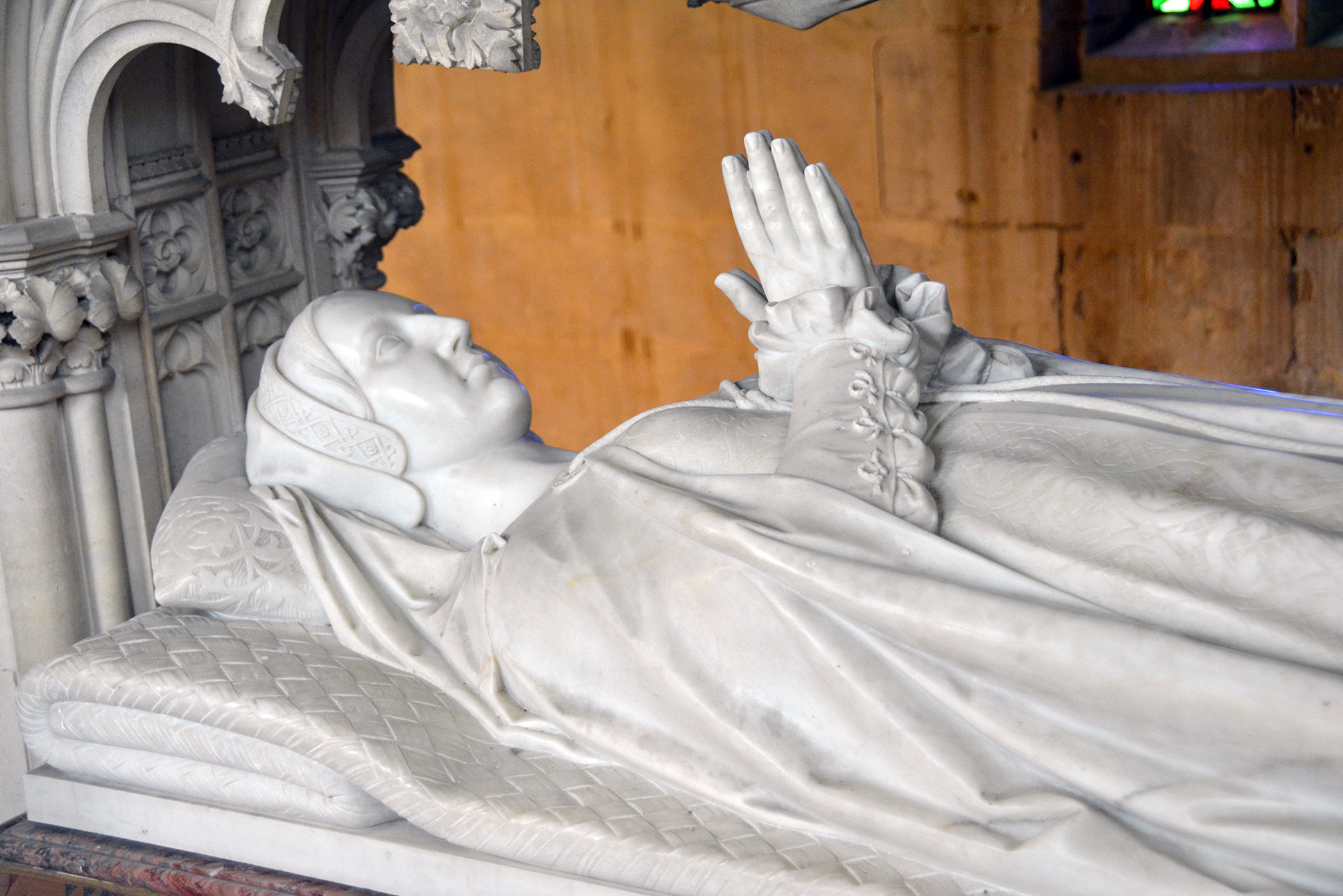
Between 1854 and 1855, St Mary's Chapel was restored and re-dedicated in 1863. The neo-Gothic tomb for Katherine Parr, designed by George Gilbert Scott and dating from the 1860s, was placed in St Mary's Chapel. The Stable block was also built during this time. Sudeley Castle was inherited by Dent's nephew, John Coucher Dent, who became the High Sheriff of Gloucestershire and married Emma Brocklehurst in 1852.
In 1890, Emma completed the building works at Sudeley, including the North and West Lodges, the North Tower, and a new main entrance from Winchcombe. She also added the Jubilee addition to the Western Range.
When Emma Dent died in 1900, the castle passed to her nephew, Harry Dent-Brocklehurst, to whom her husband had bequeathed the castle when he died in 1885. The Dent-Brocklehursts have held Sudeley Castle since.
In 1930, more restoration work was carried out on the Eastern range by architect Walter H. Godfrey. Between 1939 and 1949, Sudeley Castle served as a prisoner-of-war camp during World War II, where German and Italian prisoners worked the land. The castle was also a safe house used to store much of the Tate Gallery's collection while London was under bombardment from the Blitz.
In 1969, Mark Dent-Brocklehurst and his wife, Elizabeth, inherited the castle and decided to open it to the public, transforming it from a family home into a tourist attraction.
Mark died in 1972, and Elizabeth married Lord Ashcombe in 1979, becoming Lady Ashcombe. They carried out further refurbishments in the 1980s, building new staircases, chimney pieces, opening up old windows, and adding new doorways.
Castle Highlights
Sudeley Castle is a great castle to visit. It blends medieval history, Tudor heritage, and beautiful formal gardens. It has ten award-winning gardens on the estate.
The castle's interior can be explored via a guided tour, while the grounds are viewable at your own pace. The castle features the "Royal Sudley 1000: Trials, Triumphs and Treasures" exhibition, which includes personal effects of Queen Katherine Parr and other historical figures.
The guided tour explores the West wing of the castle, built in the 15th century, and the East wing, still in use by the family today. The staircase in the South Hall features panels of painted Dutch glass from the 16th and 17th centuries. At the top of the staircase, a large painting can be seen of "The Allegory of the Tudor Succession", one of Sudeley's finest treasures.
The tour also includes the Morning Room, the Library with over a thousand books and rare tapestries, and the Chandos Bedroom with a huge four-post bed said to have been slept in by Charles I. Also featured are Katherine Parr's Anterooms, the oldest rooms in the castle, with a Tudor-style blue ceiling.
Queen Katherine's tomb is also viewable in St Mary's Chapel behind the castle.
Sudeley Castle is also home to one of the largest public collections of endangered pheasants in the world, and it works tirelessly with the World Pheasant Association to increase their numbers before reintroducing them to the wild and their natural habitat.
Sudeley Castle can take anywhere from a few hours to all day to explore. If you do find you have half a day to spare, Goodrich Castle or Berkeley Castle are close enough to see the same day.
Sudeley Castle is also haunted.