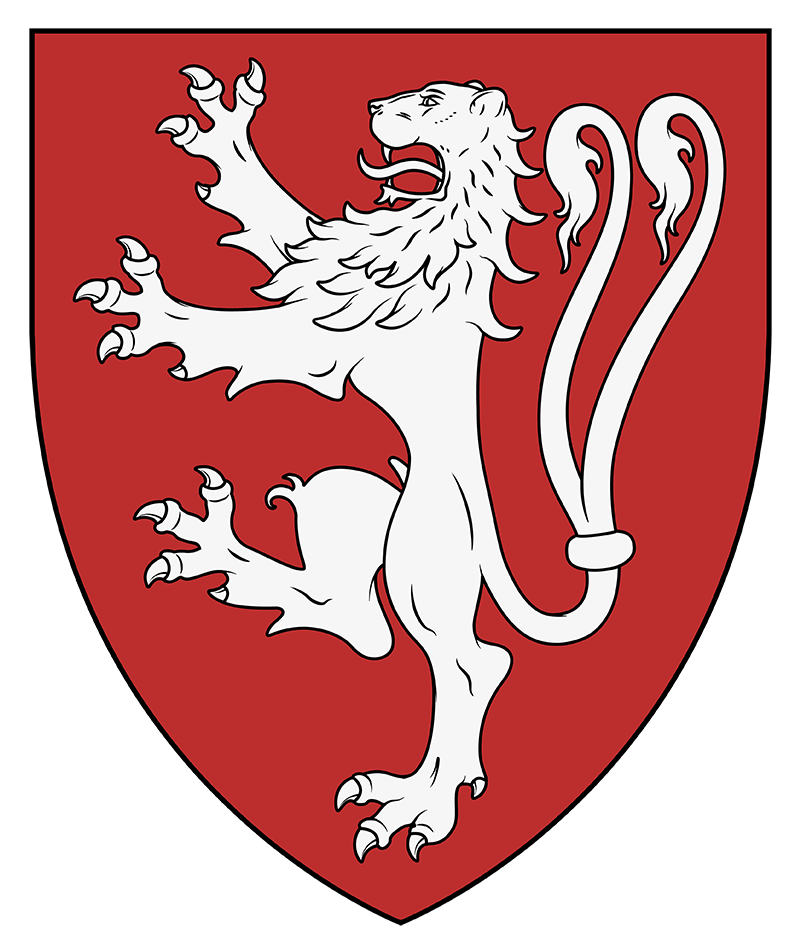
Simon de Montfort - 6th Earl of Leicester
Simon de Montfort, 6th Earl of Leicester, was a French-born Nobleman who led the barons' rebellion against Henry III and ruled England for about a year after his victory at Lewes. He is often remembered as one of the founders of the House of Commons.

Simon was born around 1208 at Montfort-l'Amaury, near Paris. He was a younger son of Simon de Montfort, 5th Earl of Leicester, who led the crusade against the Cathars in southern France, and Alix de Montmorency. As a boy, he went on campaign with his parents. His father was killed at the Siege of Toulouse in 1218, and his brother Guy died at Castelnaudary two years later.
The family also held the English earldom of Leicester. In 1229, Simon agreed with his brother Amaury that Simon would give up his French claims and Amaury would give up his English ones. Simon arrived in England that year and petitioned for the Leicester inheritance. He received it the following year but did not take full possession for several years, and he was not formally invested as Earl of Leicester until 1239.
In January 1238, Simon secretly married Eleanor, Henry III's sister and the daughter of King John. Eleanor was the widow of William Marshal, 2nd Earl of Pembroke, and she had vowed to remain chaste after his death, so Archbishop Edmund Rich condemned the match. Henry supported it, and Simon traveled to Rome in March to seek the pope's approval. The king's brother Richard, Earl of Cornwall, rose in anger at the marriage, and Henry bought him off with 6,000 marks. Simon and Eleanor's first son, Henry, was born that November. They would have seven children.
The friendship between Simon and the king soured within a year. Simon owed a large sum to Thomas, Count of Flanders, and named Henry as his security without asking him. On August 9th, 1239, Henry confronted him, called him an excommunicant, and threatened him with the Tower of London. Simon and Eleanor fled to France. Simon then joined the Barons' Crusade to the Holy Land, where he helped negotiate the release of Christian prisoners, including his brother Amaury. By July 1242, he was back in the king's service, taking part in Henry's failed campaign in Poitou against Louis IX.
In 1244, Henry gave Simon custody of Kenilworth Castle in Warwickshire. In 1248, Henry named him Lieutenant of Gascony. Simon suppressed local nobles and factions so harshly that complaints reached the king, and Henry ordered an inquiry. Simon was cleared of oppression, but Henry disputed his accounts, and the two men quarreled bitterly. Simon retired to France in 1252.
Robert Grosseteste, Bishop of Lincoln, urged the two men to make peace, and they did in 1253. Around 1253 or 1254, Henry granted Kenilworth to Simon and Eleanor, and it became Simon's strongest fortress and principal headquarters, where he is thought to have strengthened the defenses. Also in 1254, Simon led the opposition to a royal demand for money. At the Oxford Parliament of 1258, known as the "Mad Parliament," the barons forced Henry to accept the Provisions of Oxford, which placed the king's government under a Council of Fifteen. Simon sat on the council and led the reform movement. In 1261, Henry revoked his agreement to the Provisions, and Simon left England in despair.
Simon returned in 1263 at the barons' invitation and rebelled to restore the Provisions. Both sides asked King Louis IX of France to arbitrate, but in January 1264, his Mise of Amiens upheld the king's rights and annulled the Provisions. War resumed. In April 1264, Simon laid siege to Rochester Castle but withdrew when Henry's army approached (Siege of Rochester Castle). A few weeks later, on May 14th, 1264, he defeated the royalists at the Battle of Lewes and captured Henry III, Prince Edward, and Richard of Cornwall.
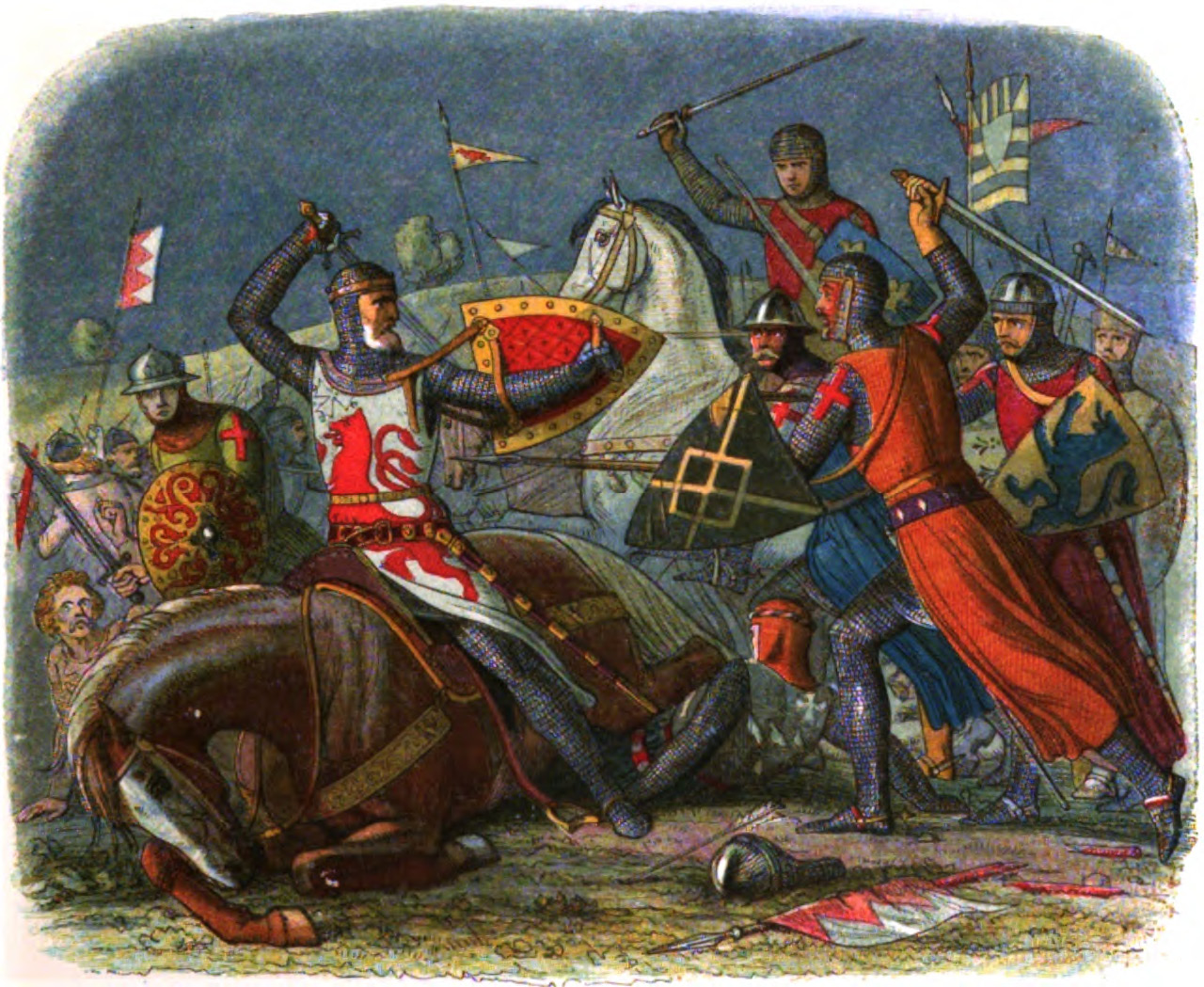
The death of Simon de Montfort at Evesham. Chromolithograph after James William Edmund Doyle, A Chronicle of England, 1864. Public domain, Wikimedia Commons.
For the next year, Simon governed England in Henry's name through a council he led, while Eleanor, who held Odiham Castle in Hampshire as part of her dower lands, made it her principal residence. Simon effectively controlled Odiham as well for a time. In December 1264, he summoned a Parliament that opened at Westminster on January 20th, 1265. Along with the barons and senior churchmen, it included two knights from each county and two burgesses from major towns such as York, Lincoln, and Sandwich, and from the Cinque Ports. Because it brought knights and townsmen together, it is often called the first representative Parliament, and Simon is sometimes called a founder of the House of Commons. Some historians caution that most of those present were his supporters, which made it a partisan assembly rather than a democratic one.
Under the Mise of Lewes, Prince Edward and his cousin Henry of Almain were handed over as hostages. Edward was moved between Dover, Wallingford, and Kenilworth Castle, where he was treated honorably because Simon's wife Eleanor was his aunt. In early 1265, his confinement was eased, and he was moved to Hereford under the watch of Simon's son Henry.
Simon's coalition was already coming apart. Gilbert de Clare, Earl of Gloucester, quarreled with Simon's sons and went over to the royalists. On May 28th, 1265, Edward was allowed to ride outside the walls of Hereford. He tired out his escorts' horses by racing them one after another, then mounted a fresh horse and galloped away to Roger Mortimer's men, who were waiting nearby and took him to Wigmore Castle. There, Edward joined forces with Gilbert de Clare and began raising an army. The Marcher lords rallied to him, and he trapped Simon in Wales. Edward then routed the army of Simon the Younger outside Kenilworth Castle and took its banners.
On August 4th, 1265, Simon was camped at Evesham, waiting for his son, when an army approached under his son's banners. Too late, he realized it was Edward's. At the Battle of Evesham, his smaller army was trapped and quickly overwhelmed. Edward and his allies, including Gilbert de Clare and Roger Mortimer, are said to have chosen a squad of about a dozen trusted knights to cut through the fighting, reach Simon, and kill him rather than take him prisoner. Simon's eldest son Henry was killed early in the fighting, and Simon is reported to have said that it was time to die. He kept fighting on foot after his horse was killed. According to contemporary accounts, Roger Mortimer forced his way to him and delivered the fatal blow, a lance thrust through the neck, and one account says Mortimer could be recognized by his armor. Simon's last words are traditionally given as "Thank God." Peter de Montfort and Hugh le Despenser also died on the field. The royalists mutilated his body. His head was sent to Wigmore Castle as a gift for Mortimer's wife, Maud, and his hands and feet were sent to other places. The canons of Evesham Abbey buried what remained before the high altar, and Henry III later had the remains moved to a secret place, probably the abbey crypt.
Despite an official ban, a popular cult grew up around Simon's grave. The abbey recorded about 200 alleged miracles in a "miracle book," and pilgrims continued to visit until about 1280. Evesham Abbey was destroyed at the Dissolution of the Monasteries, and a memorial stone was laid on the site in 1965. After the Siege of Kenilworth Castle in 1266, Simon the Younger and his brother Guy escaped to Italy, where in 1271 they murdered Henry of Almain to avenge their father. Simon's daughter Eleanor married Llywelyn ap Gruffudd, Prince of Wales, and died in childbirth in 1282.
Simon's reputation is complicated. He is remembered as a champion of representative government, and De Montfort University in Leicester is named for him. A statue of him stands on the Haymarket Memorial Clock Tower in Leicester, and a relief of him hangs in the chamber of the United States House of Representatives. His rule lasted just over a year. His record also includes the expulsion of the Jewish community from Leicester in 1231, which he ordered as earl. He later ordered or tolerated the cancellation of debts owed to Jews, often by the violent seizure of their records, and his supporters carried out massacres of Jewish communities in places including London, Worcester, and Derby. In 2001, Leicester City Council formally rebuked him for his treatment of the Jews.