Peter de Montfort
Peter de Montfort was a 13th century English Nobleman, magnate, soldier, and diplomat. He is best known as the first recorded presiding officer (prolocutor) of the English Parliament, now known as the Speaker of the House of Commons.
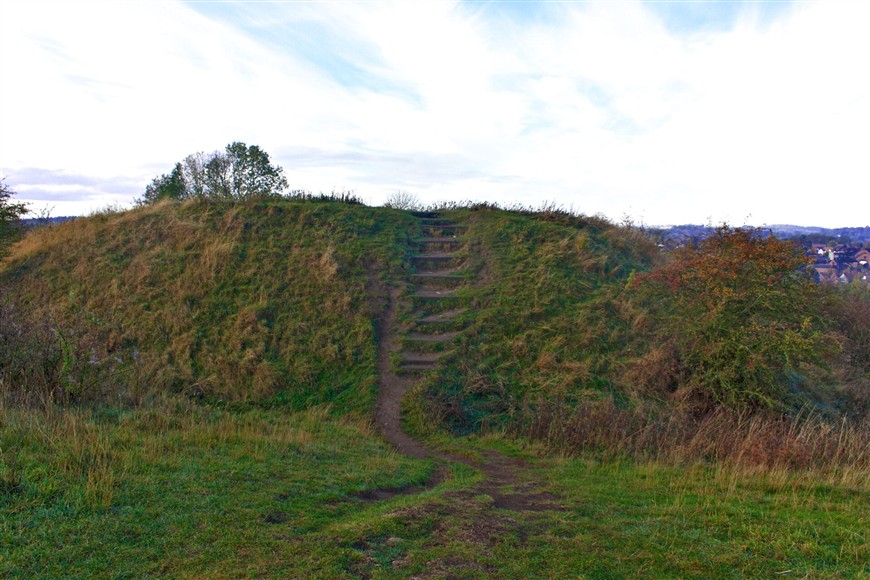
The motte at Beaudesert Castle, Henley-in-Arden. Photo by Paul Buckingham, Wikimedia Commons, CC BY-SA 2.0, resized.
Peter was born around 1205 in Beaudesert, Warwickshire, England. His father was Thurstan de Montfort, 4th Lord of Beaudesert. His mother was Mabel de Montfort, whose father was William de Cantilupe.
Montfort's principal estate was Beaudesert Castle, where he is thought to have fortified the inner bailey with stone walls.
When his father died in 1216, Peter was a minor, and King John granted his wardship to his maternal grandfather, William de Cantilupe. During this period, Peter formed a lasting friendship with his uncle, Walter de Cantilupe, Bishop of Worcester, who was William's son.
In 1242, Peter de Montfort joined King Henry III's expedition to Poitou. Earlier, he had participated in a forbidden tournament at Cambridge, resulting in the loss of his lands as a penalty; these were restored in 1245.
Beaudesert Castle was just nine miles from Kenilworth Castle, the main seat of Simon de Montfort, with whom Peter had a close, long-standing association. Peter, although not directly related to Simon, attested several of his charters. In 1248, Peter was a member of Simon's retinue while Simon served as Seneschal in Gascony. By 1251, Peter had returned to England and was granted custody of Horston Castle in Derbyshire, but he soon went back to Gascony. Peter and Simon remained close allies throughout their lives.
Peter accompanied Prince Edward, the future Edward I, to Spain for Edward's marriage to Eleanor of Castile in 1254. In the same year, he acted as surety at Bordeaux for the king's debts. Subsequently, he undertook diplomatic missions for King Henry III until 1257, when he became a member of the royal council and was appointed High Sheriff of Shropshire and Staffordshire in the Welsh Marches.
In April 1258, Peter de Montfort was among seven magnates who revolted against King Henry III. He was also one of twelve who drafted the Provisions of Oxford and sat on the council of fifteen established to rule England in the king's name.
He presided over Parliament at Oxford in 1258, which was called the "Mad Parliament" by the king's supporters. As a result, he became the earliest recorded presiding officer of the Commons.
On April 12th, 1261, Pope Alexander IV issued a papal bull freeing Henry III from his oath to uphold the Provisions of Oxford. Peter was one of three baronial representatives elected to negotiate with the king.
As Peter's influence with the barons grew, the Sheriff of Warwickshire was ordered to stop him from fortifying Beaudesert Castle. Peter joined the barons in attacking Worcester, which fell in February 1263. In July, peace was arranged, and Peter was given charge of Corfe and Shirburn castles.
In March 1264, civil war broke out in England. Peter de Montfort sided with Simon de Montfort and the barons against the king. On April 3, Peter and his two sons were at Northampton Castle when its Keeper surrendered it to Simon de Montfort the Younger. Two days later, the king retook the castle at the Battle of Northampton, starting the Second Barons' War. Peter and his sons were captured and held at Windsor Castle, but were released after Simon's victory at the Battle of Lewes on May 14, 1264.
As Simon de Montfort gained power, Peter became one of nine council members forced upon the king in June 1264. Later, on November 16, he and his heirs were granted the manor of Garthorpe, and on December 20, he received custody of Hereford Castle and Whittington Castle.
He accompanied Simon de Montfort into Wales, where he also jointly kept the royal seal during that campaign.
Peter de Montfort was with Simon de Montfort on their final campaign; both died at the Battle of Evesham on August 4, 1265. Peter's two sons also fought, were wounded, and taken prisoner.
The final chapter of Peter de Montfort's life remains a mystery, as his burial place is unknown.
