Burg Rheinstein
History
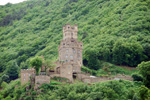
Situated on a rocky ridge, Burg Rheinstein rises approximately 270 feet above the River Rhine in the Loreley Valley. Originally built as a toll castle, it was called the Vogtsburg or Feitsburg. The castle is first mentioned as a possession of Mainz in 1323, and it was built in the early 14th century under Archbishop Peter von Aspelt as a counter-fortification to nearby Burg Reichenstein, which King Rudolph of Habsburg had destroyed in 1286 after it was used as a robber baron's nest of the Lords of Hohenfels.

While Reichenstein was being rebuilt, Mainz built Rheinstein farther south to keep control of the Rhine, and it also built Burg Heimburg for the same reason, to counter Burg Sooneck. The oldest timbers in the south wall have been dated to 1316-17.
A second period of building was undertaken at the castle around 1330. But, by 1344, Burg Rheinstein began to lose its strategic importance in the region when the Electoral Palatinate renounced Reichenstein in favor of Mainz.
From the 14th century on, the Archbishops of Mainz granted the castle as a fief to a series of lords, including Konrad von Falkenstein in 1348, later Archbishop of Trier. In 1572, when the castle had long since lost its importance, it passed to the Mainz cathedral custos and chamberlain Anton von Wiltberg. The castle was never destroyed by an attack, but from the 17th century on, it gradually decayed.

The castle above the Rhine.
On March 31st, 1823, the castle ruin and its foundation stone were purchased for 100 talers by Friedrich Wilhelm Ludwig, Royal Prince of Prussia, a nephew of King Friedrich Wilhelm III and a cousin of the later King Friedrich Wilhelm IV. It was the southernmost castle ruin in the Rhineland, which had become part of Prussia in 1815 as the Rhine Province. The architect Karl Friedrich Schinkel had taken an interest in the ruin, and the castle was rebuilt from 1825 under the direction of the famous architect Claudius von Lassaulx and, from 1827, his pupil Wilhelm Kuhn, who completed the rebuilding in 1829. It was the first Rhine castle rebuilt from a ruin, an early example of Rhine Romanticism. The castle was renamed Burg Rheinstein due to its imposing rocky location above the River Rhine.
In 1842, the castle became a favorite residence of Prince Frederick, who hosted many heads of state at the castle, including Queen Victoria of England and Empress Alexandra Feodorovna of Russia. Plans were also drawn up for the chapel and crypt, which would be built within two years. Prince Frederick died in 1863 and was buried in the crypt, where his wife Luise and their son Georg were later laid to rest. The castle then passed through the Hohenzollern family, including Prince Heinrich of Prussia, brother of Kaiser Wilhelm II, in 1902, and ended with Princess Barbara of Prussia in 1953.
In 1973, Princess Barbara put the castle up for sale. A supposed English buyer tricked her and removed and sold some of the furnishings, and the state of Rhineland-Palatinate refused to buy the damaged castle because the restoration costs were too high. Since 1975, Burg Rheinstein has been privately owned by the Hecher family. The Austrian-born opera singer Hermann Hecher, who died in 2021, repaired and restored the castle over many years, with the support of the state monument office, to regain its glory from days long ago. The castle has been part of the Upper Middle Rhine Valley UNESCO World Heritage Site since 2002.
Castle Highlights

The chapel.
Burg Rheinstein possesses a working drawbridge and portcullis, illustrating medieval construction and defense. Upon entering the castle and walking past the gift shop down to an opening on the left, the courtyard may be visited, which offers a spectacular view of the River Rhine. Burg Rheinstein's courtyard is known as the "Burgunder-Garden," named after the growing Burgundy grapevine. The vine, which is approximately 500 years old, still produces grapes, and the garden is part of the Route of World Heritage Gardens. A lookout tower, the Rheinturm, offers views over the Rhine valley.
From the garden, steps lead down to the chapel. In the center of the Gothic altarpiece of the chapel exists a woodcarving depicting Jesus at the Last Supper. Between the rock and chapel, additional steps lead down to the royal crypt of Prince Friedrich Wilhelm Ludwig's family.

The Rittersaal, or Knight's Hall.
Heading upwards to the Burgunder-Garden, another set of steps leads to the central portion of the castle. The largest and most impressive room of Burg Rheinstein is located at the top of the stairway to the left once inside the castle. The "Rittersaal" or "Knight's Hall" includes beautiful stained glass windows and three-dimensional paintings. There are no guided tours, as visitors explore on their own with a floor plan, and Burg Rheinstein has a restaurant for ticket holders and a gift shop offering miniature handmade wooden treasure chests and traditional items, including postcards and guidebooks for purchase. In the weeks before Christmas, the castle is decorated in the style of the 19th century for its "Fairytale Christmas Castle" event.
The owners also rent out three double rooms with views of the Rhine for overnight stays.
Burg Rheinstein has a legend.