Burg Klopp
History
Burg Klopp was probably built in the middle of the 13th century, in the time of Siegfried III of Eppstein, the Archbishop of Mainz, to exact tolls on river trade on the Rhine, along with Burg Ehrenfels and the Mausturm, which was added in the 14th century. Tradition places an old Roman fortification on the Burgberg (Castle Hill) above Bingen on the Middle Rhine, said to have been built by Nero Claudius Drusus around 10 BC, and the castle was once called the Drususburg, but a Roman origin is considered very unlikely.

In 1240, Kloppberg was mentioned as the residence of a churchman, and in 1277, Burg Clopp was first mentioned.
During the Tariff War of 1301, troops of King Albrecht I of Habsburg besieged and conquered Bingen, and the castle surrendered after fire made further defending the castle pointless. This broke the power of the Rhenish electors for some years and forced them to remove the customs duties levied along the River Rhine. After Albrecht was assassinated in 1308, the customs duties began again.
In 1438, Archbishop Dietrich Schenk von Erbach sold the town of Bingen and the castle to the Mainz Cathedral Chapter, and the castle then served as a fortress to keep the townspeople, who wanted independence, under control. It was destroyed during the Thirty Years' War and was rebuilt in 1653.

The keep and gatehouse.
Burg Klopp was home to the knights of the archbishop of Mainz until its destruction in 1689 by French soldiers of Louis XIV in the War of the Palatine Succession. In 1711-1713, the Mainz garrison demolished the castle's remains to prevent it from being used as a base by the enemy in the final phase of the War of the Spanish Succession.
In the early 19th century, the lawyer Hermann Faber bought the ruin, built a stairway and a viewing room, and laid out a garden, and the castle became a major sight of the Romantic Rhine. Starting around 1853, the gatehouse, bridge across the moat, and castle fortifications were restored in the Neo-Gothic style of 15th century Rhine castles for the Cologne shipowner Ludwig Maria Cron. The keep or bergfried was rebuilt as a crenelated tower standing 125 feet high. Between 1875 and 1879, the architect and former Bingen mayor Eberhard Soherr built the Neo-Gothic main building as a summer residence. The base of the keep, moat, and portions of the southern curtain wall are all that's left of the medieval fortifications.

The Neo-Gothic main building.
The town of Bingen bought the castle in 1897, and the castle served as the town hall and a folk museum, which moved to a former power station on the waterfront in 1998. Burg Klopp suffered damage in 1944 during World War II, and repairs were carried out between 1952 and 1953.
Castle Highlights
Burg Klopp sits majestically above Bingen, overlooking the River Rhine. A ring wall surrounds the castle, and the keep is separate from the other buildings that share a courtyard. The castle grounds contain a restaurant, and the main building houses offices of the Bingen city administration. According to the city and the Upper Middle Rhine World Heritage site, the courtyard is open year-round, and the keep can be climbed from April to October for views over the Rhine valley and a small exhibition on the castle's famous visitors. The coat of arms of the Cathedral Chapter of Mainz can be seen above the gatehouse entrance.

The coat of arms of the Mainz Cathedral Chapter.
There are small car parks a few streets from the castle, but it's easier to park near the river in Bingen and walk up to the castle. The best views of the castle are from the river. Bingen is a great starting spot for the cruises that go up and down the river. Start in Bingen and head towards Koblenz. When you get as far up the river as the Marksburg, take a different boat heading back towards Bingen or get off at one of the left bank stops like Boppard and return to Bingen by train. A round-trip boat ride can take all day, while a one-way boat ride and train ride takes about 3 to 4 hours.
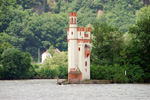
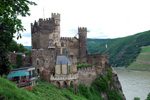
The Burg Ehrenfels is just across the river from Burg Klopp, and the Mausturm is on an island between the two castles. The closest castle to Burg Klopp that visitors can tour is Burg Rheinstein, just up the B9 from Bingen.