Burg Ehrenfels
History
Burg Ehrenfels is located on a protruding quartzite rock halfway up the hillside on the right bank of the River Rhine between Rüdesheim and Assmannshausen. There was already a tower on this site in the 12th century, belonging to Mainz's diocese since 983.
Philipp von Bolanden began to build the central castle in 1208 until he died in 1218, in the name of Archbishop Siegfried II of Eppstein of Mainz (some sources date the main building to about 1211-1212). The castle was meant as a defensive bulwark, because Mainz territory was under attack during the dispute over the German throne between Philip of Swabia and Otto IV, including raids by the Count Palatine. His widow Beatrix completed the building in 1220. Philipp had paid for the castle himself, but when Beatrix married Dietrich von Heinsberg, Mainz claimed it. The castle was first mentioned in 1222 in documents from a court judgment that ordered the widow to hand over Burg Ehrenfels to Siegfried II due to the estate rights of the archbishop.

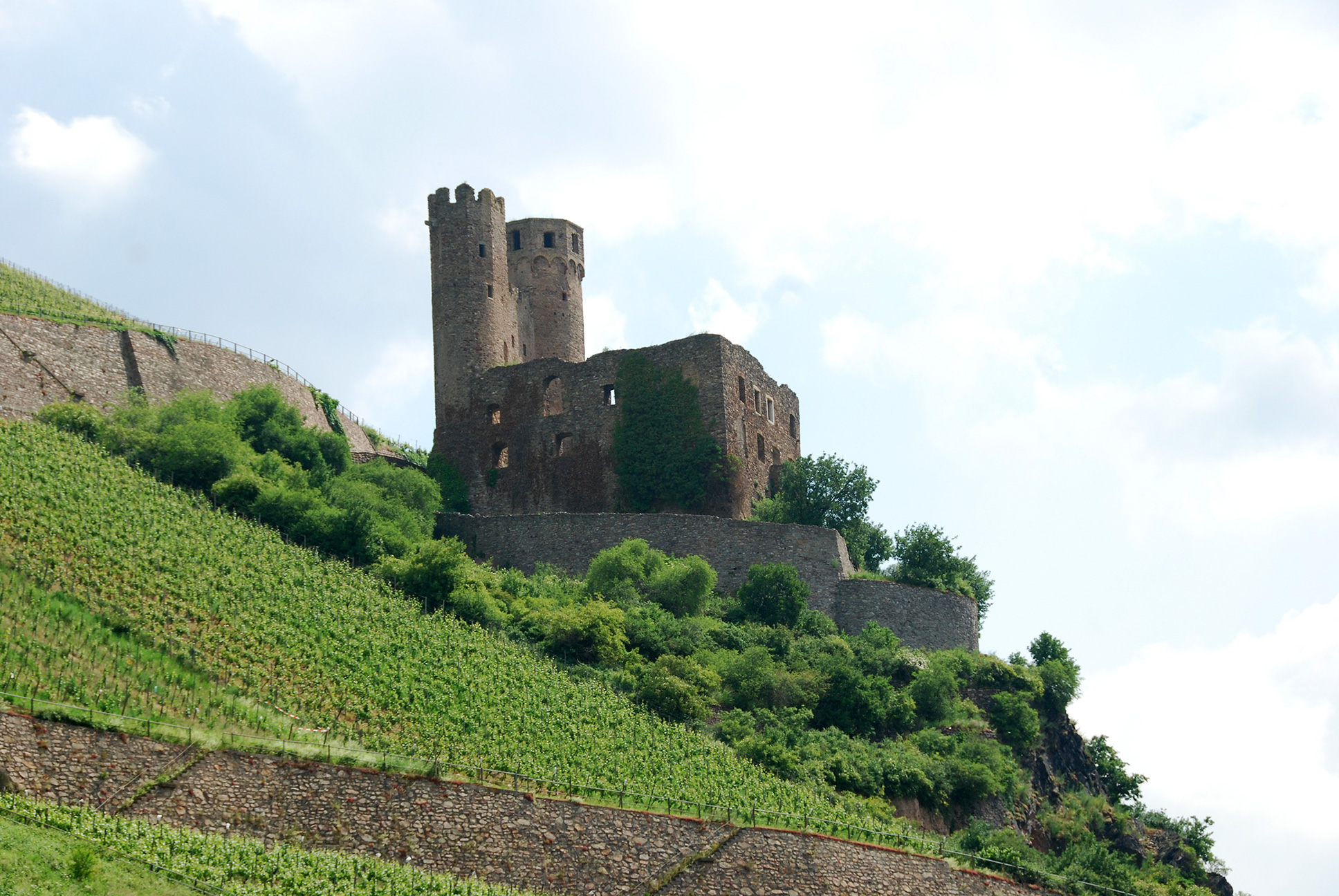
Burg Ehrenfels on its rock above the vineyards.
By the mid-13th century, Burg Ehrenfels was a Rhine toll station for Mainz, with the actual customs post on the riverbank. Toll rights were contested at times, but with the recognition of the toll rights by King Adolf in 1298, Burg Ehrenfels, with its bank fortification and supplemented by the Mäuseturm, collected toll duties from ships passing on the Rhine, which continued for centuries. Together, the two controlled the narrow and hazardous stretch of the river known as the Binger Loch, and only certain exempt nobles avoided the fees. The archbishops of Mainz also used the castle as a stronghold, a temporary residence, and a refuge for the archbishop and the cathedral treasure, and they garrisoned it with castle men, or Burgmannen. During the Rhenish Toll War in 1301, Archbishop Gerhard II used it as a stronghold against King Albrecht I.
In 1353, during the second Mainz Church Dispute, the castle was pledged to Kuno II von Falkenstein, Cathedral provost of Mainz, who expanded it significantly. He enlarged the central castle, added a three-story building with a chapel in the outer ward, improved the great hall, and raised the towers. Archbishop Gerlach of Nassau retook the castle by force in 1356, amid accusations against Kuno, and used it as a secondary residence. Further changes were made in the 15th and 16th centuries, which saw the raising of additional stories to the main castle and the addition of gardens, an outer ward, and a new ring wall.
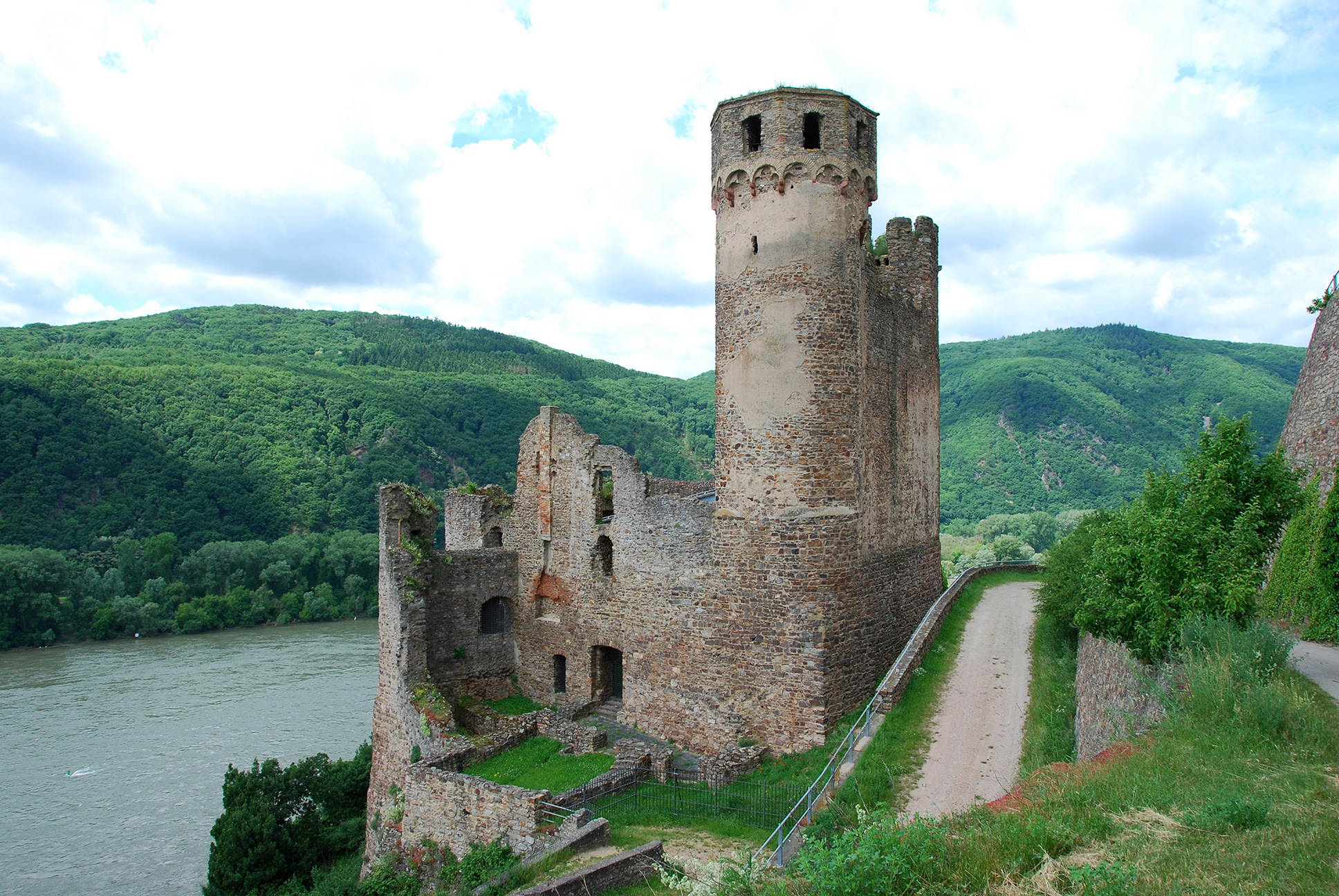
The towers of Burg Ehrenfels, with the Rhine below.
The castle was occupied and besieged several times by imperial and Swedish soldiers from 1631 during the Thirty Years' War (1618-1648), and the Swedes did some damage around 1635, but it survived without being destroyed. An order by the archbishop to destroy it in 1636, to deny it to plunderers as a base, was never carried out. However, during the Palatinate War of Succession, it was occupied by Louis XIV troops in October 1688, and when they withdrew, on May 30th, 1689, the castle was blown up and set on fire by the French, whose army was commanded by Marshal Nicolas Chalon du Blé, Marquis d'Huxelles, and left in a ruinous state.
After the ruin was abandoned, the estates around it were sold, and parts of the outer works were removed for vineyard terraces. With the secularization of church lands in 1803, it became Nassau domain property, and in 1866, it fell to Prussia. Since 1945, Burg Ehrenfels has been the property of the state of Hesse, which conducted extensive repair work, including major efforts from 1990 to 1995, to keep the ruin from decaying further. Since 2002, it has been part of the UNESCO World Heritage site of the Upper Middle Rhine Valley.
Castle Highlights

The shield wall and towers of Burg Ehrenfels.
The most impressive parts of the castle are the two round towers flanking the shield wall on the side of the castle facing the mountain. The shield wall is 4.6 meters thick and 20 meters high, and the two corner towers rise 33 meters. Circling walls enclose the great hall, courtyard buildings, and cistern on the river side of the castle, and the remains of a gatehouse also survive.

The footpath along the castle wall.
Burg Ehrenfels is closed to the public, and its courtyard is gated, partly because peregrine falcons nest there, but you can walk up close to the castle along footpaths in the vineyards from Rüdesheim or Assmannshausen. I found it a worthwhile walk to see the castle's towers from behind the castle. The best views are from the River Rhine from one of the River tour boats.
If you choose to do the walk, it will take an hour or two. You can take a water ferry from Rüdesheim across to Bingen and visit Burg Rheinstein the same day should you want to see the inside of a Rhine Castle. The castle also gave its name to the Ehrenfelser grape grown in nearby vineyards.