Burg Reichenstein
History
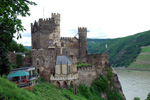
Burg Reichenstein, also known as Falkenstein, is a historic Rhine castle in Trechtingshausen, Germany, known for its medieval robber knight associations, sieges, and neo-Gothic restoration.

In the 9th century, Ludwig the Pious gave the area to Kornelimünster Abbey. To protect their land and property, Burg Reichenstein and Burg Sooneck were built in the 1100s and assigned governors. The name Burg Reichenstein is said to derive from "Castrum Richenstein," referring to its builder, Richwin.
One early governor was the knight Rheinbodo von Bingen and his progeny. One of them, Gerhard von Rheinbodo, who lived at Burg Reichenstein, was an unfaithful steward. Unbridled and greedy, he became a robber knight and ravaged the area with help from his castle guards. In 1213, he was disposed as governor.
The earliest documented record of Burg Reichenstein dates to April 2nd, 1214, when Philip von Bolanden, his successor, was invested in the castle and swore an oath of allegiance to the Abbey. He also built the nearby Burg Ehrenfels.
In 1241, the castle passed to Philipp von Hohenfels, who also became an infamous robber knight. He and his castle guards robbed merchants, plundered boats along the River Rhine, did not shy away from murder, and mistreated the people he was ordered to protect. In 1245, the Abbot of Kornelimünster asked Archbishop Siegfried III of Mainz to "take over the protection of his possessions."
In 1253, the Rhenish Town Alliance assembled an army and besieged the castle. Philipp von Hohenfels surrendered, vowed to be a good steward, and took an oath of allegiance to the king, and his life was spared. But this did not last long, and he refortified Burg Reichenstein and extended the castle with further defenses.
On January 13th, 1257, Richard of Cornwall was elected King after his rival, William of Holland, met his demise on the battlefield in 1256. Richard elevated Philipp von Hohenfels to the high office of Imperial Vicar. Philipp continued as a robber knight and now helped himself to church property, wearing out the patience of the Archbishop of Mainz, who put him under a church ban. Philipp again promised to better himself in 1267.
In 1273, Rudolf I of the House of Habsburg was elected King and intended to end the robber knights' engagements along the Rhine. He and his army rode to Reichenstein and besieged the castle, but were unable to take the well-fortified stronghold by a storm attack. He then decided to starve the castle garrison with a prolonged siege. In 1282, starving and weak, the garrison surrendered. Dietrich von Hohenfels was beheaded, the castle guards were hanged on tree branches, and the castle was burned to the ground. Dietrich von Hohenfels is said to haunt the castle. In 1290, King Rudolf forbade the rebuilding of Burg Reichenstein for all eternity.
Despite the eternal ban, the castle was rebuilt relatively soon. Around 1344, the Counts of Palatine handed the ruins to the Electorate of Mainz. They built a new main castle with a double curtain wall, inner courtyard, rectangular tower, and an outer bailey, which was completed by 1349.
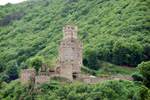
With the introduction of new weapons, the castle's defenses lost much of their military value, and it began to fall into decay in the 16th century. It was further destroyed during the Palatine War of Succession in 1689.
In 1834, Franz Wilhelm von Barfus bought the ruins and converted a tower into a residence. In 1877, his heirs sold the castle to Baron von Rehfuß, and in 1889, it was sold to Consul Chosodowsky.
From 1899 to 1902, the castle was rebuilt in the neo-Gothic Tudor style by Baron Nikolaus von Kirsch-Puricelli during the Rhine Romanticism period, when many Rhine castles were being restored. Reichenstein was the last castle in the Upper Middle Rhine Valley to be rebuilt.
In 2014, the castle was purchased by Lambert Lensing-Wolff, who used it as a weekend residence.
Castle Highlights
Burg Reichenstein is a beautiful castle with great views of the River Rhine with lots to see and explore. The best views of the castle are from the river.
The castle is accessed through the Gate Tower, flanked by two circular towers. Beyond that lies the narrow castle courtyard, with cannons facing the river. The cannons are of French origin and fell into German hands after the 1870/71 war.
The residential building is the main part of the castle. The castle museum starts in the courtyard and continues in the castle on the ground floor and the next three levels of the residential building.
The Weapons Chamber contains arms and armor from five centuries. In direct view are four Landsknecht (German mercenary) suits of armor from the 15th and 16th centuries. The cavalry helmet, a so-called zischägge or Pappenheimer, is from the Thirty Years' War. Along the right wall are cuirasses, helmets, and sabers of the bodyguards of the last French Emperor, Napoleon III. The gun stand houses 17 front-loading guns.
The Knights Hall features the gallery of ancestors. After the restoration, it was adorned with richly ornamented wood paneling. The paintings are of the Puricelli family from the 18th and 19th centuries. The young man in the dark blue and gold braided morning suit is Frederick Wilhelm Utsch, the "Jäger aus Kurpfalz" (Hunter from the Electoral Palatinate). The huge painting on the next wall shows the death of the Swedish King Gustav Adolf at the Battle of Lützen during the Thirty Years' War. The chandelier is made of the clock face of an old church tower clock with Roman numerals.
The library features a carving of St George's fight with the dragon above the door. The room also has large carved oak beams along the ceiling. The library's walls are lined with bookshelves that hold over 4,000 books from the 18th to the 20th centuries. The oldest book in the library is a "Xenophon" printed in 1572. Beside the book is a skull, said to be that of the last robber-knight of Burg Reichenstein.
Besides visiting the castle and museum, there is also a hotel and restaurant within the castle complex. The castle can also host weddings.
You can spend two hours or more visiting Burg Reichenstein. To fill a day of castles on the Rhine, Burg Sooneck and Burg Rheinstein are both on the same side of the river as Reichenstein.
Burg Reichenstein is also haunted.