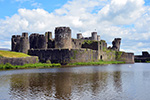
Ogmore Castle / Castell Ogwr
History
Situated on the south bank of the River Ewenny, Ogmore Castle was one of three Norman castles (along with Coity and Newcastle) built in the 12th century to guard Glamorgan against attacks from the Welsh in the west.

The construction of Ogmore Castle began in 1106 as a ringwork castle. The foundations of the site may even date from before the Norman invasion, and archaeologists have found parts of two stone crosses there. According to the Historie of Cambria (Now Wales) by Caradoc of Llancarfan, the manor and castle were given to William de Londres, one of the legendary Twelve Knights of Glamorgan, by Robert FitzHamon, the Norman conqueror of Glamorgan.
In 1116, William de Londres fled the castle as Welsh forces appeared. His butler, Arnold, protected the castle from the Welsh attack and was later knighted as Sir Arnold Butler, receiving Dunraven Castle as a reward for his bravery.

The keep and the inner gate-tower arch.
Around 1120, William's son Maurice built the oblong stone keep, which is perhaps the oldest Norman keep in Glamorgan. In the early 13th century, a second story with private apartments was added to the keep.
William de Londres or his descendant, John, founded Ewenny Priory, located about a mile from the castle, in 1141. Thomas de Londres replaced the wooden palisade walls with a stone curtain wall around 1200. In 1298, Ogmore Castle passed through marriage to Henry, 3rd Earl of Lancaster, and through his descendants, including his son Henry of Grosmont, the 1st Duke of Lancaster, it remains in the hands of the Duchy of Lancaster.

The ruins of the courthouse.
A courthouse was added in the 14th century. After being damaged during Owain Glyndwr's revolt, a new courthouse was built in 1454 in the castle's outer bailey and remained in use until at least 1631.
Ogmore Castle was taken into state care in 1928 and is now in the care of CADW (Welsh Historic Monuments).
Castle Highlights
The ruins of Ogmore Castle are small but beautifully set along the banks of the River Ewenny. The original banks and ditches can still be seen, including a moat that fills with sea water at high tide. It's free to visit almost every day except a few days around Christmas and New Year's.
The most impressive part of the castle today is the remains of the keep, which still contain three walls, allowing the imagination to picture what it may have looked like intact. The keep included a first-floor hall, reached by an external staircase.

Ogmore Castle seen across the River Ewenny.
Enough of the earthworks and curtain walls remain around the inner bailey to identify the castle's footprint. The courthouse ruins are also substantial in the outer bailey area of the castle. A stepping-stone bridge spans the river, allowing for picturesque views of the castle from the opposite bank, although Cadw warns that the stones are slippery and uneven and advises against using them as a crossing.
The river is tidal, and the small car park, which holds about 20 cars, can flood at spring high tides. Sheep sometimes graze on the site, so please close the gates, and dogs on short leads are welcome on the ground floor. Please do not climb the ruins, because stones can fall in bad weather.
It will not take more than an hour or two to explore all of Ogmore Castle. Its two sister castles, Coity Castle and Newcastle Castle, are only a few miles away, providing a convenient way to fill the day.
Ogmore Castle is also haunted.