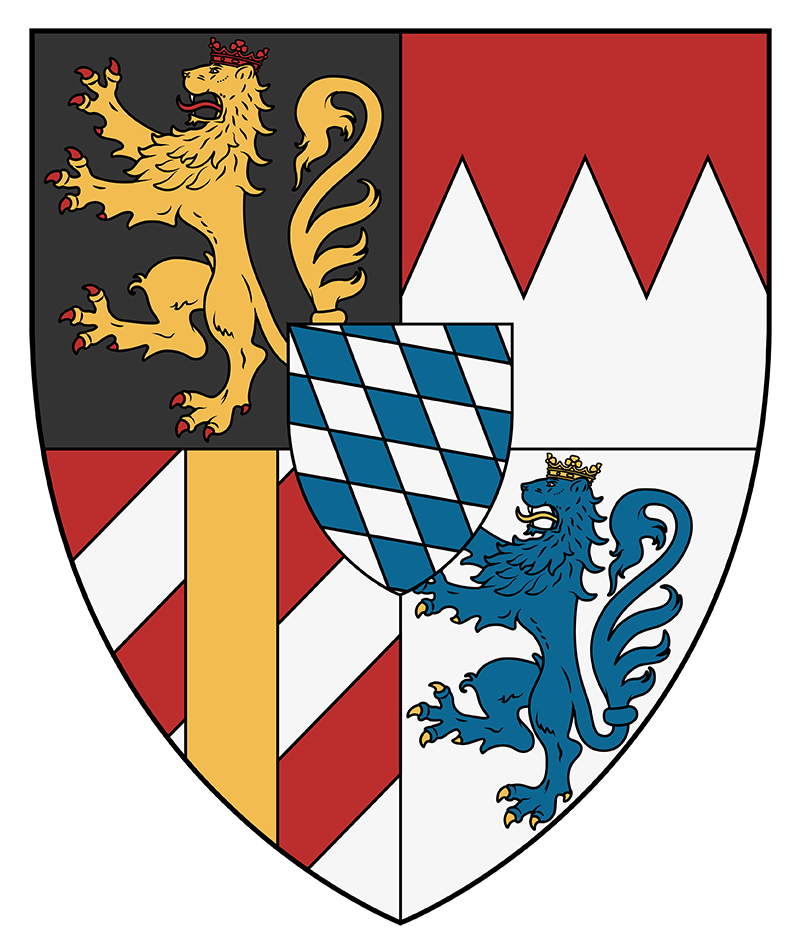
Ludwig II - King of Bavaria (1864-1886)
The Fairy Tale King
Ludwig II ruled Bavaria from 1864 to 1886 and is the best known of its kings. He came to the throne at eighteen, spent his reign building fairy-tale castles and sponsoring Richard Wagner's operas, and was deposed as insane at the age of forty. The next day, he was found drowned in Lake Starnberg, and the question of what happened there has never been settled. In Germany, he is called the Fairy Tale King, and elsewhere, he is often called Mad King Ludwig, though many historians now doubt that he was mad.

Schloss Neuschwanstein, begun by Ludwig in 1869 on a crag above his parents' castle.
Ludwig Otto Friedrich Wilhelm was born on August 25th, 1845, at Nymphenburg Palace in Munich, the elder son of Crown Prince Maximilian of Bavaria and Marie of Prussia. His parents meant to call him Otto, but his grandfather, King Ludwig I, insisted on Ludwig, because August 25th is the feast day of Saint Louis IX, a patron saint of Bavaria. Maximilian became King Maximilian II in 1848, and he wanted his sons raised strictly. Ludwig was not close to either parent. His father kept him under tutors and a rigid routine, and his mother's chatter irritated him so much that, once he was king, he called her "my predecessor's consort." He was closer to his grandfather. His younger brother, Otto, later became severely mentally ill, but Ludwig stayed fond of him.

Schloss Hohenschwangau, where Ludwig spent his boyhood summers.
The family spent their summers at Hohenschwangau, the castle in the Alps that Maximilian had rebuilt as a medieval romance, with wall paintings of German sagas that include the legend of Lohengrin, the Knight of the Swan. Ludwig took no interest in his father's hunting. He preferred to read, to ride and to act out scenes from the stories with his friends. He saw Wagner's Lohengrin at the age of fifteen, and Tannhäuser ten months later, and the operas stayed with him for the rest of his life. They also spent time at Berg Palace on Lake Starnberg, which became his favorite summer residence, and where he would die.
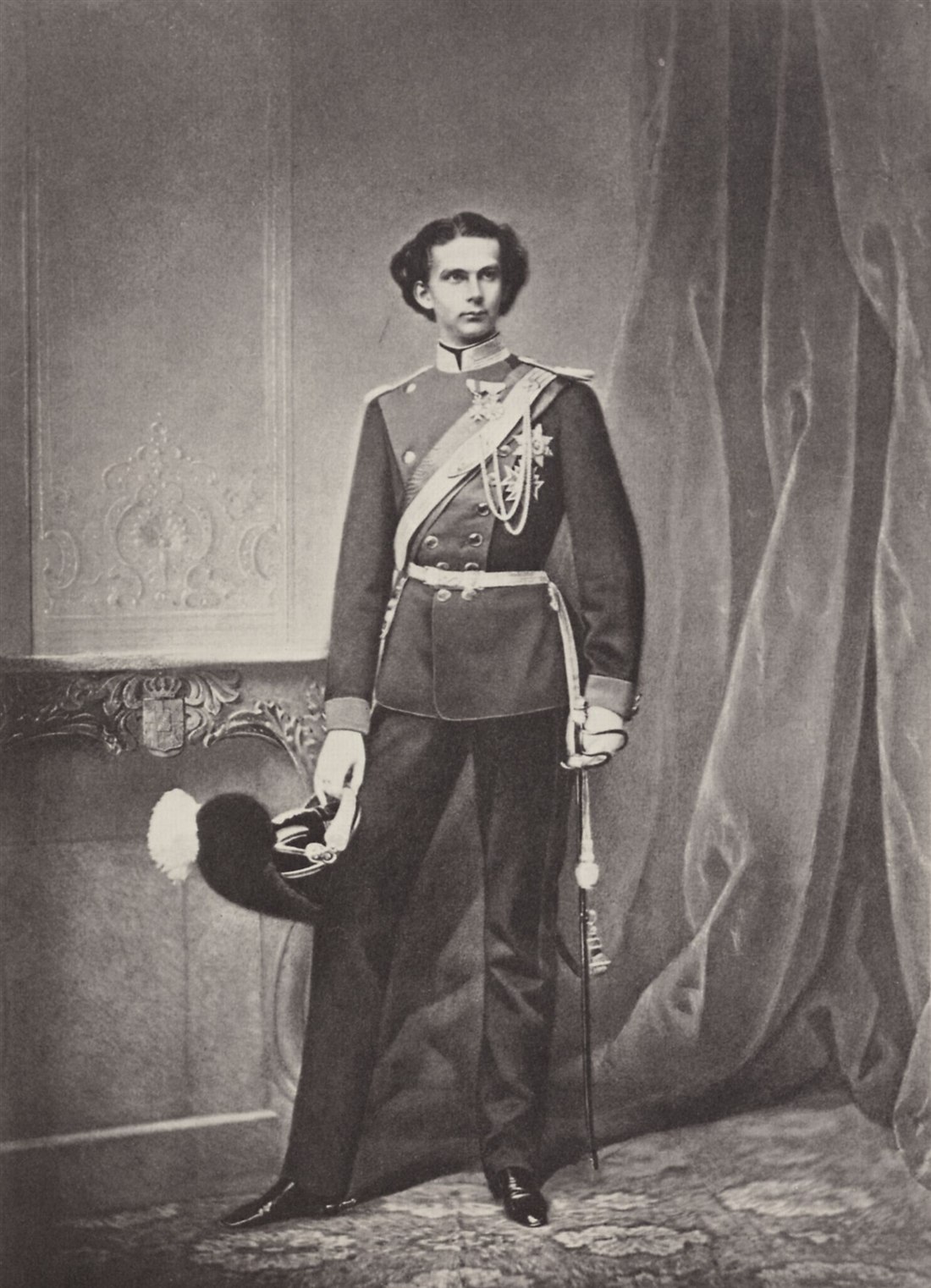
Ludwig II in about 1864, the year he became king. Photo by Joseph Albert, court photographer, from Wikimedia Commons, public domain, resized.
Maximilian II died, after a three-day illness, on March 10th, 1864, and Ludwig became king. He was six feet and four inches tall, and was popular for his youth and good looks. He kept his father's ministers, and his interests were art, music and architecture, not government. Less than two months after he became king, on May 4th, 1864, he received Richard Wagner, then fifty-one and deep in debt and on the run from his creditors. The audience lasted nearly two hours, and Wagner wrote that the king was "so handsome and wise, soulful and lovely." Ludwig paid his debts and supported him, and Tristan und Isolde was staged in Munich a year later. But Wagner's spending and his meddling in politics upset the Bavarian court, and in December 1865, Ludwig had to ask him to leave the city. He thought of abdicating to follow him, but was persuaded to stay. Wagner was given a house in Switzerland, which Ludwig visited in secret in 1866, and there he finished Die Meistersinger, which was first performed in Munich in 1868. When Wagner could not raise the money for his own festival theater at Bayreuth, Ludwig lent him 100,000 thalers, and he also paid for Wagner's villa, Wahnfried. Ludwig himself attended the dress rehearsal and the third performance of the complete Ring at Bayreuth in 1876, but he stayed away from the opening performances, when the German emperor and other monarchs were present.
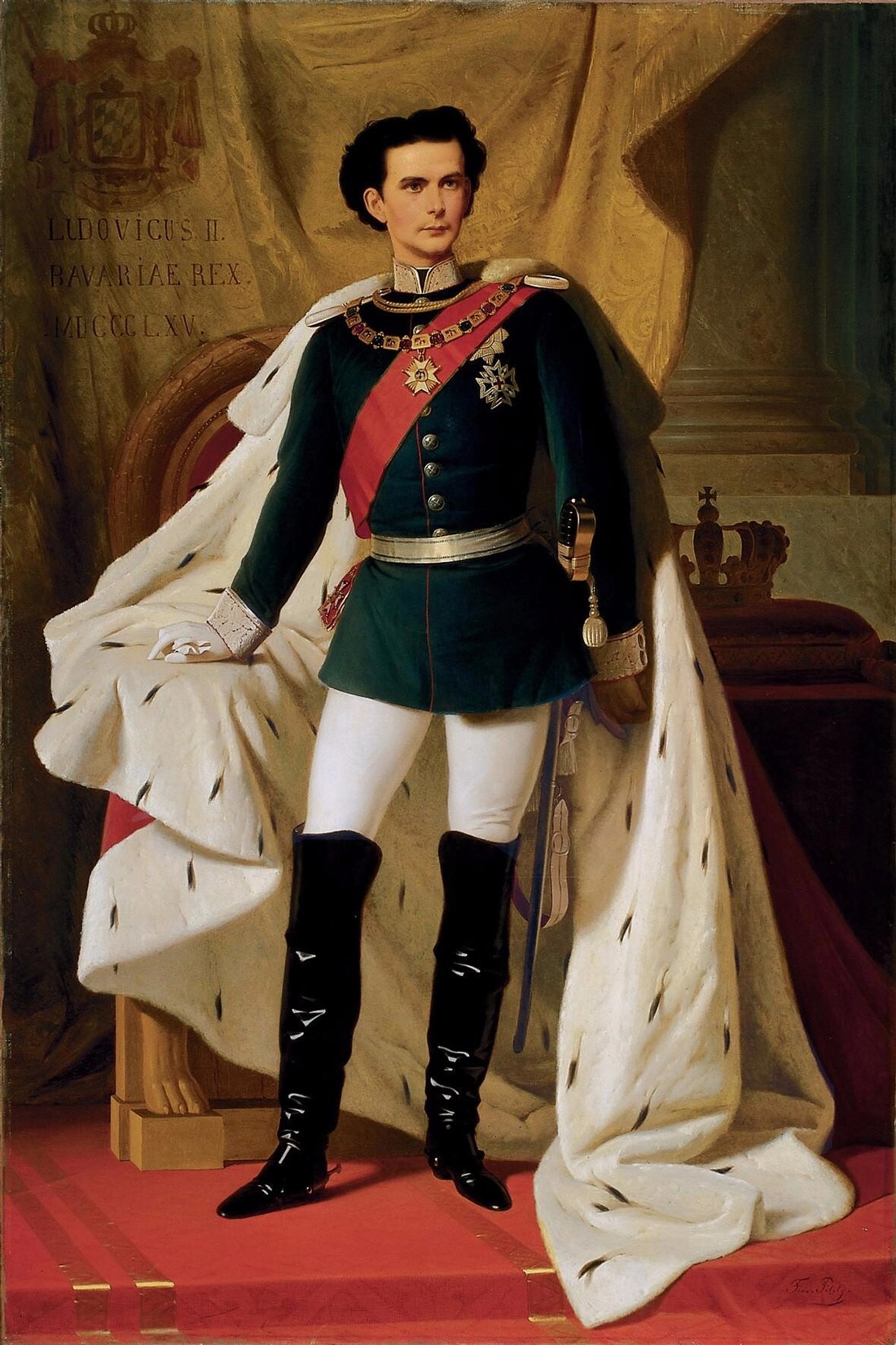
Ludwig in general's uniform and coronation mantle, painted by Ferdinand von Piloty in 1865. King Ludwig II Museum, Herrenchiemsee. From Wikimedia Commons, public domain, resized.
In January 1867, Ludwig became engaged to his cousin, Duchess Sophie in Bavaria, the sister of Empress Elisabeth of Austria. He wrote to her that the main basis of their relationship was Wagner's extraordinary fate, and he wanted what he called an "angelic marriage." He kept postponing the wedding, and at the engagement ball in February, he stayed for about an hour and then left. In October 1867, he broke it off in a letter that began "My beloved Elsa!" and was signed "Heinrich," after the characters in Lohengrin. Sophie later married the Duke of Alençon. Ludwig never married and had no known mistresses. His diaries and letters show that he was attracted to men, and that he struggled with feelings that his Catholic faith told him were sinful. The Empress Elisabeth, who remained his friend all her life, is supposed to have said that he was not mad, only "an eccentric living in a world of dreams."
Politics were not so easily ignored. In 1866, Bavaria fought on the losing side of the Austro-Prussian War, and it was forced into an alliance with Prussia. When war with France broke out in 1870, Bavaria had to fight beside Prussia, and in November 1870, it joined the North German Confederation, which ended its independence, though it kept its own army and diplomats in peacetime. In December, Bismarck used money to get Ludwig to sign a letter proposing that the Prussian king, Wilhelm I, be made German emperor. Ludwig refused to go to the proclamation at Versailles on January 18th, 1871, and he sent his brother and his uncle Luitpold instead. From 1873, Bismarck also paid him an annual subsidy of 270,000 marks from the sequestered fortune of the deposed king of Hanover, which was sent in secret through Swiss banks, and the payments helped to keep Ludwig from appointing a government hostile to Prussia. After 1871, he largely withdrew from public life. He held his last court banquet on February 10th, 1876, and he began to live at night and sleep during the day. Between 1872 and 1885, he commissioned 209 private performances for himself, or for himself and one guest, including twenty-eight operas by Wagner. He told the theater manager, "I want to look myself, not to be a spectacle for the masses."
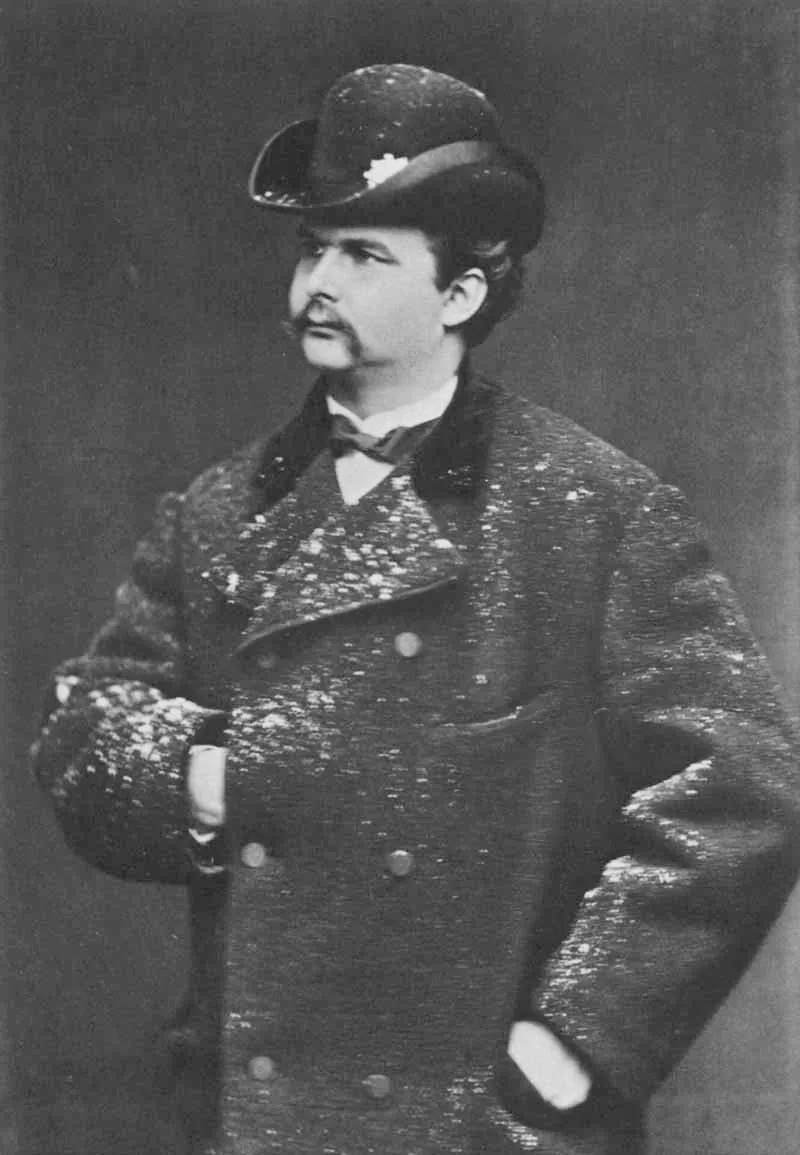
Ludwig II in about 1870, photographer unknown. A winter coat suits the king who rode through the snow by night. From Wikimedia Commons, CC BY-SA 4.0, resized.
Instead, he built castles. Neuschwanstein, above Hohenschwangau, was begun on September 5th, 1869, as a castle in the style of the old German knights, and was designed by a theater scene painter, Christian Jank, before the architects took over. Its rooms are painted with scenes from Wagner's operas, and Ludwig first moved into the finished rooms of the palace in May 1884. Only a part of it was ever completed, and the keep and chapel that he planned for the upper courtyard were never built. Then there was Linderhof, in a valley in the Alps, which was begun in 1869 and became a small Rococo palace in the style of the French kings Louis XIV and Louis XV, whose lives and buildings Ludwig studied closely. Louis XIV called himself the Sun King, and Ludwig called himself the Moon King, and he rode through the winter mountains at night in an eighteenth-century-style sleigh lit by an electric lamp.
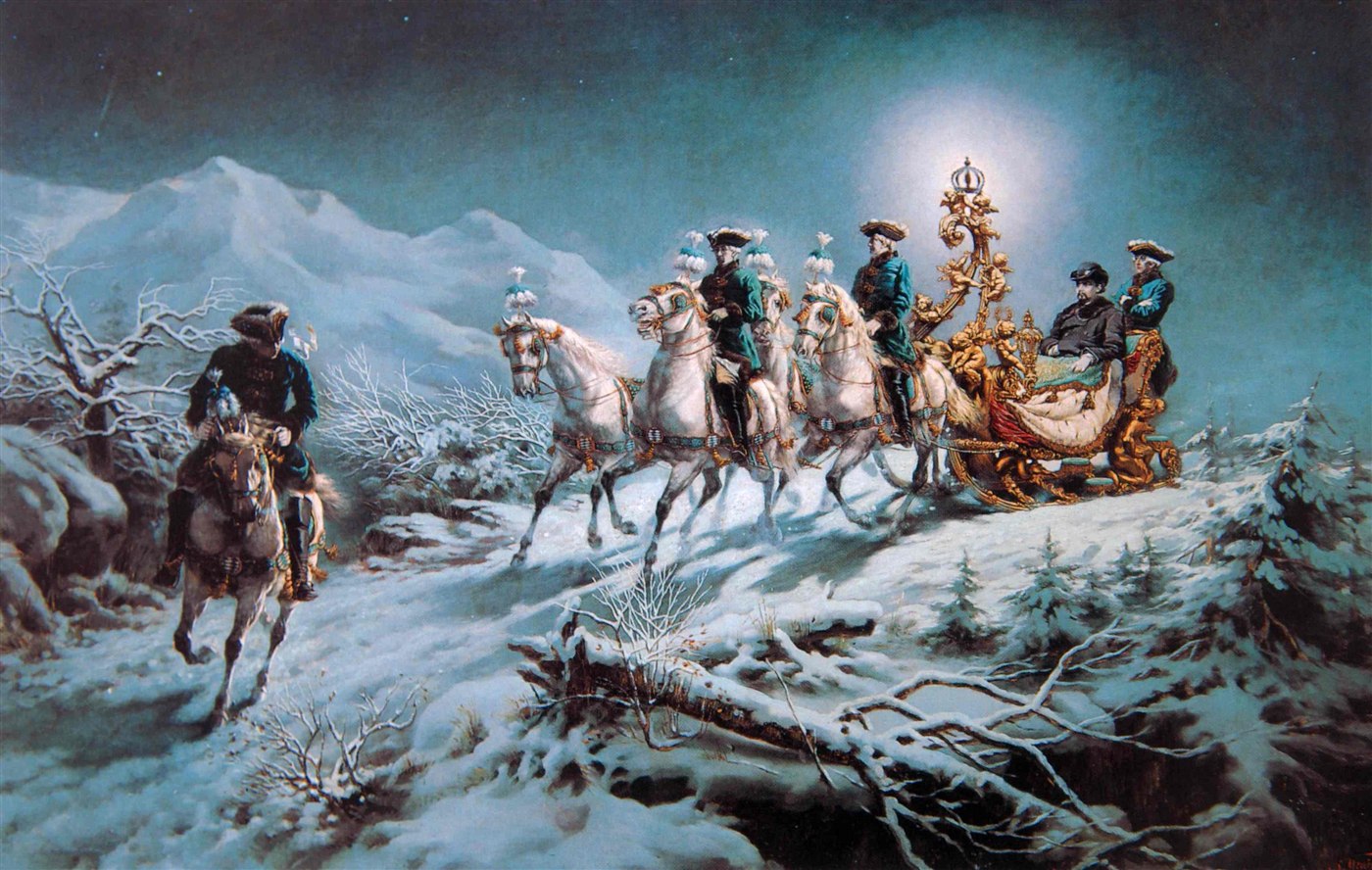
Ludwig's nighttime sleigh ride, a painting by R. Wenig from about 1880. Marstallmuseum Nymphenburg. From Wikimedia Commons, public domain, resized.
Linderhof was the only one of his palaces that was finished in his lifetime, and he lived there for much of the time from 1876. It has a Hall of Mirrors, and a dining room in which the table, set for guests, was lowered through the floor to the kitchen and sent back up, so that he could eat without servants in the room. The table was laid for at least four, because he talked to imaginary guests, such as Louis XV and Madame de Pompadour. In the park, a grotto, built between 1875 and 1877, shows the first act of Tannhäuser. It was lit by electricity, with a lake on which the king was rowed in a shell-shaped boat. A hut from Die Walküre, a hermitage from Parsifal and a Moorish kiosk with a peacock throne stood in the grounds. The third, and the most extravagant, was Herrenchiemsee, on an island in the Chiemsee, a partial copy of Versailles, begun in 1878, as a temple to Louis XIV and to absolute monarchy. Its Hall of Mirrors is slightly longer than the original, but only the central part was built, and Ludwig stayed there for ten days in October 1885. He drew up plans for a fourth castle, Falkenstein, and proposed a Byzantine palace and a Chinese summer palace, but none of them were built.

Schloss Linderhof, the only one of Ludwig's palaces that was finished in his lifetime.
The cost was huge. The official figures published in 1968 gave about 6.2 million marks for Neuschwanstein, 8.5 million for Linderhof and 16.6 million for Herrenchiemsee. By 1885, he owed about 14 million marks, foreign banks threatened to seize his property, and and in 1886, his government declared him insane and deposed him, which was a procedure that the Bavarian constitution did not provide for. Bismarck wrote that the ministers "wish to sacrifice the King, otherwise they have no chance of saving themselves."
In the first months of 1886, a group of ministers and relatives assembled a medical report. The constitution did not provide for removing a king, but it did say that a report was needed, stating that the king "is prevented from exercising government by some cause which persists in its effects for a period of more than one year." Count Maximilian von Holnstein collected most of the evidence, using bribes to collect complaints from the king's servants, and Ludwig's uncle, Prince Luitpold, agreed to serve as regent only if the king was proved insane. The report was confirmed on June 8th, 1886, by Professor Bernhard von Gudden, the best-known German psychiatrist of the time, who ran the Munich asylum, and three other doctors. It stated that "His Majesty is in an advanced stage of mental illness, and that illness takes the form of the disease known to all doctors for the insane as paranoia," and that he was "to be considered incurable." No examination of the king ever took place, and Gudden had met him only once, twelve years earlier. Bismarck called the report "rakings from the King's wastepaper-basket and cupboards." On June 9th, Ludwig was certified unfit to govern. The next day, June 10th, Luitpold took over the government, and at four o'clock in the morning a state commission arrived at Neuschwanstein to inform the king. Ludwig had been warned by his coachman, and the guards turned the commission away. One woman, the Baroness Spera von Truchseß, is said to have attacked the commissioners with an umbrella. A second commission arrived on June 12th and was more successful in delivering its message. "Ah!" the king is said to have answered. "So Prince Luitpold has finally managed it. But he need not have used all that cunning. If only he had said, then I would have renounced my government obligations and gone abroad." They set out from Neuschwanstein at four in the morning on June 12th and reached Berg Castle at noon, after an uneventful journey. There, Ludwig asked Gudden how he could be declared insane without being examined, and Gudden answered that the servants' reports were "very copious and completely substantiated."
On Sunday, June 13th, Ludwig and Gudden went out for a walk along the shore of Lake Starnberg at about six o'clock in the evening, and Gudden told the attendants not to follow them. They were due back at eight, and they did not return. Their bodies were found at about half past ten, in shallow water close to the bank, and Ludwig's pocket watch had stopped at 6:54. The official ruling was suicide by drowning, but the autopsy found no water in the king's lungs. Ludwig was a strong swimmer, and the water was only about waist-deep, and Gudden's body showed blows to the head and signs of strangulation. The explanations include suicide, a heart attack in the cold water while trying to escape, and murder. A fisherman, Jakob Lidl, left notes that described a shot from the bank, and a countess later showed her guests a grey coat with two bullet holes, but there is no evidence that he was shot, and the autopsy found no wound. The king's body lay in state in the Residenz in Munich in his regalia of the Order of Saint Hubert, with a sprig of jasmine picked by Empress Elisabeth. He was buried in the crypt of Saint Michael's Church in Munich on June 19th, and his heart was sent in a silver urn to the Shrine of Our Lady in Altötting, where it lies next to those of his father and grandfather. A memorial service is still held there each year on June 13th.

A bust of Ludwig in the gardens at Linderhof.
Ludwig was succeeded by his brother, Otto, who had been mentally ill and under medical care since 1883, and Luitpold continued to rule as regent until his death in 1912. His son took over the regency, and in 1913, he deposed Otto and became King Ludwig III. The monarchy ended with the First World War in 1918. The question of whether Ludwig was ever insane has not been settled. Modern writers doubt the diagnosis of paranoia, and some suggest a personality disorder, or even a form of dementia, but the 1886 report was based on servants' gossip, and no doctor had examined him. He is quoted as saying, "I wish to remain an eternal enigma to myself and to others."
His castles, which the Wittelsbach family gave to the state of Bavaria in 1923, are now his memorial. Neuschwanstein was opened to the public on August 1st, 1886, seven weeks after his death, and it has had millions of visitors since. The Bavarian palace administration says that his palaces have been visited by more than 130 million people since his death. Neuschwanstein is said to have been the model for Disney's Sleeping Beauty Castle, and in 2025, Neuschwanstein and his other palaces were inscribed on the UNESCO World Heritage list. The king who wanted to be left alone left behind palaces that are among the most famous in Europe.