Hohenschwangau
History
Schloss Hohenschwangau is a breathtaking neo-Gothic 19th century palace, perched regally above the quaint village of Hohenschwangau, near Füssen in Bavaria, Germany. The original castle at this site was built in the 12th century by the Knights of Schwangau. The Knights, later Counts, of Schwangau were knights and administrators of the House of Welf.
By 1440, the lords sold their fief to the Wittelsbach dukes but continued to live at the castle as Burgraves. They regained ownership in 1521 but sold the land in 1535.
Two Tyrolean envoys surveyed the structural condition of Burg Schwanstein and wrote:
"Schwanstein is situated on a low outcrop of rock between the two lakes. It is situated neither for exigency nor defense, but has very thin walls and is accessible on all sides without difficulty; it is internally entirely of timber construction and poorly built, with all roofs, stairs, internal structures, and appurtenances in a state of ruin."
Johann Paumgartner, a wealthy Augsburg merchant, purchased the castle and hired Italian architect Lucio di Spazzi to rebuild the lower castle. Spazzi retained the exterior walls and towers while redesigning the interior by 1547; the floor plan from that era still exists. The older upper castle fell into neglect. After Paumgartner died in 1549, his son sold the new castle to Duke Albrecht V of Bavaria from the House of Wittelsbach, who used it as a retreat and lodge for bear hunting.
In 1743, Austrian troops plundered the castle. Later, in 1803, the county of Schwangau became part of the Electorate of Bavaria. The castle was used as quarters by both French and Austrian troops. It suffered a short but unsuccessful French bombardment and siege during the Napoleonic Wars (1800-1809). This damaged the roof and contributed to its dilapidated state by the early 19th century, though the damage was not catastrophic—the structure survived as a ruin until its reconstruction. By 1820, King Maximilian I of Bavaria sold the castle.
In 1832, Maximilian II of Bavaria, then crown prince, bought the old, dilapidated castle for 7,000 guilders, then known as Schwanstein, after discovering it during a walking tour in April 1829.
Reconstruction began in 1833 under the direction of Maximilian's art teacher, Domenico Quaglio, a painter of architectural and theatrical scenes. He transformed the castle's exterior in the Neo-Gothic style by 1837, with additions continuing through 1855.
The castle was renamed Hohenschwangau and transformed into the splendid summer home and hunting retreat of Maximilian, his wife Marie of Prussia, and their two sons, Ludwig and Otto. Ludwig would one day ascend to the throne as King Ludwig II of Bavaria, while Otto would become King Otto I of Bavaria. The young princes spent many years of their childhood at Hohenschwangau, growing up amid the magic of German romances such as Parzival and Lohengrin, the legendary Knight of the Swan.
The Queen's cousin, Frederick William IV of Prussia, had Schloss Stolzenfels on the River Rhine rebuilt at the same time in the same Gothic Revival style.
On March 10th, 1864, Maximilian II died; soon after, Ludwig II became King and moved into his father's room at Hohenschwangau, while his mother remained on another floor. Not long thereafter, the young dreamer began building a castle of his own, choosing a site high above his parents' castle in the Bavarian Alps, on the grounds of an old Schwangau fortress, just a few hundred yards from Hohenschwangau. He called his new castle Neuschwanstein.
While constructing Neuschwanstein, Ludwig began using vast family resources to build Linderhof and Herrenchiemsee, with further plans for an alpine castle called Falkenstein.
Ludwig's family declared him insane. On June 10th, 1886, a government commission entered Neuschwanstein and escorted Ludwig away to the isolated Berg Castle on the shore of Lake Starnberg. On June 13th, 1886, he set out for an evening walk with his psychiatrist, Dr. Bernhard von Gudden, and vanished into the dusk. Their bodies were later discovered floating in the still waters of Lake Starnberg that night. The death was officially ruled a suicide by drowning, though no water was found in his lungs.
After Ludwig's death, his mother, Queen Marie, was the sole resident at Hohenschwangau until her own passing in 1889. Subsequently, her brother-in-law, Prince Regent Luitpold of Bavaria, moved into the castle's third floor. In 1905, he modernized the castle by introducing electricity and installing an electric elevator. After Luitpold died in 1912, the castle opened as a museum the following year.
In 1923, the Bavarian State Parliament recognized the former royal family's right to live at the castle. The castle and other holdings were transferred back to the Wittelsbach Compensation Fund, which still owns the castle.
From 1933 to 1939, Crown Prince Rupprecht of Bavaria used the castle as a summer residence; it remains a favorite among his successors.
In May 1941, Adolf Hitler issued the Prinzenerlass, barring royals from military service. As a result, Prince Adalbert of Bavaria was removed from the military and retired to Schloss Hohenschwangau, where he remained for the war's duration.
Today, Hohenschwangau, like Neuschwanstein, is a major tourist attraction, attracting hundreds of thousands of visitors a year.
Castle Highlights
Schloss Hohenschwangau embodies 19th century Romanticism. It blends medieval inspiration with the lavish comforts of its era. Crowning a hilltop above the Alpsee Lake and the storybook village of Schwangau, the castle stands as the dramatic prologue to the legend of the "Mad King" Ludwig II.
The castle is open to visitors year-round, but the interior can be seen only on a guided tour. There is a ticket office at the base of the castle where you can buy tickets. You can also buy them online in advance for both Hohenschwangau and Neuschwanstein. The best way is to tour Hohenschwangau in the morning, have lunch, and then tour Neuschwanstein in mid-afternoon.
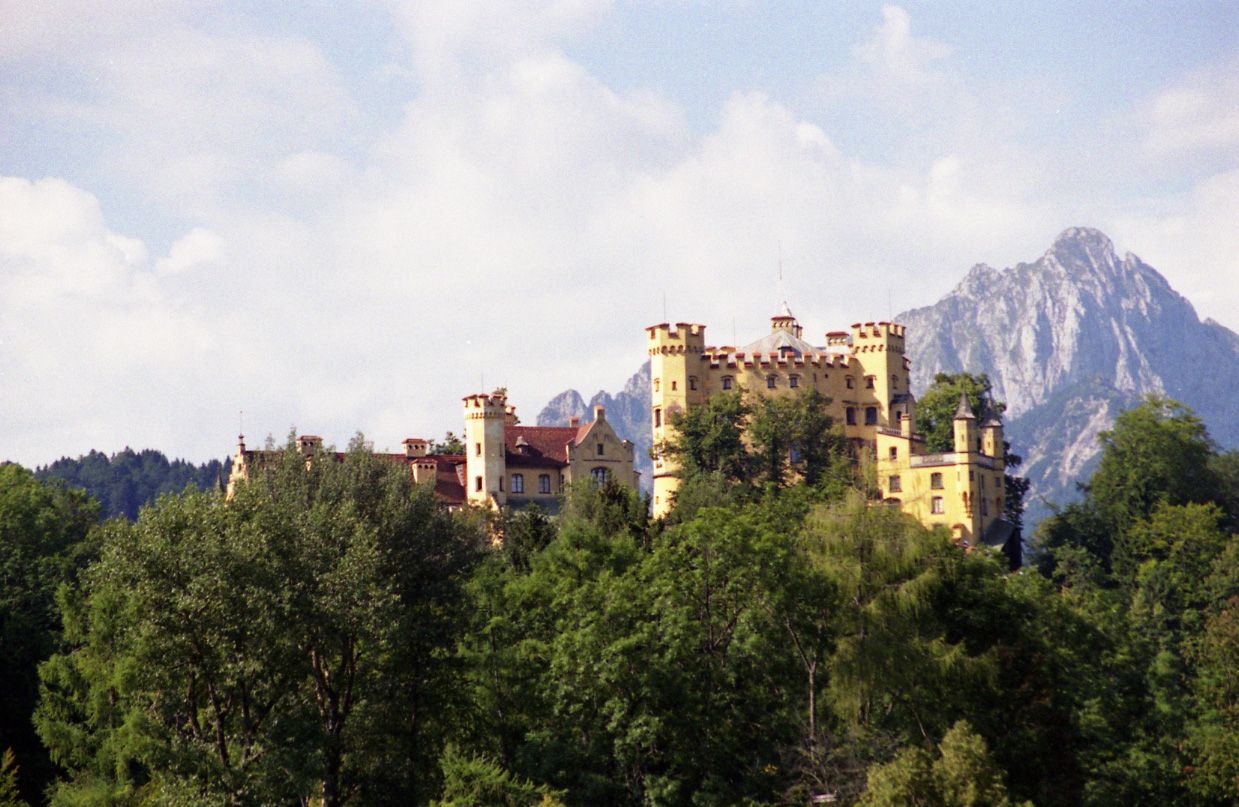
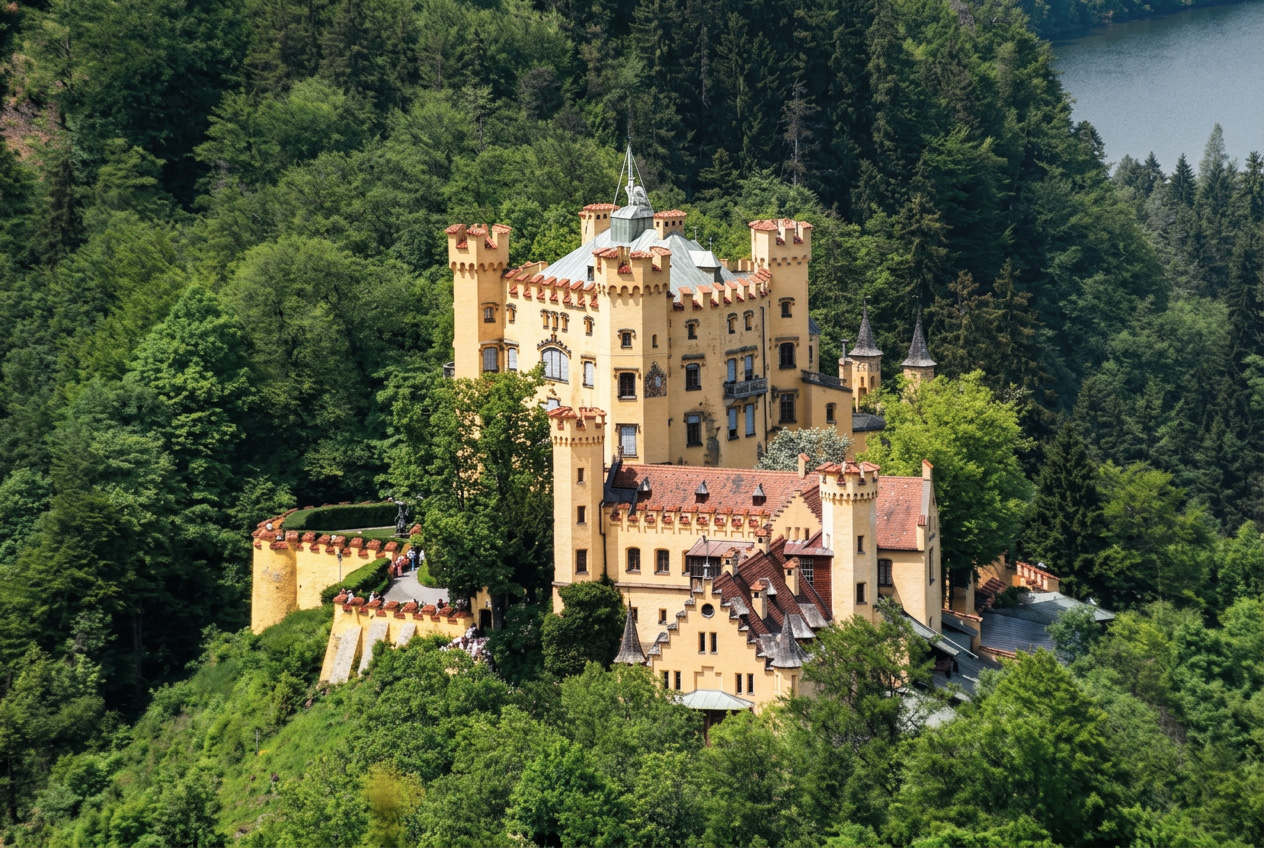
Hohenschwangau features yellow facades, corner towers, and battlements. Inside the castle are over 90 murals depicting Germanic legends, history, and knightly themes.
Rooms include the Hall of Heroes, the Swan Knight Hall, Queen Marie's Oriental Room, King Maximilian's bedroom, and a music room. Richard Wagner performed in this music room for King Ludwig II.