Battle of Stanhope Park
The Weardale Campaign and Battle of Stanhope Park
Background
The English had been completely expelled from Scotland by 1323. The Scots then carried out several successful raids into Northern England, forcing Edward II to flee south after the Battle of Old Byland.
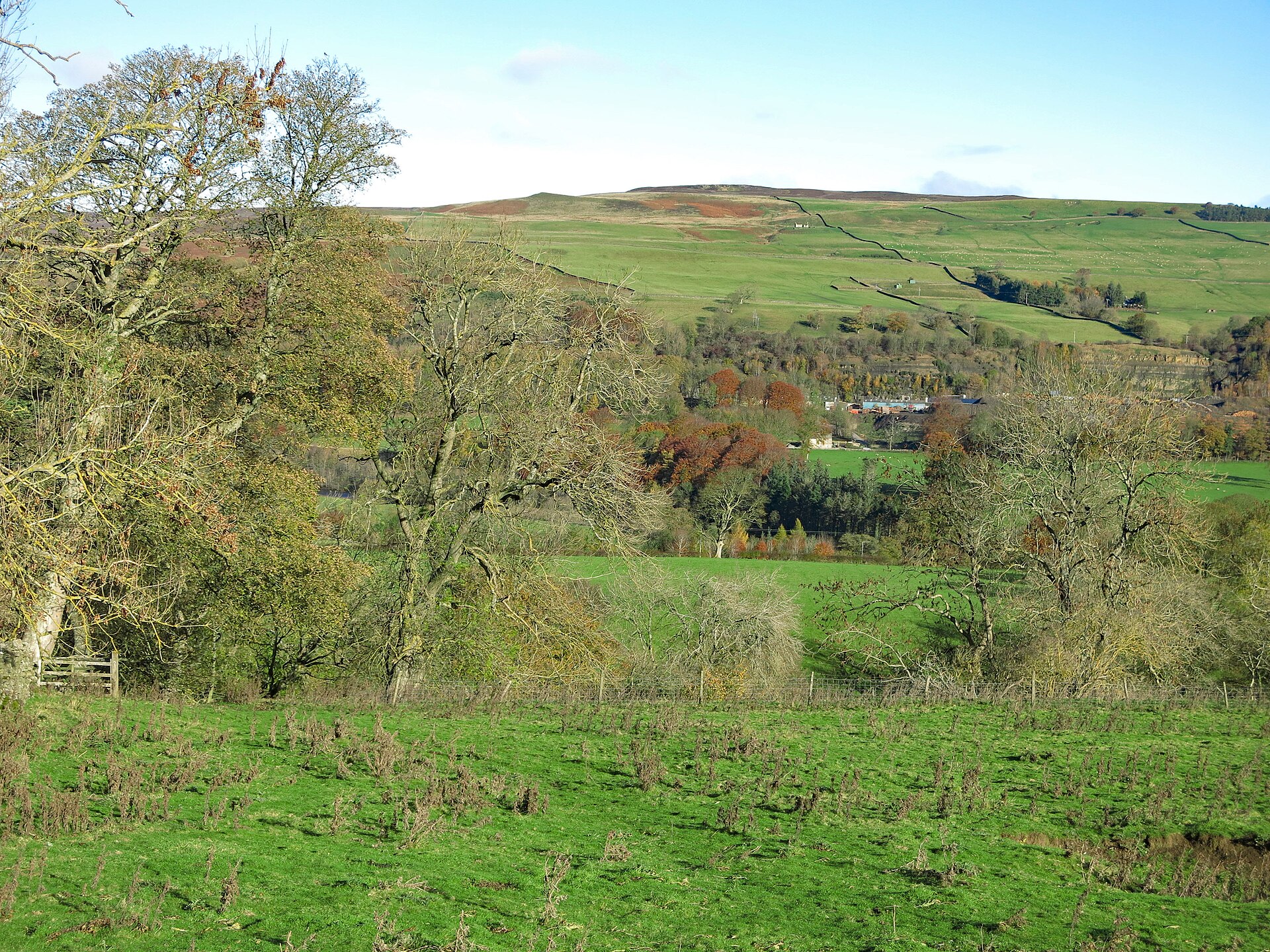
Weardale between Stanhope and Frosterley. Photo by Mike Quinn, Wikimedia Commons, CC BY-SA 2.0, resized.
By February 1326, Edward's wife, Queen Isabella, had taken the exiled Roger Mortimer as a lover in Paris. In August and September, Edward II began mobilizing defenses along the English coast in Portsmouth and Orwell. He was anticipating an invasion by the French or Roger Mortimer. Edward issued an appeal for his subjects to defend the kingdom. Many of his barons were still against him because of their dislike for the Despensers. Over 2,000 men were ordered to Orwell, but only 55 arrived.
On September 24th, 1326, Queen Isabella, Roger Mortimer, thirteen-year-old Prince Edward, the heir to the throne, and Edward II's half-brother, Edmund of Woodstock, landed in Orwell, Suffolk. They encountered no resistance.
While Edward II took refuge in the Tower of London, he sought support from Londoners. However, the City of London opposed him. On November 16th, authorities captured Edward II north of Caerphilly Castle and escorted him first to Monmouth Castle, then to Kenilworth Castle.
He begrudgingly abdicated his throne. On February 1st, 1327, his son Edward III ascended the English throne. Edward III remained a minor, and his mother, Queen Isabella, and Roger Mortimer controlled him.
The Scots saw this as a chance to create chaos across the border and besieged Norham Castle. Up until now, Edward II refused to acknowledge Robert the Bruce as king of Scotland. Now that Edward II was no longer in power, the Scots launched new raids to pressure England to acknowledge his Kingship.
In 1327, Robert the Bruce was immobilized by illness. James Douglas, Thomas Randolph, and the Earl of Mar led a large Scottish force of 10,000 men into England. They carried out a destructive chevauchée, plundering their way south until they reached Weardale in County Durham.
The English assembled an army at York, including 780 Hainault mercenary men-at-arms. These mercenaries fell out with English soldiers and engaged them in battle through York. The English positioned a large force at Carlisle and another at Newcastle-upon-Tyne. They assumed that armies on three fronts would hinder a Scots retreat and force them to battle.
The English army in York reached Durham by July 15th. The fourteen-year-old Edward III served mostly as a figurehead, while Roger Mortimer commanded the army.
Battle
By late July, the English had located the Scottish forces. The Scots had taken a defensive position on the north bank of the River Wear near Stanhope Park. The Scots captured an English scout but released him to inform the English army that they were here to battle. The two armies faced each other on opposite sides of the river for several days.
On the night of August 3rd, the Scottish army quietly moved to a stronger position deeper in Stanhope Park. The English pursued them the next day but could not force a decisive battle, resulting in a continued stalemate.
On the night of August 4th, the Scots under James Douglas crossed the River Wear undetected. They launched a surprise raid on the English camp, causing panic. Men were killed and wounded, and they nearly reached Edward III's tent, while shouting "Douglas!".
Having achieved their goal, the Scots slipped away the next day and returned to Scotland, largely unscathed.
Aftermath
The Battle of Stanhope Park was mostly a standoff with limited engagement between the armies. However, it was a strategic and political victory for Scotland. The English campaign was very expensive, yielded little, and exposed the crown's weakness.
As a result of these events, the battle helped pave the way for the Treaty of Edinburgh-Northampton in 1328, which formally recognized Scotland's independence and brought an end to the First War of Scottish Independence.