Norham Castle
History
Norham Castle, a 12th-century stronghold in Northumberland, England, is famed for its commanding position on the River Tweed, on the border with Scotland, and for its enduring record of sieges, at least 13 in all.

Norham Castle was built in 1121 by Ranulph Flambard, Bishop of Durham. The Bishops of Durham exercised near-royal authority in northern England to maintain order along the Scottish border. Alongside Berwick Castle and Wark Castle, Norham Castle played a critical defensive role on England's northeast border.

A ruined archway at the castle.
In 1136, King David I of Scotland invaded Northumberland and seized Norham Castle. Although it was soon restored to the Bishop, it was retaken in 1138 and severely damaged. Thereafter, it remained in ruins until Hugh de Puiset, Bishop of Durham, rebuilt the castle at Henry II's order.
A new conflict arose in 1174: Hugh revolted against Henry II and joined the rebels. At the same time, William the Lion, king of Scotland, invaded Northumberland. After the revolt was suppressed, Hugh surrendered Norham Castle to the crown. The castle then housed royal soldiers until 1197, when it was given to the new Bishop of Durham, Philip of Poitou, Hugh's successor. When Philip died in 1208, the castle returned to the crown.
In 1209, Norham Castle hosted King John of England and William the Lion, when William did homage to John for his English lands. From 1208 to 1211, John maintained Norham's defenses and provided a strong garrison. He may also have added the Sheep Gate and other enhancements. These improvements were later tested in 1215, when King Alexander II of Scotland invaded and besieged the castle for forty days without success. Afterwards, in 1217, Norham was restored to the Bishop of Durham.
Later, in May 1291, Bishop Antony Bek hosted Edward I and his advisors at Norham Castle while they arbitrated among thirteen claimants to the Scottish crown, a process called the Great Cause. At Edward's command, sixty-seven northern magnates arrived at Norham with their required armed retinues. The royal party's size necessitated 164 horses for the household.
The following year, in 1292, King Edward I again visited Norham Castle, where John Balliol did homage to Edward after the judgment in Balliol's favor at Berwick Castle. Soon afterward, in 1296, Edward invaded Scotland.

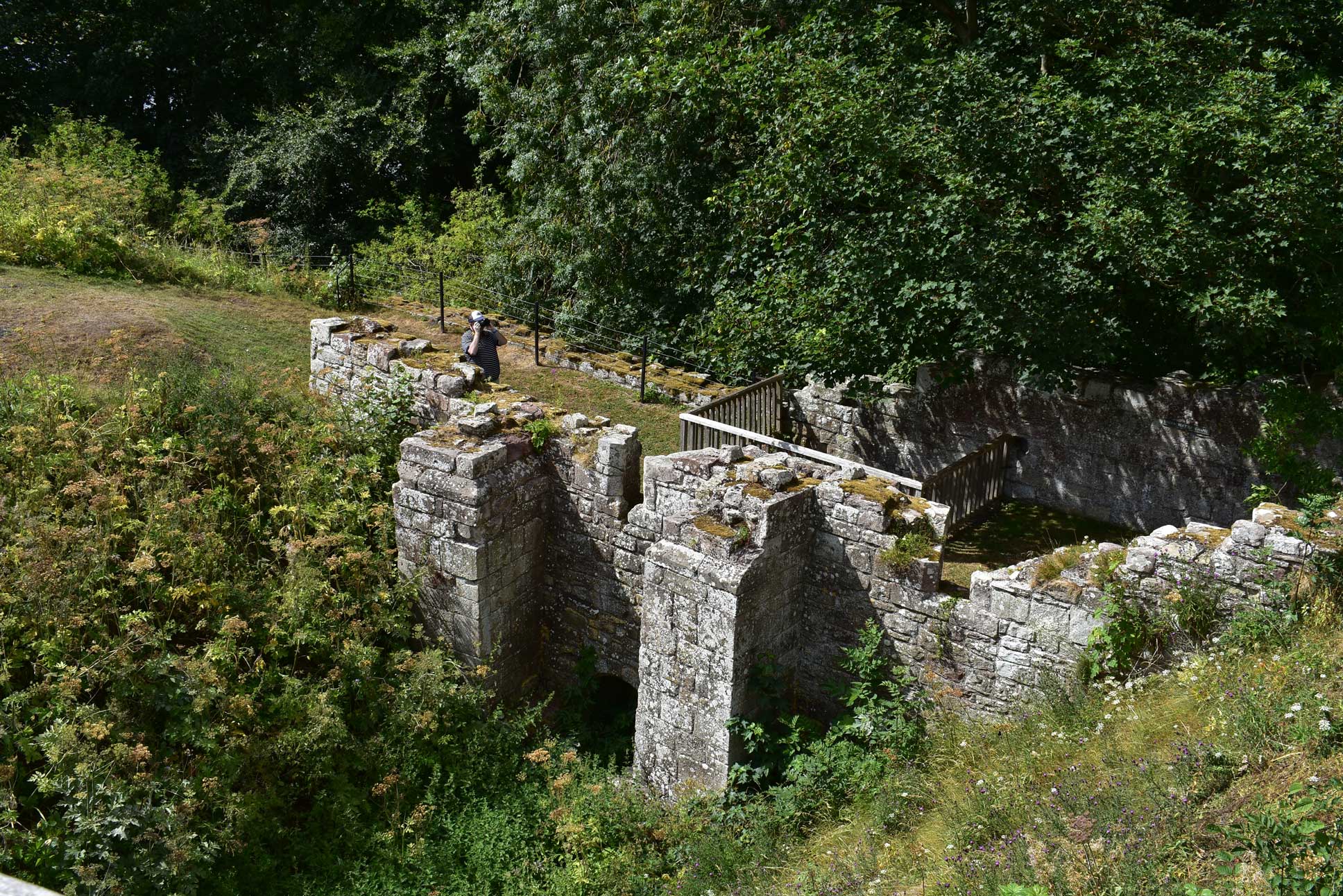
The ruined walls of the castle.
In 1318, Robert the Bruce besieged Norham Castle for almost a year. The Scots briefly occupied the outer ward before being driven out. In 1319, another seven-month siege also failed. Sir Thomas Grey of Heton commanded during both sieges, despite having been captured at the Battle of Bannockburn in 1314. The Scots finally captured Norham in 1327, but it was soon restored to Bishop Lewis de Beaumont after peace between England and Scotland.
During the Wars of the Roses, Norham Castle was held by the Yorkists in 1462 on behalf of Edward IV. The next year, a Lancastrian army besieged the castle for eighteen days but was unsuccessful. In 1464, those holding the castle changed allegiance and supported the Lancastrians. They were forced to surrender it to a Yorkist force. Richard Foxe, Bishop of Durham, later strengthened the castle defenses.
In 1497, Norham Castle was besieged again for two weeks by the Scots, led by James IV of Scotland, in support of Perkin Warbeck, a pretender to the English throne. This time, the siege included cannons, including the massive Mons Meg, now on display at Edinburgh Castle. Following the unsuccessful siege, the castle was repaired again.
The castle soon faced another challenge. In 1513, James IV of Scotland invaded England and moved on Norham Castle. His cannons fired on the outer defenses for several days until his army took the outer ward, and the castle surrendered. However, just a few weeks later, James IV was killed at the Battle of Flodden Field, and Norham Castle was back under English control.
After this, restoration work on the castle continued until 1521. This time, the restoration included improved defensive measures against the use of gunpowder and cannon. In 1523, Henry Howard, Earl of Surrey, gave orders for new earthwork defenses and the “mending of broken places with turvis and yerthe”.
Norham Castle's defenses were strong and well garrisoned. In 1542, Brian Layton, its captain, reviewed security after rumors that insiders might surrender it to the Scots. He later invaded Scotland during the Rough Wooing and died in February 1545 at the Battle of Ancrum Moor.
Peace in the region led to a reduced garrison and neglected defenses. In 1574, Lord Hunsdon propped up the floors of the hall, parlor, and kitchen with ship masts.
As time passed, the castle deteriorated further. In 1596, Queen Elizabeth firmly declared that no funds would be allocated to Norham Castle. Afterwards, James VI of Scotland, upon ascending the English throne, granted the castle to George Home, 1st Earl of Dunbar.
The ruins of Norham Castle have been in the care of English Heritage since 1923.
Castle Highlights

The wooden bridge leading toward the Great Tower.
Though a ruin today, Norham Castle is an impressive sight. A wooden bridge on the site of the old drawbridge leads across to the inner bailey. On one side stands the Great Tower, or keep, which measures 84 ft by 60 ft and stands 88 ft high. On the other side was the Great Hall, where the bishop and important guests were accommodated. It measured 60 ft by 30 ft, but only its foundations remain today. To the right, in front of the Great Tower, as you cross the bridge, are the ruined foundations of Clapham's Tower.
The remains of the West Gate, or Marmion's Gate, and barbican still protect the castle's west side towards the town of Norham. The undercroft of the chapel is located to the north of the wooden bridge.
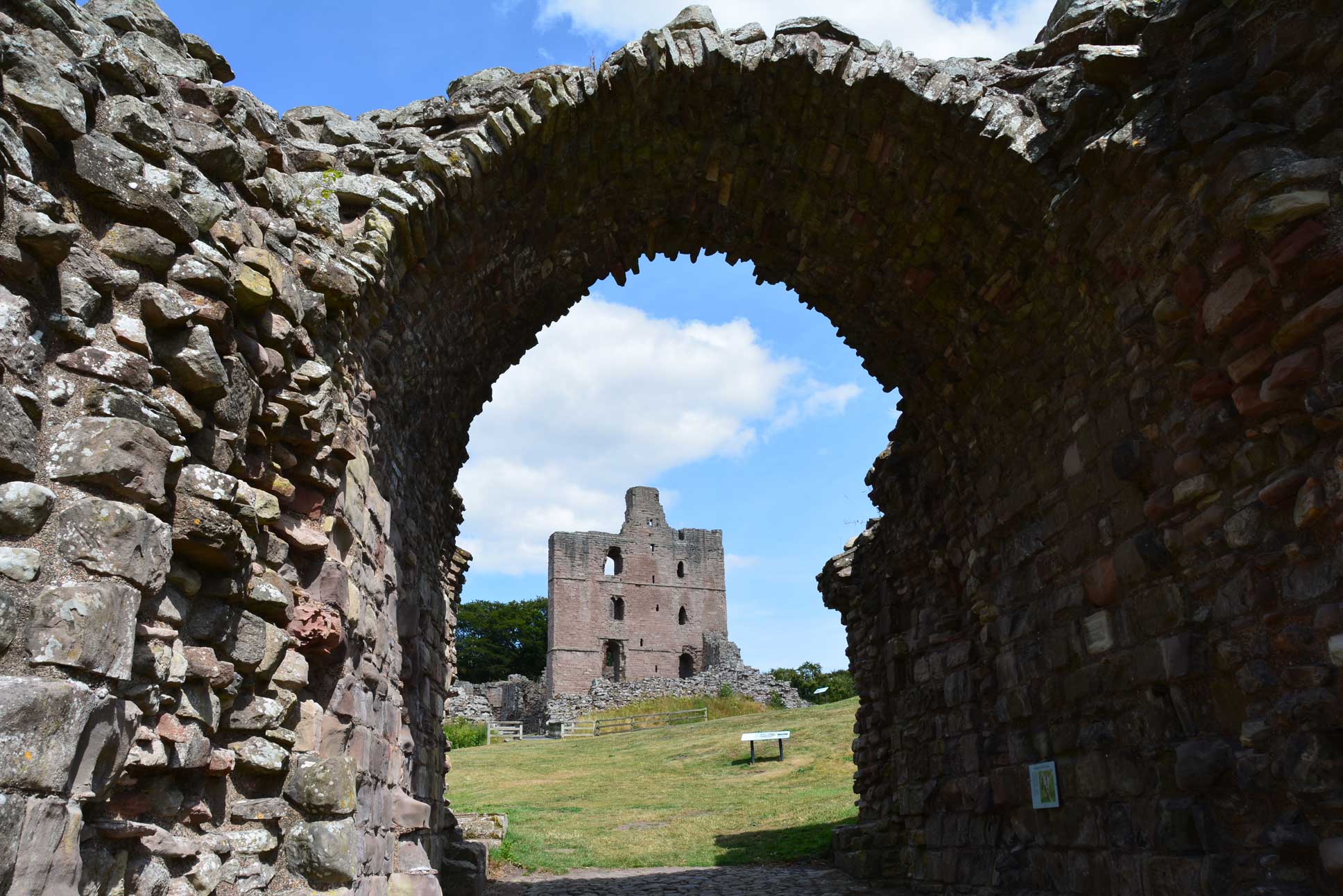
A gateway arch, with the Great Tower beyond.
Access to the castle from town is through the West Gate. An archway along the south wall, once the Sheep Gate, provides access from the castle car park. The best views of the Great Tower are from that location.
Some areas are currently closed for health and safety and conservation work, including the Marmion Gate entrance and bridge, the bridge to the inner ward, and the Great Tower, so check before you visit. The outer ward can be reached from the car park.
Norham Castle is open to visitors and free to enter. There are no amenities except the car park. Guidebooks can be purchased in Norham and at the gift shop at nearby Etal Castle.
Norham Castle can be easily explored in an hour or two. To see more castles the same day, Etal Castle is just a few miles away. Bamburgh Castle is also close enough to see on the same day.