Harold II - King of England (1066)
Harold Godwinson
Harold Godwinson was the last Anglo-Saxon King of England, ruling from January 5th to October 14th, 1066. He is remembered for his military skill, brief yet consequential reign, and death at the Battle of Hastings, which ended Anglo-Saxon rule.
Harold Godwinson was the son of Godwin, Earl of Wessex, and Gytha Thorkelsdóttir. During the reign of Edward the Confessor, Harold's father held power as one of the most influential nobles in England.
Harold's sister, Edith, married Edward the Confessor on January 23, 1045. Around then, Harold became Earl of East Anglia to defend against a threat from King Magnus the Good of Norway. He also began a relationship, in the Danish manner (More danico) and not blessed by the Church, with Edith the Fair, heiress to lands in Cambridgeshire, Suffolk, and Essex—within Harold's new earldom and likely reinforcing his authority. They had seven children: Godwin, Edmund, Magnus, Gunhild, Gytha, Harold, and Ulf.
In 1047, Harold's older brother Sweyn was exiled after abducting the abbess of Leominster, and his lands were divided between Harold and his cousin Beorn. In 1049, Harold commanded a ship sent with the fleet to aid Henry III, Holy Roman Emperor, against Baldwin V, Count of Flanders.
In 1051, Edward the Confessor appointed an enemy of the Godwins as Archbishop of Canterbury and exiled the Godwins. A year later, the Godwins returned stronger, forcing the king to restore them. In 1053, Earl Godwin died, and Harold became Earl of Wessex, making him the most powerful man in England after the king.
In 1055, Harold Godwinson drove back the Welsh who had burned Hereford. Three years later, he became Earl of Hereford. He replaced his father as the main opponent to the Normans' growing influence in England. Harold led several campaigns against the Welsh King Gruffydd ap Llwelyn of Gwynedd and defeated Gruffydd in 1063, resulting in his death.
In 1064, Harold seems to have been shipwrecked at Ponthieu, but why he was there is surrounded by speculation. Norman chroniclers say that Harold was sent to swear fealty to William, Duke of Normandy. They claim William was offered to succeed Edward as king of England upon Edward's death. Later chroniclers suggest Harold's journey to Normandy was to seek the release of his family members, who had been held hostage since Godwin's exile in 1051. Some say he was simply fishing and his boat was blown across the English Channel by an unexpected storm.
Whatever his reason for being in Normandy, Count Guy I of Ponthieu captured Harold and took him hostage to the castle at Beaurain. William, Duke of Normandy, arrived soon after and ordered Guy to release Harold to him. While traveling with William, Harold reportedly rescued two of William's men from the quicksands near Mont Saint-Michel. William presented Harold with weapons and knighthood. The Bayeux Tapestry states that during this time, Harold swore an oath on sacred relics to support William's claim to the English crown.
In 1065, Harold's brother Tostig was the unpopular Earl of Northumbria for being heavy-handed with those who resisted his rule and his double taxation. This caused barons in the north to threaten rebellion. Harold, motivated by a desire to maintain stability in the region and strengthen his own position, supported the northern barons against his brother and appointed Morcar as the new Earl of Northumbria. This drove Tostig into an alliance with King Harald Hardrada of Norway.
At the end of 1065, King Edward the Confessor fell ill without designating a successor. Edward died on January 5th, 1066, leaving no heir, but before his death, he commended his widow and the kingdom to Harold's protection.
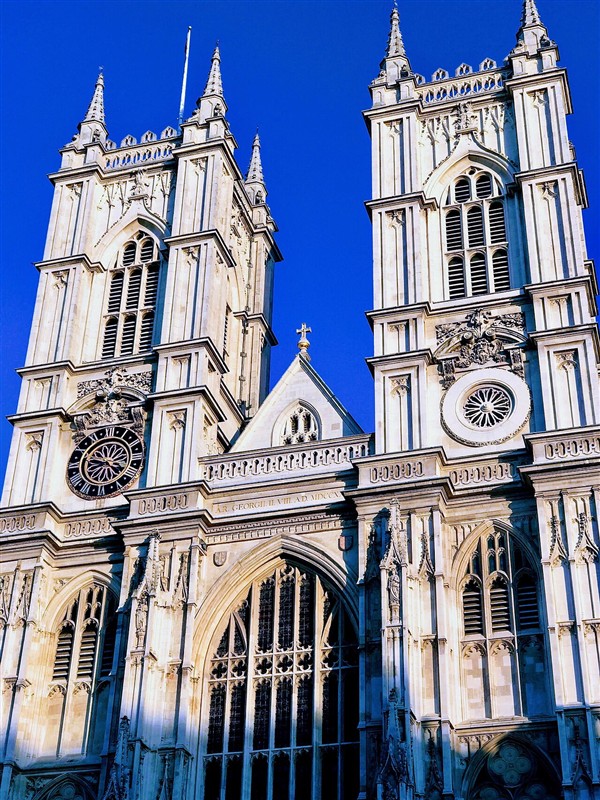
The next day, the King's Council selected Harold to succeed Edward, and they crowned him King of England on January 6th, 1066, most likely at Westminster Abbey.
William, Duke of Normandy, planned to invade England and built 700 ships after he heard of Harold's coronation. Pope Alexander II named William the rightful heir to the English throne, and French nobles joined his cause. In response to William's threat, Harold assembled his troops on the Isle of Wight to guard against invasion, but William kept his fleet in port for seven months. On September 8th, 1066, Harold disbanded his army and returned to London. That same day, Harald Hardrada and Tostig Godwinson landed an invasion force at the Mouth of the River Tyne in the North. They defeated Earls Edwin of Mercia and Morcar of Northumbria at the Battle of Fulford near York on September 20th, 1066.
Hardrada, Tostig, and their men were resting near York when Harold Godwinson and his army caught them by surprise after marching from London in four days. On September 25th, 1066, Harold Godwinson defeated Harald Hardrada and Tostig at the Battle of Stamford Bridge, where both Hardrada and Tostig died in battle.
Before the battle, a sole rider approached and offered Tostig the Earldom of Northumbria if he turned on Hardrada. Tostig asked what would be given to Hardrada, and the rider replied, "Seven feet of English ground, as he is taller than other men," then returned to the English. Hardrada asked who he was. Tostig said it was his brother, Harold Godwinson.
Harold Godwinson had no time to rest after the battle as William, Duke of Normandy, set sail for England on September 27th, arriving the following day at Pevensey Bay on the coast of East Sussex.
Harold and his army marched south to intercept William and hastily built earthworks near Hastings.
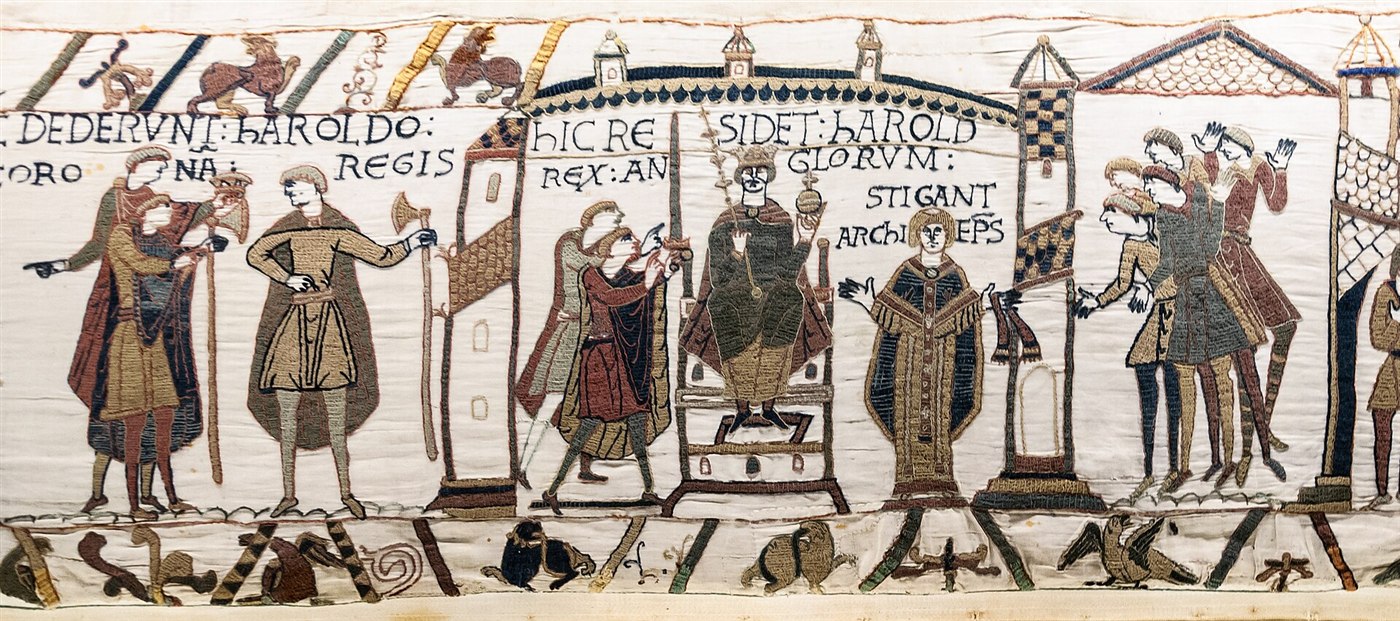
Harold crowned king, with Archbishop Stigand. Bayeux Tapestry, 1070s. Photo by Myrabella, Wikimedia Commons, public domain.
On October 14th, 1066, the two armies clashed at the Battle of Hastings at Senlac Hill, near the present town of Battle. After nine hours of intense fighting, King Harold Godwinson was killed, and his army was defeated. It's widely held that Harold was killed by an arrow through the eye, as depicted in the Bayeux Tapestry. The Bishop of Amiens wrote in his "Song of the Battle of Hastings" shortly after the battle that Harold was lanced and his body dismembered by four knights, likely including Duke William. The debate still goes on today, as some claim the arrow through the eye in the Tapestry may have been added centuries later.
It is said by the chronicler William of Poitiers that Harold's body was given to William Malet for burial:
"The two brothers of the King were found near him, and Harold himself, stripped of all badges of honour, could not be identified by his face but only by certain marks on his body. His corpse was brought into the Duke's camp, and William gave it for burial to William, surnamed Malet, and not to Harold's mother, who offered for the body of her beloved son its weight in gold. For the Duke thought it unseemly to receive money for such merchandise, and equally, he considered it wrong that Harold should be buried as his mother wished, since so many men lay unburied because of his avarice. They said in jest that he who had guarded the coast with such insensate zeal should be buried by the seashore."
Another source states Harold's widow, Edith the Fair, identified his body by a private mark. Harold may have been buried at Bosham Church in West Sussex, as he was closely associated with Bosham. Legends later claimed he received a proper burial years later at Waltham Abbey in Essex, which he founded in 1060.
Harold's death marked the end of Anglo-Saxon rule in England. Battle Abbey was built on the spot where Harold was killed in battle.