Aberystwyth Castle / Castell Aberystwyth
History
Aberystwyth Castle stands on a rocky headland at the southern end of the town, looking out over Cardigan Bay in west Wales. Today it is a ruin in a public park, and the most complete part left is the tower of its inner west gateway.

It is not the first castle in the area. About 1110, the Marcher lord Gilbert Fitz Richard built a motte-and-bailey castle roughly a mile to the south. It was besieged unsuccessfully in 1116, then captured and burned by the Welsh in 1136 and burned again in 1143. It was rebuilt in timber and stone, and Llywelyn the Great took it in 1221.
The castle that stands on the headland today dates from Edward I's conquest of Wales. In 1277, after the first war against Llywelyn ap Gruffudd, Edward's brother Edmund of Lancaster began a new castle and a walled borough, which received its charter that year, on the present site, north of the old one. The headland let the castle watch over Cardigan Bay, and the new borough was meant to bring English settlers to Ceredigion. Labor was recruited mainly from the west of England, and the work may have been directed by the master mason James of St George, who built many of Edward's Welsh castles.
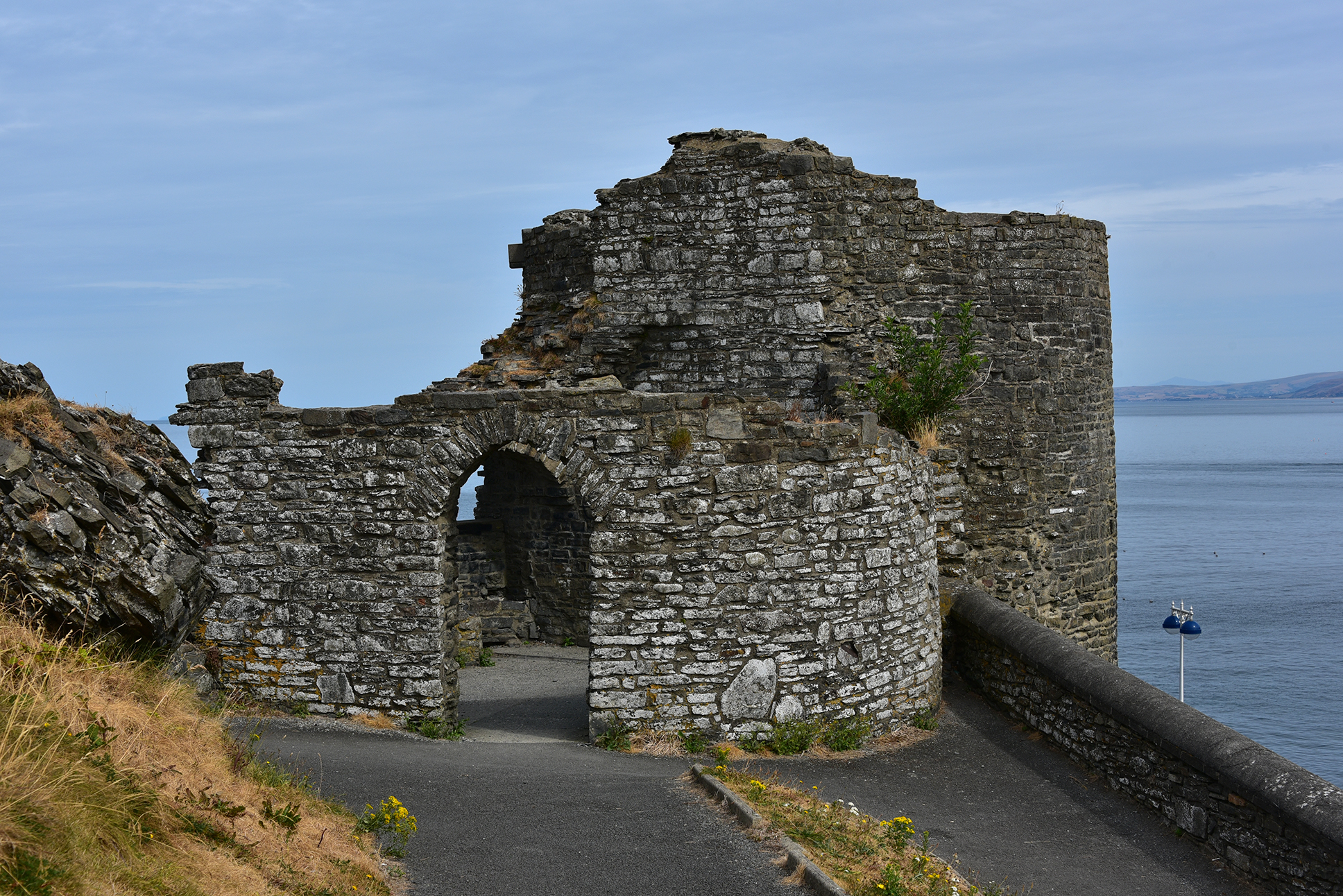
A ruined round tower with an arched doorway, above the sea.
Work began in August 1277, at the same time as Edward's castles at Flint and Rhuddlan. Building went slowly, and in 1282, at the start of Edward's second Welsh war, the Welsh captured and burned the unfinished castle and town. The castle was rebuilt and completed by about 1289, and it became a center of royal administration for Cardiganshire. The whole project cost about £4,300, a large sum for the time. Its builders chose a diamond-shaped, concentric design, with an inner ward and a narrow outer ward, round towers at the corners, and a twin-towered gatehouse.
The castle's strength was tested during Madog ap Llywelyn's revolt of 1294 and 1295. Welsh forces besieged it extensively, but it held out because it could be supplied by sea from Ireland. By 1343, when the Black Prince inspected it, the castle was already in poor repair, with its main gateway, drawbridges, king's hall, kitchens, and outer bailey in decline.
The castle's next great crisis came with the rising of Owain Glyndŵr. Glyndŵr's forces captured Aberystwyth in 1404 after a prolonged siege, the same year they took Harlech, and he made it a base for his government. On January 12th, 1405, he signed a military alliance with French envoys at the castle, in which France promised aid against England in return for Welsh support. The English struck back in 1408. Prince Henry, the future Henry V, besieged the castle from midsummer, reportedly using early cannon, and the Welsh garrison surrendered in September. Glyndŵr himself escaped and kept up a guerrilla resistance.
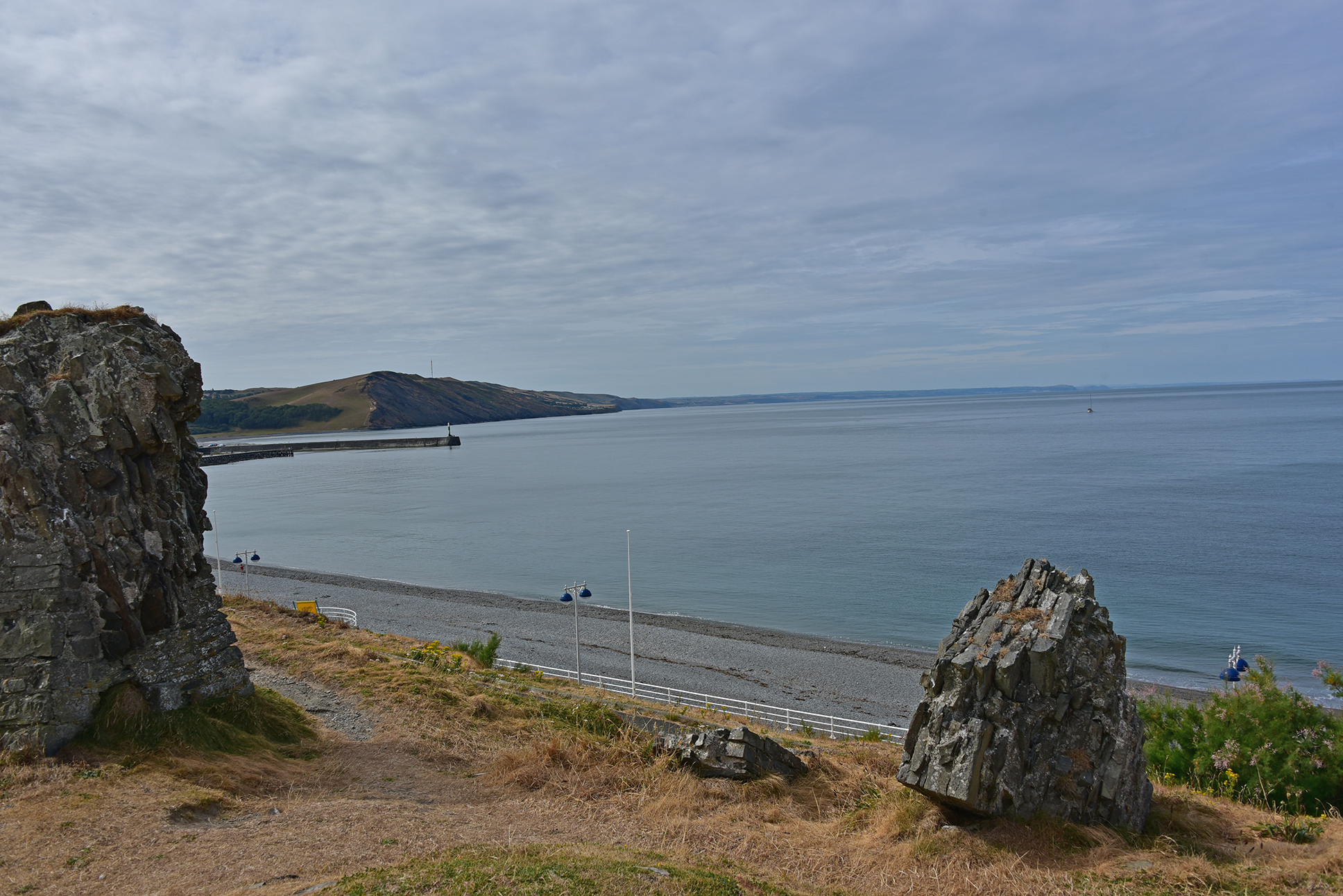
The shoreline of Cardigan Bay, seen from the castle headland.
Aberystwyth had an unusual job in the 17th century. At the urging of Thomas Bushell, Charles I set up a royal mint in the castle hall in 1637, and it struck coins from silver mined nearby. The mint closed in September 1642, after the king issued the Wellington Declaration at the start of the Civil War, and Bushell moved the bullion and equipment to Shrewsbury and then Oxford. The castle then became a Royalist stronghold under Colonel Whitley. Parliamentary forces under Colonel Rice Powell besieged it from November 1645, but the garrison could be supplied by sea and held out until it surrendered in April 1646. In 1649, shortly after the king's execution, Parliament ordered the castle slighted, so that it could never be used as a stronghold again.
A reminder of the Civil War turned up in 1988, when archaeologists digging inside the castle found the skeleton of a young man, deliberately buried just inside the inner curtain wall. Nicknamed “Charlie,” he is thought to date from the Civil War and to have died during the siege, and his skeleton is now in the Ceredigion Museum in Aberystwyth.
The ruins later became a recreational park. The grounds were laid out about 1800 by John Probart, an architect from Shrewsbury, and the north side has a Victorian crescent-shaped shelter with eight bays on cast-iron columns. The circle of standing stones among the ruins is a Gorsedd circle, the kind of stone circle set up at National Eisteddfod sites for the ceremonies of the Gorsedd of Bards, and it dates from the 1916 Eisteddfod held in Aberystwyth. The castle was listed Grade I on September 14th, 1962, and today it is an open public park.
Castle Highlights
Aberystwyth Castle is a ruin of coursed rubble masonry, laid out as a lozenge, with an inner ward and an outer ward and a dry moat on the west side. The inner west gate tower is the most complete part. It is a twin-towered gateway with D-shaped towers, a pointed entrance, a portcullis groove, a crenellated parapet, and a stair turret on the north side. Round corner towers once stood at the corners of the walls, and a northern enclosure has been lost to coastal erosion.
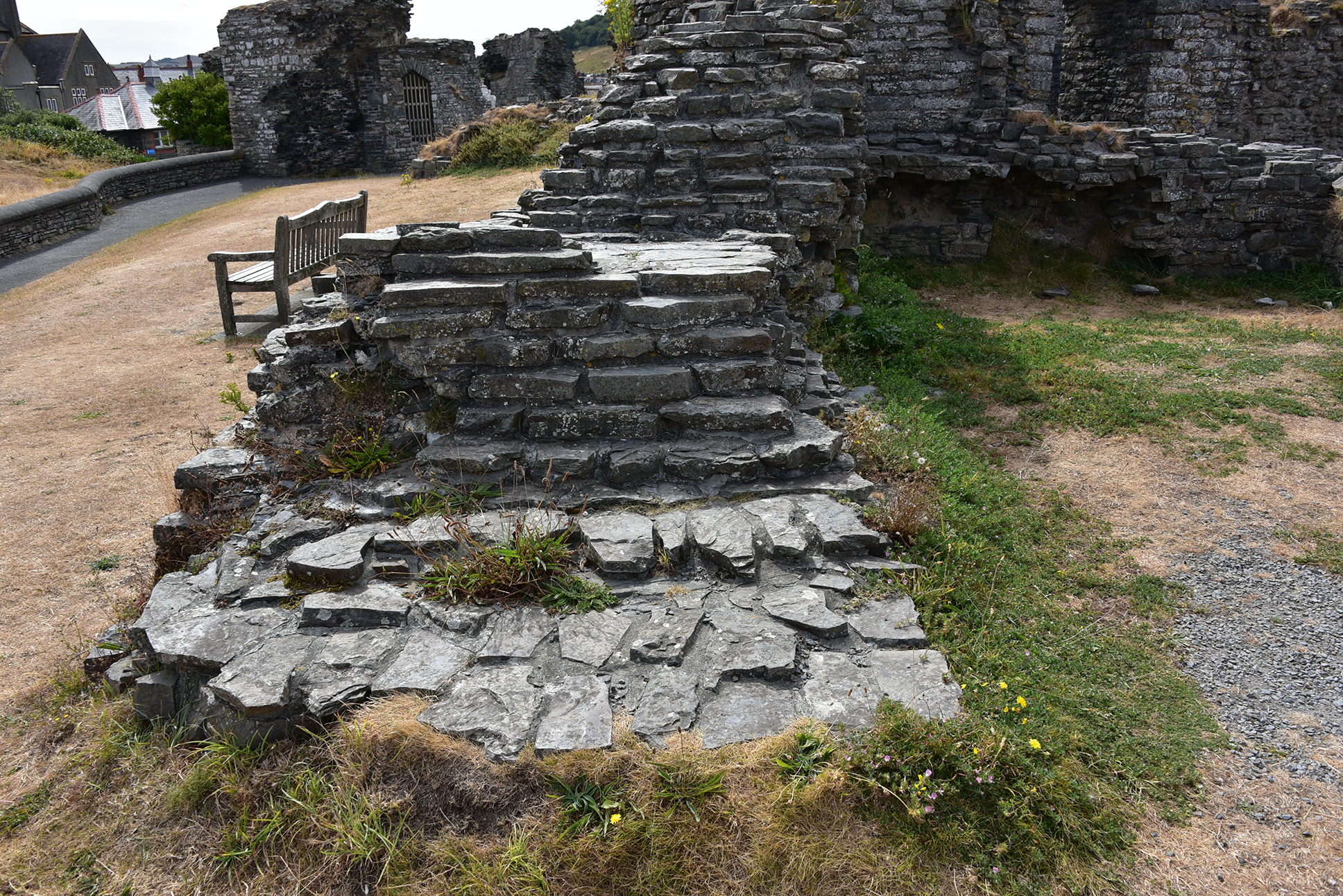
The thickness of a ruined wall, with a bench beyond.
Elsewhere, you can see the remains of the Great Gate, known as the Porth Mawr, on the east side, the footings of the hall to the southwest, a dungeon at the southwest end, and a mural tower on the south side of the inner ward. The standing stones of the Gorsedd circle stand among the ruins and add to the atmosphere.
Aberystwyth Castle is unstaffed, and there are no facilities, so most visitors come to sit on one of the benches and enjoy the view out over the sea. It takes only a short time to explore. There is no castle car park. In summer I parked in the St Michael's Church car park beside the castle, and it was a level walk to the ruins. There is also some on-street parking close by.