York Castle
History
Constructed of timber, York Castle was built in 1068 by William the Conqueror to control northern England. It was located in York, North Yorkshire, England, near the Old Baile Castle across the River Ouse. However, both were burnt to the ground in 1069 by the Danish and English Northerners who opposed William's rule. Only the earthworks of the second castle, Old Baile, remain today.

William paid the Danes to leave England and wanted to face the Northern English in battle, but none would face him. As a result, he burnt cities, towns, and fields to the ground across the north, particularly in Yorkshire and the City of York, as a warning concerning any potential future rebellions. This became known as the Harrying of the North. In 1069 and 1070, York Castle was rebuilt in timber and enhanced to include water defenses, including a moat.
King Henry II temporarily visited York Castle on several occasions and, in 1175, received recognition from King William of Scotland in York. In March 1190, while the sheriff was away on crusade, a fire broke out in York and a mob attacked the city's Jews. About 150 Jews, led by Joceus, sought refuge in the castle's timber keep, where the constable first sheltered them. When he left on business and they refused to let him back in, fearing betrayal, troops were summoned and joined a growing mob that included indebted local gentry such as Richard Malebisse. On the night of 16 March, trapped and facing forced conversion or slaughter, the Jews chose to take their own lives rather than surrender, urged on by a rabbi, Yom Tov of Joigny. They set fire to their possessions, and the blaze consumed the timber keep. Those who emerged the next morning, promised amnesty or conversion, were murdered by the mob, who then burned the records of the debts owed to the Jews in York Minster.

The keep and its forebuilding.
A gale destroyed the rebuilt wooden keep in 1228. In 1244, Henry III decided to strengthen York Castle and bring it up to date with the latest style of fortifications, and nearly 2,600 pounds was spent on the castle during his reign. Master Simon of Northampton and Master Henry of Reynes, the senior carpenter and stone mason respectively of Windsor Castle, were ordered to York to confer with other experts. The structure was rebuilt in stone to meet the standards of the time, including the unique quatrefoil-shaped keep that remains today. The present tower is first mentioned in the royal accounts in 1251, but work probably began as early as 1245. Moreover, stone walls replaced timber walls surrounding the outer bailey, as in many Norman motte-and-bailey castles of the period.
King Edward I spent a great deal of time at York Castle, which served as his staging point for aggression against Scotland in the north. Between 1298 and 1338, royal administrative duties were frequently relocated from London to York Castle. In 1308, 25 Knights Templar were held prisoner at York Castle and examined on charges of heresy, idolatry, and other crimes, after the arrests of Templars began in France in 1307. After a long trial, the evidence proved too weak for a conviction. The knights did not admit guilt but acknowledged that the order was strongly suspected of heresy, and they received absolution on 29 July 1311 and were released to live in various monasteries. Torture was used in England only towards the end of the trials, from June 1311, and only on Templars interrogated in London, so those held at York were spared. The pope suppressed the order in 1312, and much of its property passed to the Knights Hospitallers. This was a far milder outcome than in France, where many Templars were burned at the stake. After Bannockburn in 1314, Edward II was continually at the castle. In 1322, after royal forces defeated the Lancastrian rebels at the Battle of Boroughbridge, the bodies of Sir Roger Clifford and other leaders of the Lancastrian party were hung in chains from the tower.
By the end of the 14th century, York Castle was primarily utilized as a prison, holding up to 310 prisoners in its towers at any time. In 1537, Robert Aske, the leader of the Pilgrimage of Grace, the protests against the Dissolution of the Monasteries, was tried for treason in London and then executed at York on 12 July on the order of King Henry VIII. He was hanged in chains from the keep. The keep was usually called the King's Tower in official documents until about 1596, when the present name of Clifford's Tower, presumably derived from the hanging of Clifford, first occurs, in a scandal in which the gaoler, Robert Redhead, pulled down the upper part of the keep to sell the stone.
In July 1644, the city of York, including York Castle, surrendered to Parliamentarian forces two weeks after the Royalists were defeated at the Battle of Marston Moor, just five miles from York. This would be the last conflict involving the castle. In 1684, on St George's Day, an explosion in the magazine destroyed the interior of the keep, and the cause is disputed. Approximately a century later, in 1739, John Palmer was arrested for horse theft and held prisoner at York Castle. Following a letter he wrote to his brother-in-law, a former school teacher recognized the handwriting and identified him as none other than the infamous highwayman Dick Turpin. After that, Turpin was found guilty and sentenced to death by hanging.
By the 19th century, Clifford's Tower was all that remained of York Castle, as the mills and prisons were no longer needed. The prison portion of the outer bailey closed in 1929, and several prison buildings were demolished in 1935, except those designated for the incarceration of women and debtors. In 1915, the tower passed to the Office of Works.
Castle Highlights
Today, only a tiny section of a rampart wall, a corner tower, and fragments of the south gatehouse behind the Crown Court building, along with Clifford's Tower high atop its earthen motte, remain from the original medieval York Castle. York Castle resides under the care of English Heritage, which manages more than 400 historic monuments, buildings, and places.

Inside the keep.
The most significant feature of York Castle is undoubtedly the keep, referred to as Clifford's Tower. In fact, most people in the north call the castle Clifford's Tower these days rather than York Castle. The keep is unique for its quatrefoil-shaped shell, consisting of four overlapping circles similar to a four-leaf clover. A small forebuilding (gatehouse) at the keep's entrance houses a chapel above the gatehouse.
The castle underwent a major conservation project, completed in 2022, transforming the interior and making more areas viewable to visitors that had been inaccessible for hundreds of years, including the chapel and a medieval garderobe. The keep now has a roof deck where you can enjoy breathtaking views of York from the top of its remnants, or of York Minster across town.

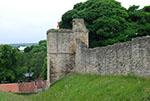
The remaining corner tower of the outer wall.
The buildings across the bailey in front of the keep entrance were once used as prisons within the old castle walls, but today serve as the Crown Court building and Castle Museum. Behind the courthouse is a small section of the outer bailey wall and a small corner tower that avoided destruction when the remainder of the outer bailey was removed during the early 20th century. York Castle can be thoroughly explored in approximately an hour or two. For convenience, a car park is located next to the castle. York Castle is also a manageable walk from York train station.
The city of York surrounding the castle is well worth a visit. Highlights include cobblestone streets, Viking and Roman history, and the York Minster. For spine-chilling fun, I recommend the Ghost Hunt of York, which begins at Shambles every night at 7:30 PM.
The castles of Knaresborough, Spofforth, and Ripley are located within 50 miles of York to the east, towards Harrogate.
Read the story of the Bleeding Walls of Clifford's Tower.