Burg Stahleck
History
Burg Stahleck was built above the town of Bacharach in the late 11th or early 12th century, possibly on an older fortification, and began as a fief of the Archbishops of Cologne. Goswin von Stahleck was first recorded as its lord in 1120-21 and confirmed as a Cologne vassal in 1135. In 1142, King Konrad III elevated his brother-in-law Hermann von Stahleck, Goswin's son, to Count Palatine of the Rhine, and Bacharach became the command center of the Rhenish Palatinate. It was the first large castle north of Bingen on the River Rhine.

After Hermann died in 1156, Emperor Frederick Barbarossa gave the Palatinate to his half-brother Konrad of Hohenstaufen. In 1193 or 1194, Konrad's daughter and heiress Agnes married Henry the Elder of Brunswick, the son of Heinrich der Löwe (Henry the Lion), in secret at Stahleck Castle because the two families were in a bitter feud. The "Wedding of Stahleck" was meant to reconcile the Hohenstaufen and Welf families, but the peace did not last. Henry took over the Palatinate after Konrad's death in 1195. When his son, Henry the Younger, died childless in 1214, the Palatinate went to Duke Ludwig I of Bavaria of the House of Wittelsbach, and Stahleck itself passed to the Wittelsbachs in 1222, when Ludwig's son Otto II married Agnes of Brunswick, Henry the Younger's sister.

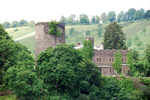
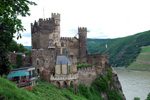
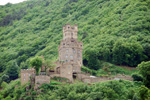
The great hall and keep.
Ludwig I moved his main seat to Heidelberg, and Stahleck was used only occasionally and run by burgraves. It still hosted important occasions: Charles IV married Anna of the Palatinate there on 4 March 1349, and Ruprecht celebrated his election as King in 1400. Between 1344 and 1366, officials enhanced the fortifications in Bacharach by adding walls, towers, and gates, and the castle was integrated into the town walls.
Stahleck Castle was besieged, conquered, and sacked eight times during the Thirty Years' War. Spanish troops under Ambrosio Spinola took the castle and town on 4 October 1620, and Protestant Swedes evicted them in January 1632. In 1635, Imperial troops under Matthias Gallas captured the castle until they were ousted by Weimaran soldiers in French service in 1639. In the autumn of 1640, Spanish troops reoccupied the castle after a 14-day siege, and in 1644, the castle was taken by French soldiers after a 10-day siege. A month later, troops from Cologne under Constantin von Nievenheimb forced the French back into the castle and bombarded it, as the commander preferred bombardment to capturing it. The French finally left in 1650.

The castle above the vineyards.
In 1666, Elector Karl Ludwig had the castle repaired and altered, adding a timber-framed upper floor, and a plaque on the courtyard side bears his inscription. This was short-lived. The castle's commander surrendered it to the French in October 1688, and on 15 March 1689, during the War of the Palatine Succession, French troops blew up the powder stores in the vaults. The explosion destroyed the curtain wall and keep, and fire gutted the residential buildings. The castle was never rebuilt.
The ruin passed to France in 1801 and to Prussia in 1815, and in 1828, Crown Prince Frederick William IV bought it. In the 1850s, large parts of the unstable walls were demolished, and the rubble filled the courtyard and moat. The Rhenish Association for Landmark Preservation and Landscape Protection bought the ruins in 1909 and began restoration work, creating the youth hostel between 1925 and 1927, with the boys' hostel opening in June 1926. The great hall was restored in 1930-31 and the main residential building rebuilt in 1934-35. During the Nazi era, the castle was used for youth indoctrination courses and, in the early 1940s, as a military hospital and a camp for young people. The hostel reopened in 1947, and the keep was raised by four meters and given its roof between 1965 and 1967, when the castle was modernized. The interiors were modernized again in the 1990s.
Castle Highlights
Burg Stahleck is not open for visitors but serves as a youth hostel with 168 beds, allowing the castle to be viewed up close from the courtyard, which is open to the public. A 2.6 meter thick shield wall surrounds one side of the castle with angled watchtowers at each end and a covered wall walk.

The keep and great hall from the vineyards.
Burg Stahleck also has a water-filled moat, a rarity in Germany, especially for a hillside castle. Cut into the rock in front of the shield wall, it holds about 500 cubic meters of water and has served as a cistern since 1928-29. The great hall stands on the river side of the castle and the round keep with its cone-shaped roof has a diameter of 7.5 meters.
Castles that are open to the public can be found just south along the River Rhein, including Burg Sooneck and Burg Rheinstein.