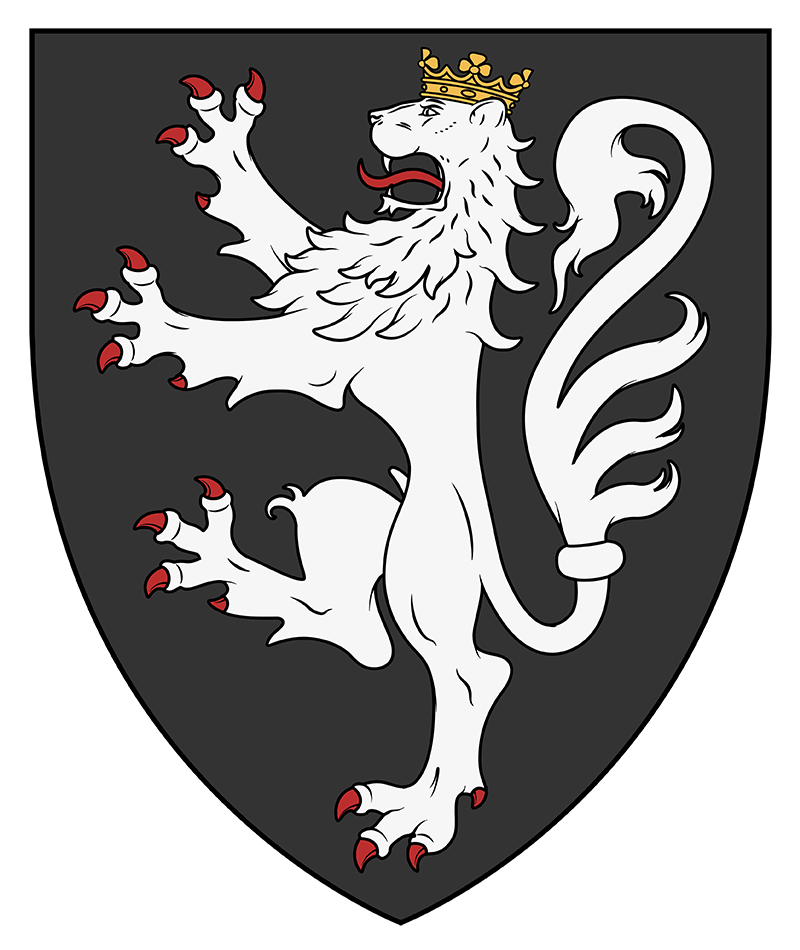
Nicholas Segrave - 1st Baron Segrave
Nicholas Segrave was an English Nobleman and soldier. He first supported Simon de Montfort against the King during the Second Barons' War, and later reconciled with the crown.

Nicholas was born around 1238, likely near the family seat at Segrave in Leicestershire, England. He was the son of Gilbert de Segrave and Amabel de Chacombe, heiress of Robert de Chacombe.
In 1254, Nicholas Segrave's father, Gilbert de Segrave, died. Nicholas was still a minor, aged 16 or 17, so Prince Edward, future King Edward I, was granted custody of his inherited lands.
Around 1255, Nicholas married Matilda (Maud) de Lucy, and they had seven children: John, Nicholas, Henry, Simon, Gilbert, Annabel, and Eleanor.
On April 18th, 1258, Nicholas performed homage to the King, which enabled livery of the inherited lands. No disputes over his inheritance are recorded in contemporary administrative rolls.
Later, on September 16th, 1261, Segrave demonstrated loyalty to King Henry III at Windsor Castle by swearing to serve the King faithfully and never oppose him. However, as a major landholder in Leicestershire, his interests aligned with barons who supported the Provisions of Oxford, which sought to curb royal authority through a council of barons and parliaments.
In late 1263, Segrave joined the baronial opposition led by Simon de Montfort, Earl of Leicester, following Henry III's announcement of papal absolution from the Provisions of Oxford. This deepened baronial disaffection with the King.
In early 1264, during the Second Barons' War, Nicholas defended Northampton against royalist forces, but after the town fell, he escaped to London. From there, he joined the baronial siege of Rochester Castle, which surrendered to Simon de Montfort's army.
On May 14th, 1264, Segrave commanded the London contingent at the Battle of Lewes, a victory for the baronial side, but his wing suffered heavy losses after Prince Edward's charge.
On August 4th, 1265, Segrave fought again for Simon de Montfort at the Battle of Evesham, where the Royalists and Prince Edward won a decisive victory. Simon de Montfort was killed, and Nicholas Segrave was wounded and taken prisoner. His lands were granted to Edmund of Lancaster.
He then joined the "disinherited" holdouts on the Isle of Ely and was later reconciled under the terms of the Dictum of Kenilworth, regaining his estates upon payment of a composition. The King formally pardoned him on July 1st, 1267.
In 1270, after regaining royal favor, he joined Prince Edward on crusade to the Holy Land. Later, after Edward became King Edward I, Segrave fought for the King in campaigns against Llwelyn ap Gruffudd, Prince of Wales, in 1277 and 1282.
Segrave was summoned to Parliament in Shrewsbury in August of 1283, where he was created Baron Segrave by writ. This reflected his restored standing after his pardon following the Barons' Wars and his subsequent service to the King.
Nicholas Segrave died before November 12th, 1295, as shown by the royal writ issued that day to begin inquiries into his lands and heir for feudal succession. His eldest son, John de Segrave, succeeded him as 2nd Baron Segrave and inherited his estates.
Nicholas Segrave was buried at Chacombe Priory in Northamptonshire, England, where his family had ties through his mother's lineage.