King John's Castle
History
Built in 1210 by John, king of England and Lord of Ireland, King John's Castle, also called Limerick Castle, stands along the River Shannon in Limerick, Ireland. The current site of King John's Castle was formerly a Viking fortress on King's Island, established in 922.
The story of Limerick's control shifted in 1169, when the Anglo-Norman invasion of Ireland began in earnest under Richard de Clare (Strongbow), bringing many of Ireland's port cities under Anglo-Norman rule.
By 1172, after a brief agreement between Domnall Mór Ó Briain, king of Thomond, and Henry II of England, an Anglo-Norman garrison was placed at Limerick. However, Ó Briain quickly reneged, besieging the town. Henry II dispatched Raymond le Gros FitzGerald to restore order, leading to the construction of an early ringwork-style castle in the north-eastern corner of today's King John's Castle.
After Richard de Clare's death in 1176, the garrison withdrew, and Ó Briain regained control of Limerick. During this time, the ringworks were destroyed, and the surrounding ditch was filled in.
Ó Briain's death in 1194 opened the door for the Anglo-Normans to retake the area in 1195, now led by John, Lord of Ireland. After ascending to the English throne, John ordered the construction of a new castle at Limerick to defend the city and secure the crown's interests. By 1212, the castle was complete, and extensive work produced the iconic twin-towered Gatehouse and North-East Tower, marking a new phase of the castle's development.
With the new castle on the River Shannon, Limerick prospered. King John established a mint inside the castle and appointed Godfrey de Rupe as its administrator. A chapel dedicated to St Andrew was also founded. By King John's death in 1216, the stone twin-towered Gatehouse and North-East Tower had risen, but the remaining outer walls were still earthwork or timber.
Subsequent royal attention continued under Henry III of England, who added two great river towers at each end of the western curtain wall. This section of the wall also included the castle's Water Gate, which is now the only surviving medieval town gate in Limerick. Around this time, the city walls were extended to encompass Limerick Castle, increasing its security against attack.
In 1280, King Edward I ordered the construction of a large two-story hall along the western curtain wall. This hall was demolished in the 18th century, but its undercroft surfaced during 1993-1994 excavations. In the late 13th century, the inner courtyard sloped steeply from the northeast high ground toward the Water Gate. In 1297, laborers leveled the courtyard, producing the even ground visible today.
In 1316, Limerick Castle was briefly captured by Edward de Brus, the brother of King Robert the Bruce of Scotland.
In 1370, Limerick was seized and burned, then reclaimed later that year. In 1423, James FitzGerald, 6th Earl of Desmond, was appointed constable and provided funds for repairs, yet the mayor and council distrusted him and petitioned King Henry VI for control, which they received.
During a visit to Limerick Castle in 1574, a priest named David Wolfe described the castle as “unoccupied for many years, with decaying buildings and walls”.
During Queen Elizabeth's reign, she created the office of Lord President of Munster. This led to new regional fortifications and increased spending on existing strongholds, including Limerick Castle. The earliest surviving maps of the castle and city date to this era.
Between 1579 and 1583, during the rebellion of Gerald FitzJames, 14th Earl of Desmond, the practice of confining prisoners at Limerick Castle was reinstated, and the practice of holding men of rank as hostages for ransom was revived. In 1581, John Shereff, vice-constable of the castle, and his wife were implicated in a successful breakout by prisoners being held at the castle. A contemporary report states that the pair “were recompensed for it shortly after, for they both were lovingly hanged together.”
In 1611, the Bastion was constructed in the south-east corner of the castle.
In May and June 1642, Limerick Castle experienced its most traumatic period. In the fall of 1641, widespread rebellion began in Ulster. About 600 English Protestant settlers fled the city of Limerick and took refuge in Limerick Castle. The Mayor of Limerick, Dominick Fanning, a Catholic, arranged for a large Catholic army raised in Munster to be admitted within the city walls of Limerick in May 1642. Limerick quickly fell with scarcely a shot fired.
Captain George Courtenay, 1st Baronet of Newcastle of Powderham, and constable of the castle, assumed command of what remained of the garrison and prepared to defend the castle. The Confederate Munster army, led by General Garrett Barry, laid siege to the castle on May 18th, 1642. The besieging forces lacked siege weapons or the firepower to batter the castle walls and resorted to digging timber mines under the foundations of the walls and setting them ablaze. The garrison inside the castle responded by digging countermines, which were meant to intercept incoming miners. These mining activities lasted several weeks. Eventually, the Irish miners successfully mined under the northern corner of the Bastion, which was quickly followed by the collapse of the southern end of the eastern wall.
Once the castle walls were breached, George Courtenay surrendered the castle to General Barry on June 23rd, ending a thirty-seven-day siege. During the siege, the lives of 280 people were claimed by those who occupied the castle. Many of them were buried in the courtyard while the siege was still underway. One of these burial pits was discovered during the 1993 excavations and included the skeletons of 14 women and children, who likely died of dysentery, which broke out in the castle near the end of the siege. The 1642 Siege of Limerick was the first of five sieges of the city of Limerick in the 17th century.
In 1751, the castle saw its most important addition since the Bastion was built 140 years earlier: a large barracks. The fortuitous timing of this construction became clear in 1760, when work began to dismantle the medieval town walls. Absent the barracks and a new function, the castle might have been demolished as well.
Limerick Castle was first referred to as King John's Castle in 1787 by John Ferrar, in his book, The History of Limerick.
In 1793, the barracks were enlarged, resulting in the demolition of the eastern curtain wall and part of the Bastion to create a parade ground opening to Nicholas Street. The old storehouse, originally built as the Great Hall by Edward I, was also levelled.
In May 1922, the British military withdrew from the castle, and custody passed from the Royal Welsh Fusiliers to a Provisional Government force commanded by General Michael Brennan. A few months later, the castle fell into Republican hands, and the barracks were set on fire on July 21st, 1922, before the castle was retaken.
In the 1970s, authorities demolished two of the three remaining barracks buildings due to safety concerns and repaved the courtyard, allowing the Office of Public Works to conduct its first archaeological excavation in 1976.
A restoration plan for the castle as a National Monument was devised in 1988. As part of this plan, all housing added to the courtyard was removed. Excavation revealed the remains of the eastern curtain wall. A new visitor center was constructed above the archaeological excavations on the eastern edge of the courtyard. This design ensures excavation features are both preserved and displayed within the center.
Castle Highlights
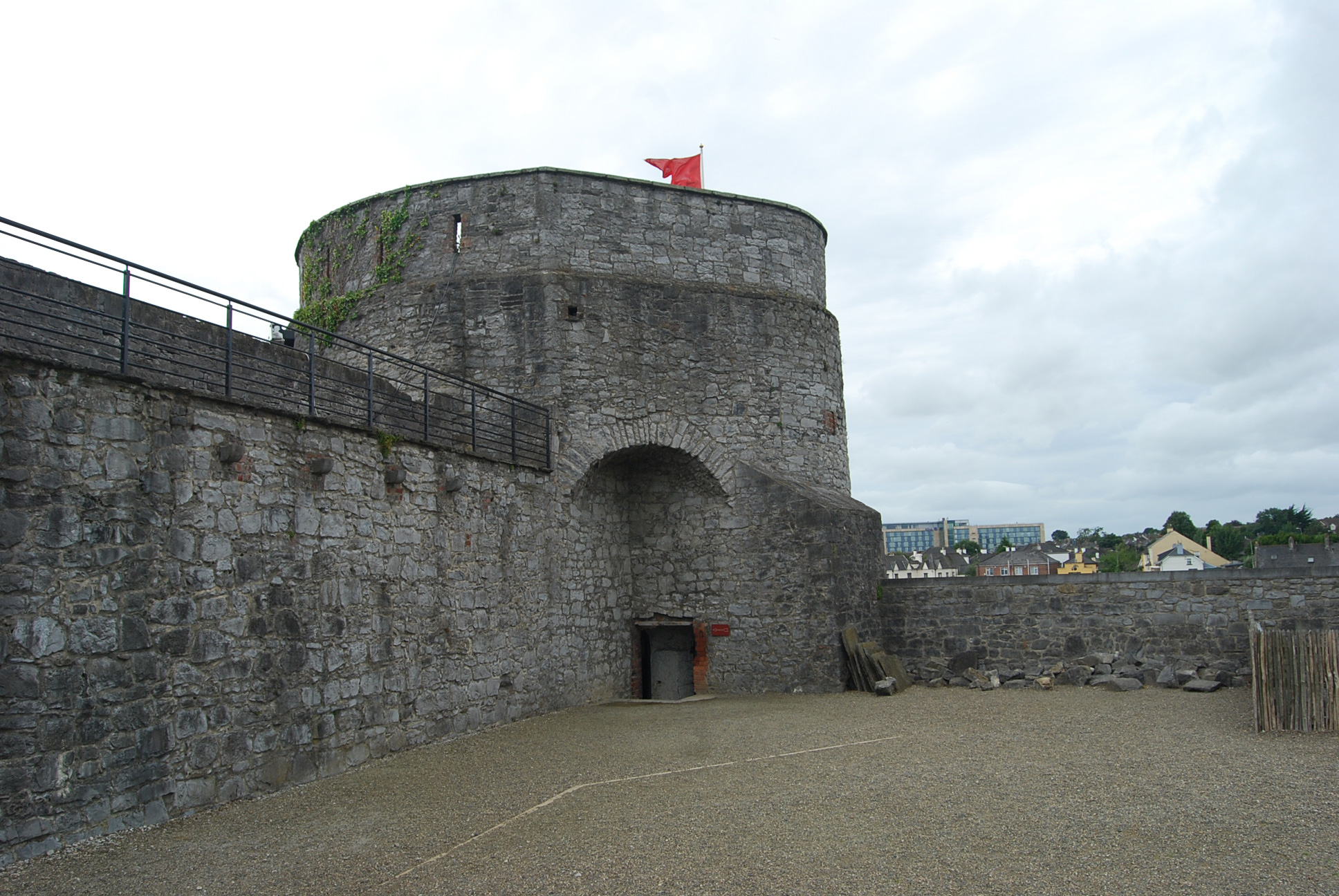
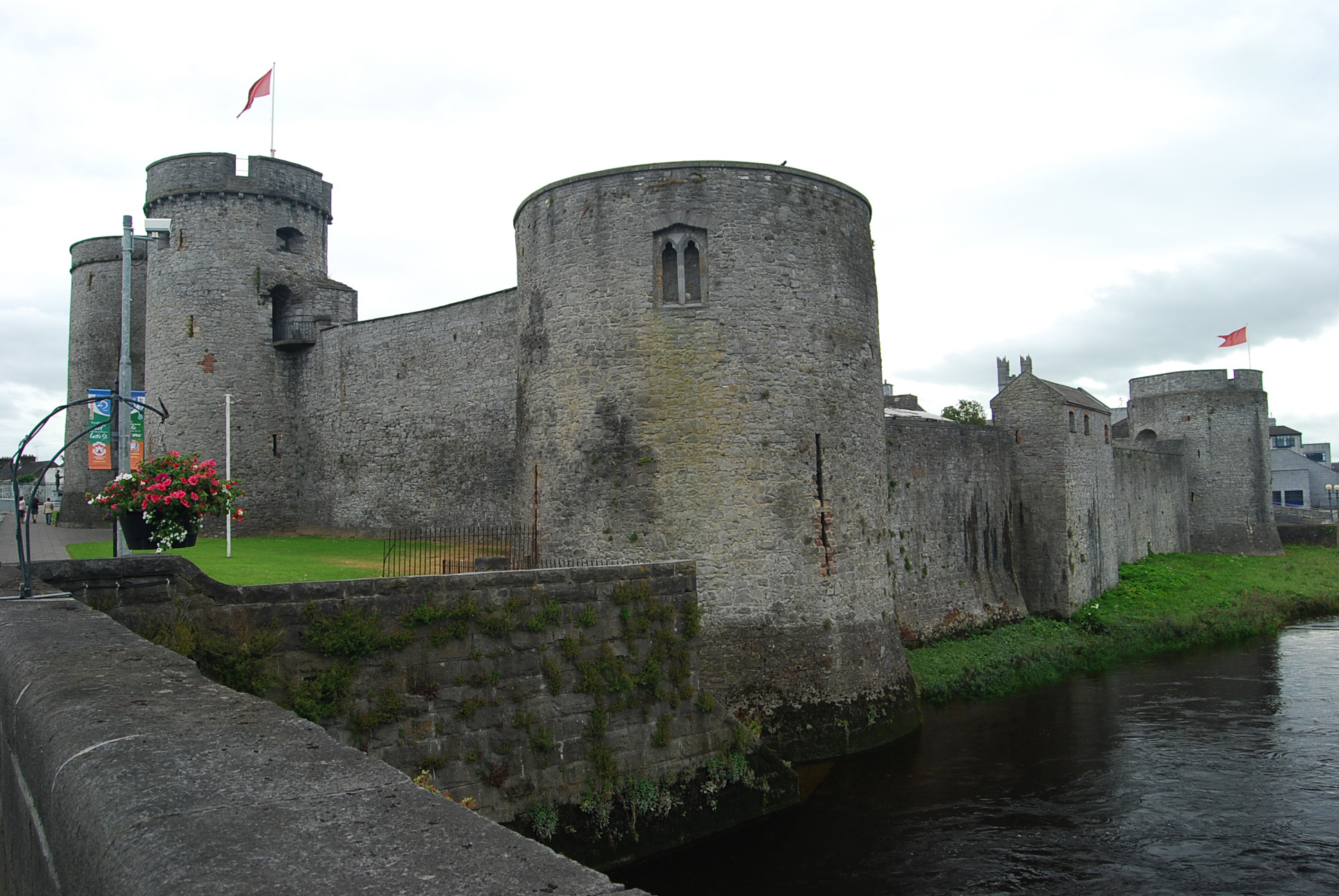
King John's Castle ranks among Ireland's largest. It overlooks the River Shannon from King's Island in Limerick. Cross the bridge for a scenic view from the other side. The rectangular inner bailey is encircled by lofty curtain walls and massive round corner towers on three sides, with the square Bastion Tower in the southeast corner.
The massive Gatehouse is flanked by imposing twin round towers. The North-East Tower features distinctive double-arrow loops, allowing two archers to control the area around the castle.
The visitor center displays preserved excavation work from the 1990s, with the upper floors featuring exhibits that bring to life the castle's medieval history.
You can easily spend half a day at the castle or longer. If you want to try another castle on the same day, Bunratty Castle and Desmond Castle in Adare are less than an hour from Limerick.
King John's Castle is also haunted.