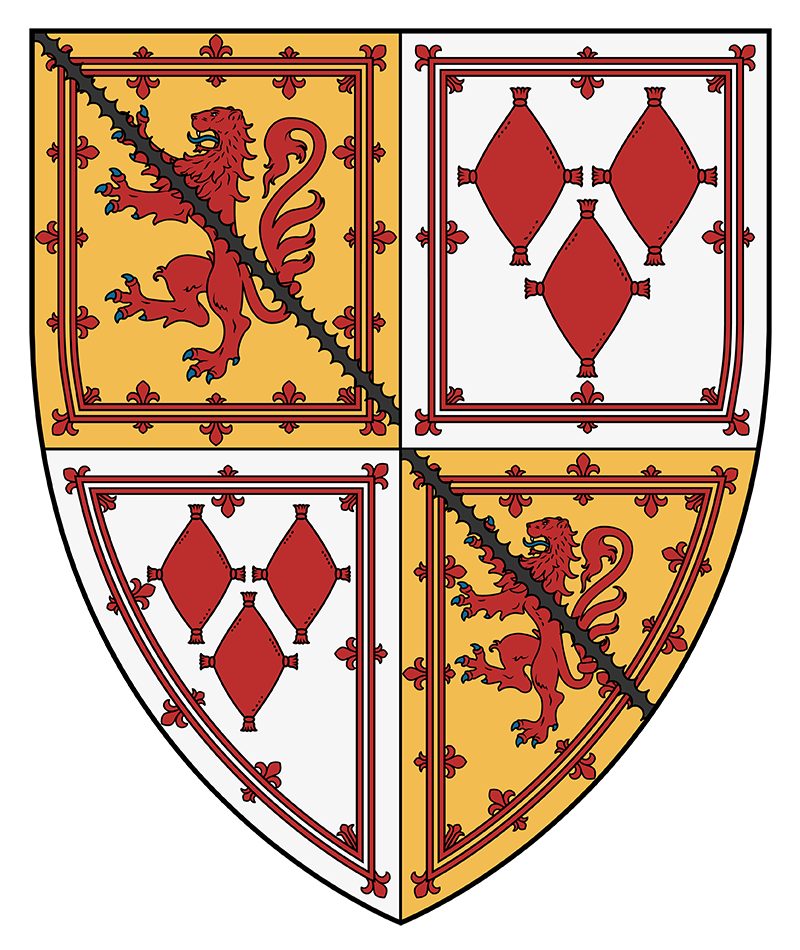
James Stewart - 1st Earl of Moray
The Gude Regent
James Stewart was a Scottish Nobleman, the illegitimate son of King James V, half-brother to Mary, Queen of Scots, and Regent of Scotland for his nephew James VI from 1567 until his assassination.

James was born around 1531 at Dunnottar Castle. He was the illegitimate son of King James V and his mistress, Lady Margaret Erskine, daughter of John Erskine, 5th Lord Erskine.
In 1536, James received a royal charter for the lands of Tantallon and Tantallon Castle. It was more a land grant than a grant of personal control, as he was only around five years old.
In 1538, he was appointed Prior of St Andrews.
In 1549, James entered into a contract of marriage with Christina Stewart, 4th Countess of Buchan, though she was just a few years old. As a result, James gained possession of her lands.
In August 1557, James Stewart led a raiding party from Edinburgh towards Ford Castle in Northumberland with his half-brother, Lord Robert, and Lord Home. They burned houses in Fenton and Glendale before retreating as an English force led by Henry Percy, later 8th Earl of Northumberland, approached.
In June 1559, he converted to Protestantism during the Scottish Reformation and became a leader among the Protestant Lords of the Congregation.
When his half-sister, Mary, Queen of Scots, returned to Scotland in 1561, James supported her despite their religious differences and became her chief advisor. Mary created him Earl of Moray in 1562 and briefly Earl of Mar. With the Earldom of Moray came Darnaway Castle.
In 1562, James married Agnes Keith, daughter of the Earl Marischal. They had three daughters: Elizabeth, Annabel, and Margaret.
On October 28th of the same year, James Stewart defeated a rebellion led by George Gordon, 4th Earl of Huntly, at the Battle of Corrichie. Huntly died immediately after the battle.
James opposed Mary, Queen of Scots' marriage to Henry Stuart, Lord Darnley, in July 1565. In August, he began a rebellion against Mary, known as the Chaseabout Raid. Rebels, including James and Archibald Campbell, the Earl of Argyll, who rose against Mary in the name of religion and bad governance. Both sides moved back and forth across Scotland without ever fighting until the rebel lords fled to England.
James Stewart crossed the border at Carlisle before making his way to Newcastle upon Tyne. He then headed towards London, but when he reached Royston, he received a letter from Queen Elizabeth I stating that he was not invited and was considered a rebel against his own Queen. He was then taken to Westminster in October 1565 to explain himself to Elizabeth and French ambassadors.
After the murder of David Rizzio, Queen Mary's private secretary, in March 1566, James was pardoned by Queen Mary and returned to Scotland. He became one of her key advisors again.
He distanced himself from the turbulent events surrounding Lord Darnley's murder and Mary, Queen of Scots' second marriage to James Hepburn, Earl of Bothwell.
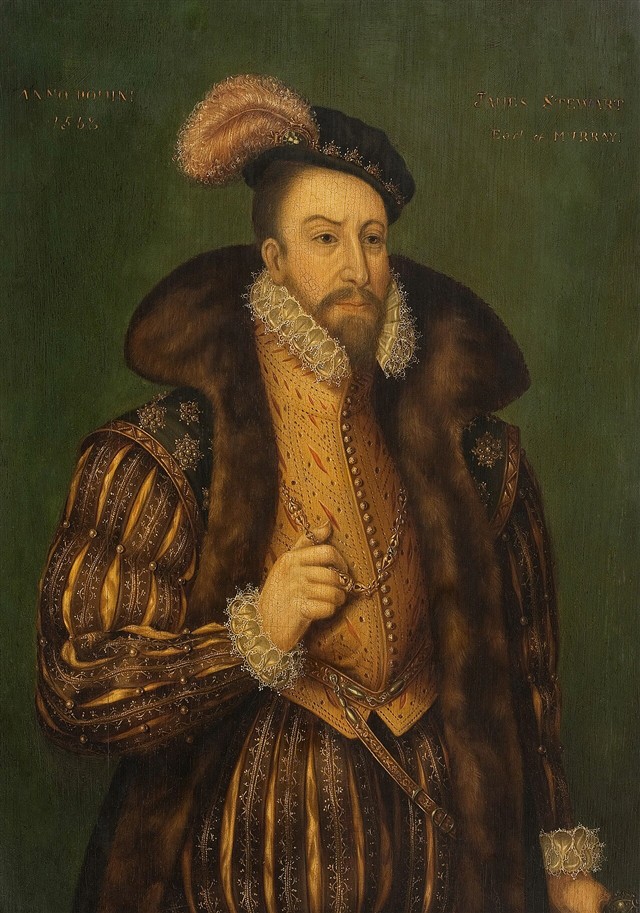
On July 24th, 1567, Mary, Queen of Scots, was forced to abdicate and was held at Lochleven Castle. James returned to Scotland from France on August 11th and was appointed Regent for the infant James VI on August 22nd. He earned the nickname "The Gude Regent" for his effective, Protestant, and pro-English governance.
On May 2nd, Mary escaped from Lochleven Castle and was supported by James Hamilton, Duke of Châtellerault, and other nobles. In response, Moray gathered an army and defeated her forces at the Battle of Langside on May 13th, 1568. Mary fled Scotland and took refuge in England.
In June 1568, James moved against Mary's supporters at the Raid of Dumfries. His army and the royal artillery were taken to Biggar, where his allies were commanded to muster before proceeding to Dumfries. There, he took Lochmaben Castle, Lochwood, and Lochhouse before returning to Edinburgh. In 1569, he was responsible for the destruction of Rutherglen Castle, which he burned to the ground in response to the Hamiltons supporting Mary at the Battle of Langside.
On January 19th, 1570, James invited the English diplomat Henry Gates and William Drury to Stirling Castle for dinner in the great hall. He said he would meet them and Scottish nobles at Edinburgh Castle on Monday or Tuesday to discuss the rendition of English rebels, the Revolt of the Northern Earls. He then sent letters to summon the Earls of Morton, Lindsay, and Hope to Edinburgh.
On January 23rd, 1570, James Stewart was assassinated by James Hamilton of Bothwellhaugh, a supporter of Mary, Queen of Scots, as James was passing in a cavalcade in the street below. Hamilton fatally wounded him with a matchlock carbine shot from the window of his uncle, Archbishop Hamilton's house. His death made James Stewart the first head of government to be assassinated by a firearm.
James Stewart, Earl of Moray, was taken to Holyrood Abbey and then later interred at St Giles' Cathedral in Edinburgh on February 14th, 1570. John Knox, leader of the Scottish Reformation, preached at his funeral. His wife Agnes was buried beside him when she died in 1588. His eldest daughter, Elizabeth, succeeded him as 2nd Countess of Moray, whose husband, James Stewart of Doune, acquired the earldom on their marriage.