Ghosts of Donnington Castle
Donnington Castle was built in the 14th century by Richard de Abberbury, a soldier who served the Black Prince and his son, King Richard II of England. It was one of several castles built around the same time by nobles who profited from England's wars with France.
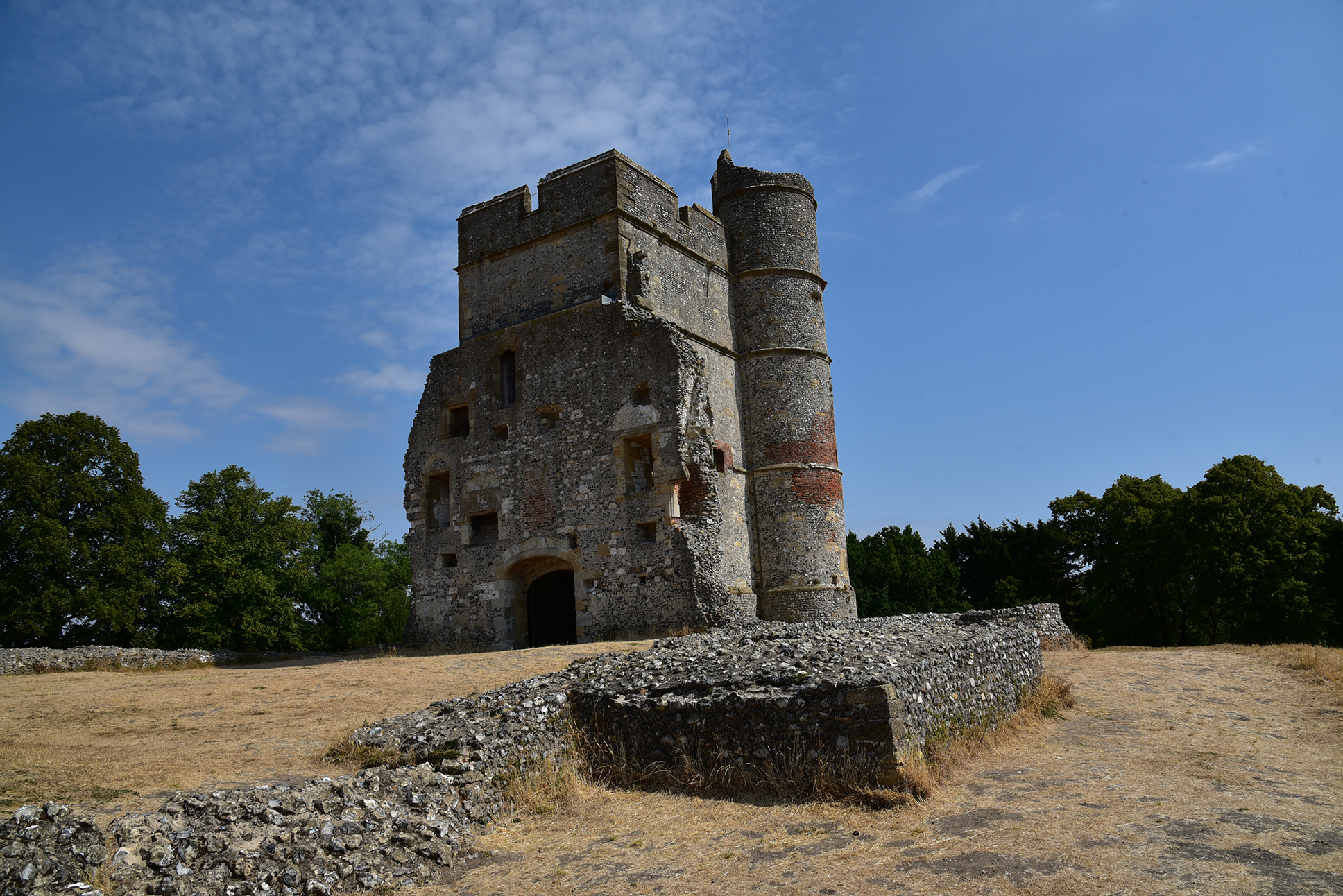
Donnington Castle was more of a luxurious residence than a defensive stronghold until the English Civil War, when it endured a 20-month siege by Parliamentarians. When the castle finally surrendered, they slighted it, leaving only the gatehouse standing.
The castle is still home to a few ghostly residents.
As Richard tells the story ...
The twin towers of the gatehouse.Donnington Castle's towering gatehouse, standing on a high spur and overlooking the old London-to-Bath road, is an awesome edifice that commands attention much as it has done since its construction in 1386. Built by Richard de Abberbury, chamberlain to Richard II's queen, Anne of Bohemia, its most eventful period was during the Civil War, when Charles I seized it from its owner, John Packer, and appointed John Boys commander of the garrison.
In July 1644, the Parliamentarian General Middleton arrived with 3,000 men and demanded that the garrison surrender. When Boys refused, Middleton launched an ill-conceived siege that not only failed to break through the castle's defenses but also cost him a tenth of his force. In September, a new force under a new commander loosed a 12-day volley of cannon fire at the walls. Three of the castle's flanking towers were blown to smithereens, and the curtain wall was breached, but still the valiant Boys refused to surrender. A month later, the Parliamentarians tried again and bombarded the castle with more than 1,000 shots. When they sent word demanding that the Boys submit, they received short shrift. Then word arrived that Charles I was on his way to relieve the defenders, and the attackers retreated. The exhausted garrison was reprovisioned and was able to enjoy a brief respite from hostilities.
When the Second Battle of Newbury ended in stalemate on October 28, 1644, another assault on the castle led by Sir William Waller ensued. Once more, the demands for surrender were met with an emphatic "no" from the gallant Boys, and a week later, a Royalist force commanded by Prince Rupert managed to relieve the garrison.
Colonel Boys used the respite afforded by the winter months to strengthen his defenses and was once more prepared to continue his valiant stand. The Civil War was drawing to a close, however. In March 1646, the Parliamentarians again demanded his surrender, so Boys sought the king's instructions and was told to get the best terms he could. On April 1, 1646, having withstood almost 20 months of constant siege, John Boys surrendered to his adversaries. Parliament then voted for the demolition of the castle, as it had become a symbol of valiant resistance. Today, all that remains are the twin towers of the mighty gatehouse, rising from the hillside to a commanding 65 feet (20 meters).
Needless to say, such a turbulent history has resulted in several ghosts. There are persistent reports of a spectral white dog that comes bounding down the hill from the castle towards the woods below. The creature makes no sound, and the first intimation that he is anything other than living flesh and blood is when he suddenly vanishes into thin air. A ghostly guard has also been seen around the gatehouse. Whether he is the shade of one of the castle's Civil War defenders is unknown, since he never stays around long enough for witnesses to ask him! One minute he'll be standing by the gatehouse, a solid and apparently human figure; the next he will suddenly disappear, as one witness put it, "like a bubble bursting."
- Richard Jones

