Craigmillar Castle
History
Around 1140, King David I bestowed land at Craigmillar upon the monks of Dunfermline Abbey. In 1253, the monks gained more territory from the laird of Craigmillar, but no record of a castle appears by this date.

In 1342, John de Preston from East Lothian acquired the estate of Gorton, near Roslin. Then, in 1374, his son Simon acquired Craigmillar from William de Capella. Simon held the town of Craigmillar from the crown as a hereditary fief in exchange for providing the sovereign with an archer to serve in the Scottish army. The tower house of the current Craigmillar Castle was built sometime before 1400 by the de Prestons, likely around the same time as David's Tower at Edinburgh Castle.
Craigmillar Castle first emerged in historical records in October of 1425, when Sir John Preston, Simon's great-grandson, affixed his seal to a charter there.
In 1479, Simon (III) Preston was implicated in the death of a member of the Scottish royal house of Stewart. King James III tasked Simon with holding his younger brother, John Stewart, Earl of Mar. The pretext for arresting John Stewart came from a dream James III had, in which a witch warned him he would die at the hand of his nearest kin. As a result, John was held prisoner at Craigmillar Castle, where he was accused of practicing witchcraft against the King. Sometime later, Simon arranged for the Earl of Mar to be taken to a house in the Canongate of Edinburgh. There, while in his bath and receiving the contemporary treatment of bloodletting, Earl John was killed under suspicious circumstances.
In 1511, James IV elevated Craigmillar to a barony for an annual rent of one penny. At this time, the outer courtyard around the tower house was built. In 1517, during an outbreak of the plague in Edinburgh, the infant James V was moved to the safety of Craigmillar Castle. A stable was built to house the King's mule. The Chapel in the outer courtyard was added in 1523.
On May 8th, 1544, English troops under Edward Seymour, Earl of Hertford, stormed and torched the castle after he ravaged Edinburgh during the Rough Wooing. Simon (IV) Preston was seized and swiftly released. As Provost of Edinburgh, Simon restored the castle and transformed the domestic ranges in the courtyard. He staunchly supported Mary, Queen of Scots, who named him to her Privy Council.
In 1561, Simon was in Mary's retinue when she returned to Scotland from France after her husband's untimely death. In September of 1563, Mary, Queen of Scots, stayed at Craigmillar Castle. There, she met the English ambassador Thomas Randolph and James Stewart, Earl of Moray, Mary's half-brother. Thomas Randolph advised the queen to find a suitable husband. She later married Henry Stuart, Lord Darnley.
In November of 1566, Mary, Queen of Scots, returned to Craigmillar Castle. By then, her marriage to Lord Darnley had already begun to fracture. In March of that year, she endured the brutal murder of her Italian secretary, David Riccio, slain before her eyes at Holyrood. Three months later, she delivered the future King James VI at Edinburgh Castle. Seeking solace and peace, she retreated to Craigmillar in November to recover from illness. She remained at the castle for three weeks.
Perhaps unknown to the Queen, a group of her advisors, including the Earls of Argyll, Huntly, and Bothwell, met secretly in the castle. There, they may have devised the fateful "Craigmillar Bond", the plot to murder her husband, Lord Darnley. The plan was for Darnley to stay at Craigmillar when he returned to Edinburgh. However, he did not care for Simon Preston, so he opted to stay at Kirk o'Field on the southern edge of the city. He was murdered there on February 10th, 1567.
After Darnley's murder, Mary's reign began to unravel. By June of 1567, she capitulated to Protestant lords at Carberry, four miles east of Craigmillar. Following her surrender, Simon Preston escorted her to Lochleven Castle, where she was imprisoned.
On June 2nd, 1571, Captain Melville and two of his soldiers were killed at the castle during the Marian Civil War when a barrel of gunpowder exploded. In 1572, Craigmillar Castle was used as a base by John Erskine while he laid siege to Edinburgh Castle. Stables were added to the castle for a company of light horsemen.
Simon (IV) Preston was the last Preston to serve as Lord Provost of Edinburgh. After him, the Preston family faded into obscurity. Later, a descendant sold Craigmillar Castle to John Gilmour in 1660; Gilmour also purchased the neighboring estate of “The Inch.”
As a Royalist, Gilmour reaped the rewards following the Restoration of King Charles II, ascending to Lord President of the Court of Session in 1661. He transformed the West Range at the castle to provide modern accommodations.
In time, the Gilmours found the old castle too antiquated and moved to Inch House. The last residents at the castle were two daughters of the laird. By 1775, the castle had become a romantic ruin.
In 1949, Sir John Little Gilmour entrusted Craigmillar Castle to state care. Today, Historic Environment Scotland safeguards the castle and welcomes visitors.
Castle Highlights
Craigmillar Castle is one of the best-preserved medieval castles in Scotland. Situated east of Edinburgh, visitors can admire a view of Edinburgh Castle from Craigmillar's roof.
The L-plan tower house anchors the castle's Keep. It soars seventeen meters to the battlements and fortifies itself with walls almost three meters thick. Giant yew trees overshadow the inner courtyard. A maze of rooms beckons exploration, including a great hall on the first floor.
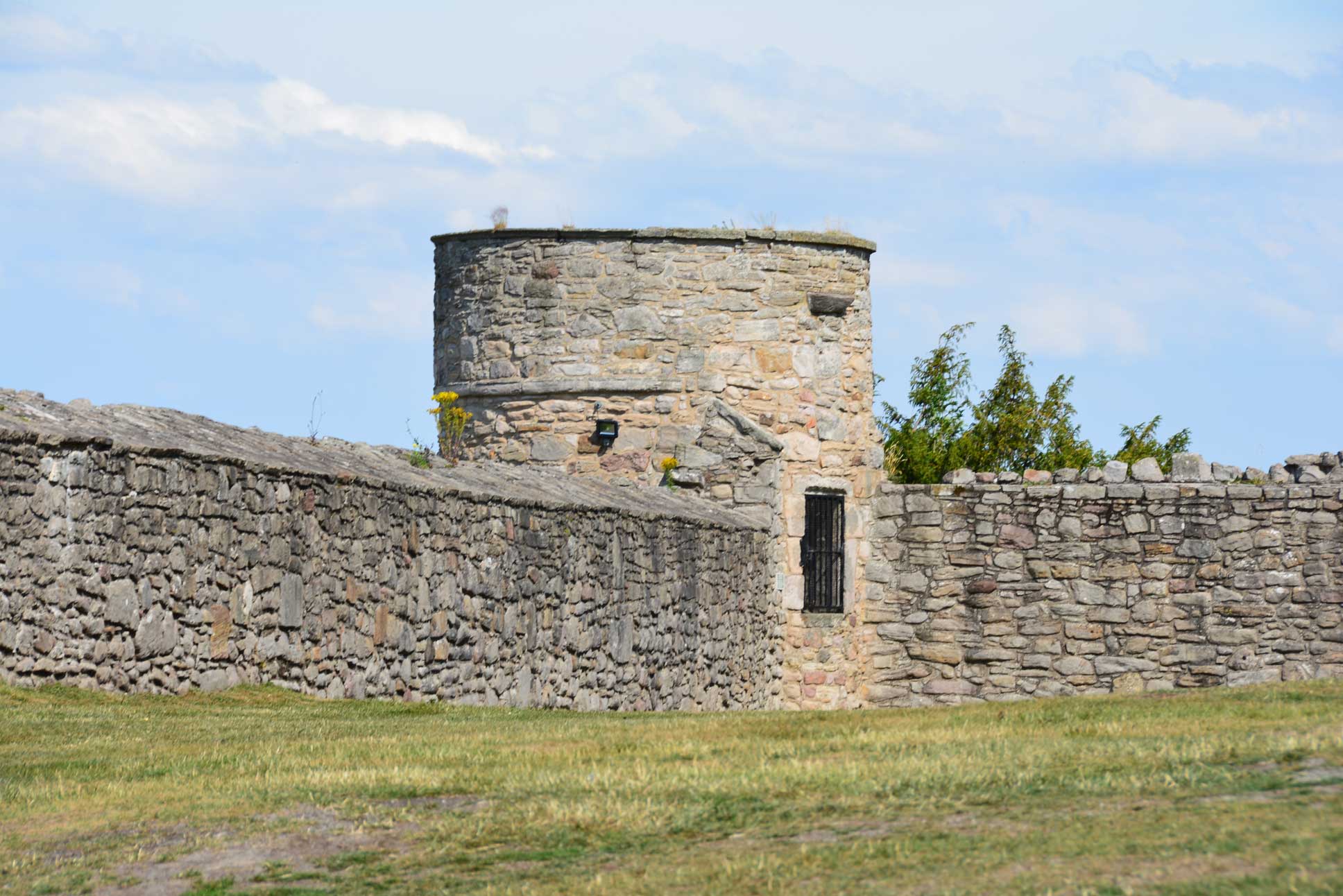
The outer courtyard features the private family chapel and the Dovecot Tower. The Gilmour family constructed the West Range in the 1600s, transforming it into their residence.
Craigmillar Castle offers a wonderful destination on the edge of Edinburgh. It rarely teems with crowds but will stand out to anyone who has watched Outlander or Outlaw King, where the castle appears in both.
The castle can easily be explored in a couple of hours to half a day. Roslin Chapel is not far from the castle, as are Crichton Castle or Hailes Castle if you want to fill a whole day. Edinburgh Castle is also close by, but it is large enough to take a whole day by itself while exploring the old town.
Craigmillar Castle is also haunted.