Clackmannan Tower
History
Clackmannan Tower stands at the summit of King's Seat Hill, a short walk from the town of Clackmannan. A royal residence probably stood on the site as early as the 12th century, and King David II, son of Robert the Bruce, was at the castle for his sixth birthday in 1330. In 1359, he granted the local estates to his kinsman, Sir Robert Bruce, and the two lower storeys of the main wing likely date from around that time. The first tower was finished around 1365.

In the 15th century, extensive alterations to Clackmannan Tower took place, including heightening the existing tower to five storeys and adding a second tower to the south, creating an L-plan castle with a crenelated parapet with machicolations, and the door moved down to the ground floor. A mansion was also added sometime in the late 16th century. In the late 17th century, a walled entrance court protected by a moat with a drawbridge was built to the east of the tower, and a new doorway with a decorated, pedimented frame was added to the tower itself.

The path up King\x27s Seat Hill.
The Bruce family went bankrupt in 1708 and sold the estate, though not the tower or mansion, and Henry Bruce later supported the Jacobites in 1745. His widow, Lady Catherine Bruce, lived at Clackmannan Tower until she died in 1791, aged 95. She entertained friends and acquaintances at Clackmannan, including the poet Robert Burns, who visited on August 26th, 1787, when she mock-knighted Burns using a sword said to have belonged to her ancestor, Robert the Bruce. As a Jacobite sympathizer, she argued that her right to do so exceeded that of the Hanoverian King George III.

Low ruined walls beside the tower.
By the end of the 18th century, the tower and mansion were abandoned, with the mansion being demolished sometime in the early 1800s. Stonework from the mansion may have been used to construct the Parish Church, built in 1815.
Coal mining beneath the hill from the late 18th century caused subsidence, and the tower began to lean. Much of the east side collapsed in 1948, and the tower was taken into state care. Historic Environment Scotland has since repaired the damage and restored the parapet walk.
Castle Highlights
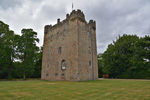
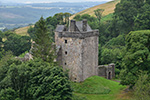
Despite the demolition of most of the castle complex, Clackmannan Tower is still impressive, rising five storeys in height. Due to its location on the summit of King's Seat Hill, it can be seen for miles.

The pedimented doorway added in the late 17th century.
It is free to roam around the grounds, which are open all year, but the interior is open only by special arrangement, such as the guided tours that Historic Environment Scotland offers during Doors Open Days in September. It is still worth a visit, but a bit of a walk from town. Parking in town is also a challenge as only a few spaces are available at the busy end of the High Street.
Look for the crenelated parapet walk on its machicolations, and the vaulted basements. Inside, the first-floor hall has a 16th-century fireplace, and there is a long, narrow gallery on the third floor. Clackmannan Tower is one of five sites on the Clackmannanshire Tower Trail, which covers the county's four medieval towers and one manor house, with information panels at each.
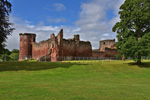
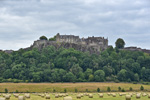
You can visit the Clackmannan Tower thoroughly in about an hour. To make a full day of visiting castles, Alloa Tower, Castle Campbell, and Stirling Castle are an easy drive from Clackmannan.