Burg Schönburg
History
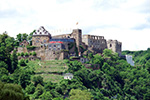
Burg Schönburg is a hilltop fortress perched on a steep slate ridge overlooking the River Rhine and the medieval town of Oberwesel in Germany's upper Middle Rhine Valley.

The castle was likely built in the first half of the 12th century. It may have served as an imperial fortification or as a defense of the Archbishop of Magdeburg's interests. It later became the residence and administrative center of the Lords of Schönburg, who collected Rhine tolls and controlled Oberwesel.
The first recorded mention of the castle dates to 1149, when Count Palatine Hermann von Stahleck held it as a fief. In 1148, Hermann allegedly let a rival, Otto von Reineck's son, starve before having him strangled.
In 1166, Emperor Frederick I (Barbarossa) exchanged properties to regain direct imperial control of the castle and Oberwesel. The Schönburg family, however, retained a connection to the fortress. The Lords of Schönburg consolidated power, administering Oberwesel as imperial bailiffs into the 13th century and accruing wealth from Rhine tolls. During the 13th century, the castle expanded into a Ganerbenburg— a shared fortress jointly owned by several family branches. Three keeps were constructed. At its peak in the 14th century, 24 families, roughly 200 people, occupied the castle. The Archbishop of Trier bolstered defenses by building the high shield wall and reinforcing the outer wards.
Among the Lords of Schönburg, the most famous was Friedrich Hermann von Schönburg, known as “Marshal Schomberg”. Serving as a 17th century general under the king of France, the Prussians, and Prince William of Orange in England, he was renowned for his military career. After Friedrich's son died, the Schönburg line ended, bringing to a close a significant chapter in the castle's history.
In 1689, French troops under Louis XIV plundered and burned the castle during the Nine Years' War, and their scorched-earth campaign in the Palatinate left the site in ruins for about 200 years. In 1885, German-American T.I. Oakley Rhinelander purchased the ruin from the town of Oberwesel and restored the castle according to historical plans, finishing most of the work by 1914. Later, in 1950, the town of Oberwesel bought the castle back from the Rhinelander family.
Since 1957, the Hüttl family has leased Burg Schönburg and operated a hotel and restaurant on the premises. The castle also houses a tower museum highlighting its history, folklore, and legends.
Castle Highlights
The best views of Burg Schönburg are from the River Rhine. To reach the castle, you can either take a steep 30-minute hike up the hillside on the RheinBurgenWeg trail or drive. If you arrive by car, the car park is located near the front of the castle, just across a small bridge.
Today, the castle not only serves as a hotel and restaurant but also invites visitors to walk the grounds while the restaurant is open. Additionally, the tower museum is open from 10am to 2pm, Tuesdays through Sundays in the High Season, and on weekends during the low season.
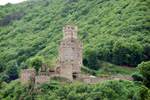
The castle includes a massive 14th-century shield wall called the Hoher Mantel, which features blind arcades and arrow slits. Additionally, the castle boasts three Keeps, or Bergfried Towers, including the Barbarossa Tower. Another highlight is the chapel, restored in the Gothic style.
From its vantage point, the castle offers grand views of the River Rhine and the town of Oberwesel, making it a scenic destination for visitors.
If visitors wish to explore more castles on the same day, Burg Rheinfels and Burg Sooneck are nearby and located on the same bank of the River Rhine.