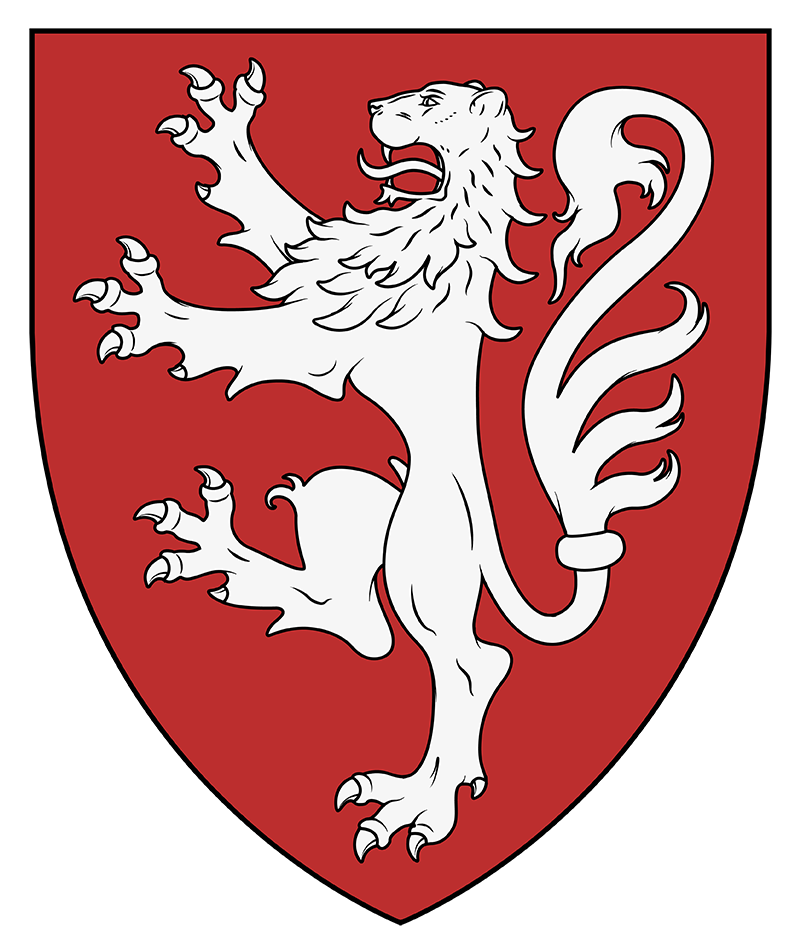
Roger de Mowbray
Roger de Mowbray was a 12th century Anglo-Norman Nobleman and magnate. He held extensive lands, supported religious institutions, and is credited with helping establish or support around 35 churches.

Roger was born in Yorkshire, England, around 1120. He was the son of Nigel d'Aubigny and Gundreda de Gournay. After his father's death in 1129, Roger, still a minor, became a ward of the crown.
When he came of age around 1138, he took control of his inheritance. He adopted the surname "de Mowbray" after the Norman lordship of Montbray (Mowbray), part of his father's holdings. He also held large estates in England centered on Thirsk and Melton, in Yorkshire.
In 1138, despite his youth, he fought at the Battle of the Standard against the Scots. As the army left Thirsk, the Yorkshire barons brought Roger with them. One of his earliest military experiences, the battle established him as a capable warrior. A stained-glass window in All Saints Church in Helmsley commemorates the event, displaying the coat of arms of Roger de Mowbray alongside those of William of Aumale and Walter Espec.
On February 2nd, 1141, Roger fought on King Stephen's side at the Battle of Lincoln. When the battle turned against them, many Earls fled, but Roger was among the barons who remained with the King. After his horse was killed, the King fought on foot and was eventually captured. Roger, along with several other barons, was taken prisoner and imprisoned. He was eventually released in late 1141 or early 1142.
Soon after his release, Roger married Alice de Gant, widow of Ilbert de Lacy and daughter of Walter de Gant. They had two sons, Nigel and Robert, and a daughter who became a nun at the Abbaye aux Dames in Caen. Her name is lost to time.
In 1147, Roger was one of the few English nobles to join Louis VII of France on the Second Crusade. Before departing, he defended claims such as the castle of Bayeux in Normandy. Influenced by the preaching of St. Bernard of Clairvaux, he then traveled with the French army as part of the crusade.
The French army suffered heavy losses, including a major defeat near Laodicea in early 1148. Praised for defeating a Muslim leader in single combat, Roger likely returned to England around 1149 or 1150. On the way back, he attended a chapter of the Cistercian order at Citeaux, where he advocated for Byland Abbey, which he established with his mother.
His experience during the Second Crusade deepened his religious devotion. He granted land to the Knights Templar in Warwickshire, where they founded Temple Balsall. He also made grants to Fountains Abbey and supported other sites, such as the Cistercian Abbey at Villers-Canivet in Normandy. He is credited with helping establish 35 churches.
In 1173-1174, Roger and his sons rebelled against King Henry II during the Great Revolt, but were defeated at Kinardferry. His castles at Thirsk and Kirkby Malzeard were besieged and destroyed. He eventually submitted to the King.
In 1186-1187, Roger de Mowbray returned to the Holy Land; there, he fought at the Battle of Hattin in 1187 and was captured by Saladin's forces. Reportedly, the Templars paid his ransom, yet he died soon afterward in 1188. Conflicting accounts of his burial remain: some claim he was buried at Tyre in Palestine. Others state that Byland Abbey monks later asserted his resting place was in their chapter house, as observed by commissioners during the Dissolution of the Monasteries in 1535.
Historians suggest that Roger was buried in the Far East after his death, with the monks at Byland likely erecting a commemorative monument to their founder rather than a grave.
His son, Nigel, continued the House of Mowbray, but also died on crusade in the Holy Land at Acre in 1191.