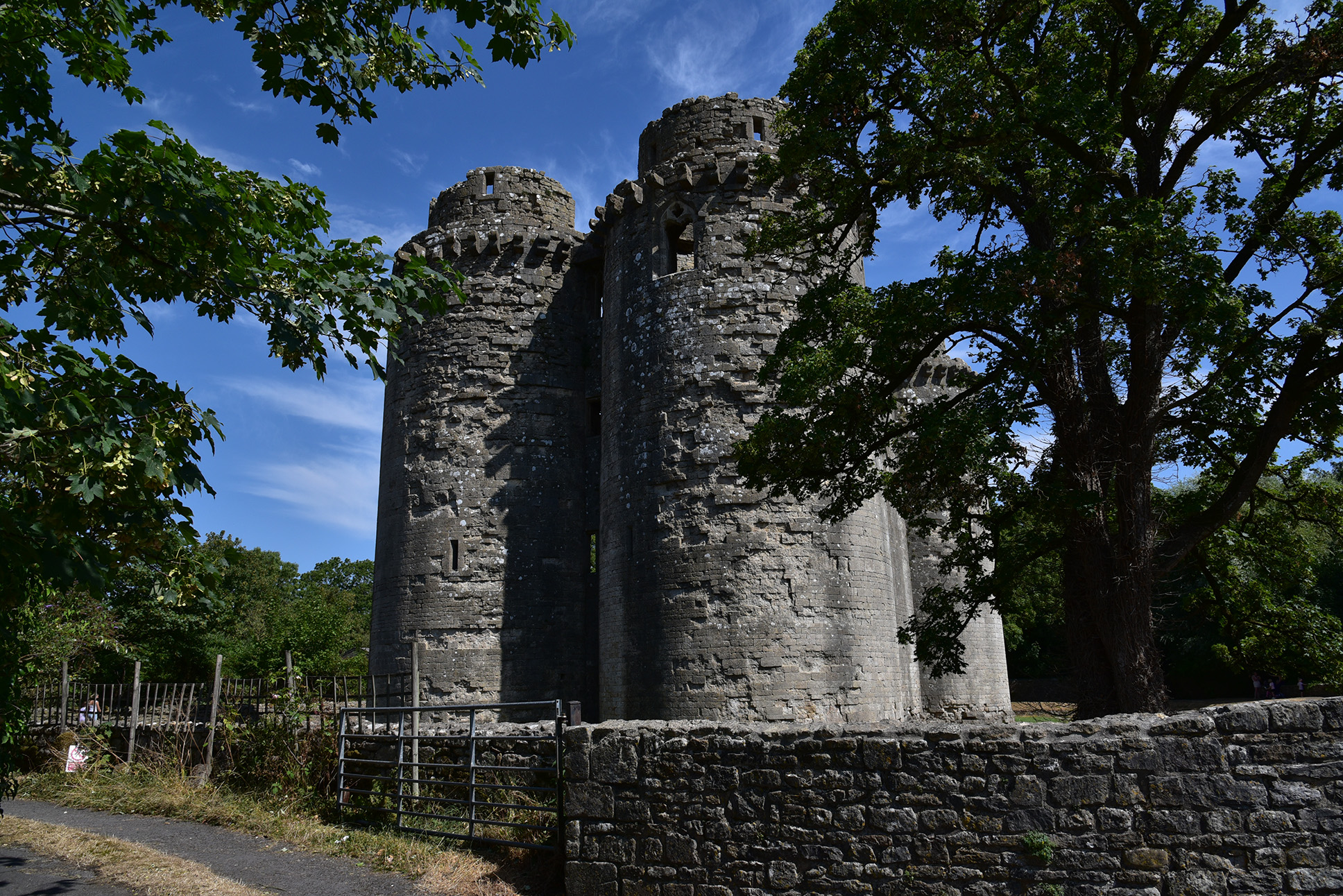
Nunney Castle
History
Nunney Castle is a picturesque medieval castle in the village of Nunney in Somerset, England.

John de la Mare (Delamare), a knight of modest means, built the castle after gaining wealth and royal favor from fighting in the Hundred Years' War in France. In 1373, King Edward III granted him a license to crenelate. John then built Nunney Castle next to Nunney Brook, on the site of his manor house, and became High Sheriff of Wiltshire in 1374.
Nunney Castle included a stone tower-keep with four round corner towers surrounded by a moat, perhaps inspired by castles Sir John would have seen during his military campaigns in France. The four corner towers originally had conical roofs.
John's son Philip inherited the castle, and then his grandson, Elias. When Elias died during Henry V's campaigns in France, the castle passed to the Poulet family through marriage. The Poulet family held the castle through most of the 15th century, though their primary residence was Basing Castle in Hampshire. William Poulet, Marquess of Winchester, was the last Poulet to own Nunney Castle, until he died in 1572.
After that, the castle passed through several owners before John Parker bought it in 1577 and sold it to Richard Prater a year later for two thousand pounds.
In the late 16th century, the Praters redeveloped the castle, enlarging the windows to let in more light. They also added a grand staircase inside one of the corner towers, a Catholic altar and a small terrace, or revetment, between the castle and the moat.
In 1642, the English Civil War began, and Colonel Richard Prater supported King Charles. As the war progressed, Nunney Castle remained one of the few Royalist strongholds in the southwest of England and was garrisoned with about 80 men in anticipation of a Parliamentarian attack, taking in many Catholic refugees. In September 1645, Parliamentarians under Lord Fairfax and Oliver Cromwell arrived in Somerset, taking Sherborne, Cary, and Shepton Mallet before focusing on Nunney. On September 18th, Parliamentarians surrounded the castle after Richard Prater refused to surrender. Their cannons opened fire and breached the walls, but Prater continued to hold out. Two days later, the castle surrendered. The castle was not further slighted because the cannon bombardment had already caused enough damage.
Richard Prater was not allowed to return to the castle, despite his promises to support Parliament. When Charles II was restored to the throne in 1660, Nunney Castle was returned to George Prater, Richard's son.
The castle declined and was sold to William Whitchurch around 1700. Still, enough of the castle remained serviceable, and in 1789 an order was received to prepare it to receive French prisoners, though they were likely never held there.
By the early 20th century, Nunney Castle was a ruin and covered in ivy. On Christmas Day, 1910, part of the north wall collapsed entirely, and local residents took most of the fallen stone, repurposing it in buildings in the village.
In 1926, the castle owner, Robert Bailey-Neale, transferred ownership to the Commissioner of Works, who began restoring the castle. Workers cleared the castle of plants and rubble and re-excavated the moat and the medieval drawbridge pit beneath the bridge.
English Heritage now maintains the castle as a tourist attraction.
Castle Highlights
Nunney Castle is a small but romantic castle, with tall walls and corner towers centered around a water-filled moat. It is free to visit, but for now, only from outside the moat, as work is being done to repair the bridge to the castle.
The tower is 54 feet tall and 60 feet long and 24 feet wide. It is three stories high and made of Lias Oolite ashlar stone. Originally, the tower stood within a larger courtyard enclosed by walls on three sides and Nunney Brook on the other, with support buildings lost to time.
The tower contained service areas and a kitchen on the ground floor, a hall on the third floor, and withdrawing chambers and living quarters on the top floor, which also included a chapel in one tower.
You can explore Nunney Castle in about an hour. It is worth the visit for the romantic ruin and moat, but combine it with other nearby castles, such as Farleigh Hungerford Castle to the north or Old Wardour Castle to the south.
Nunney Castle is also haunted.