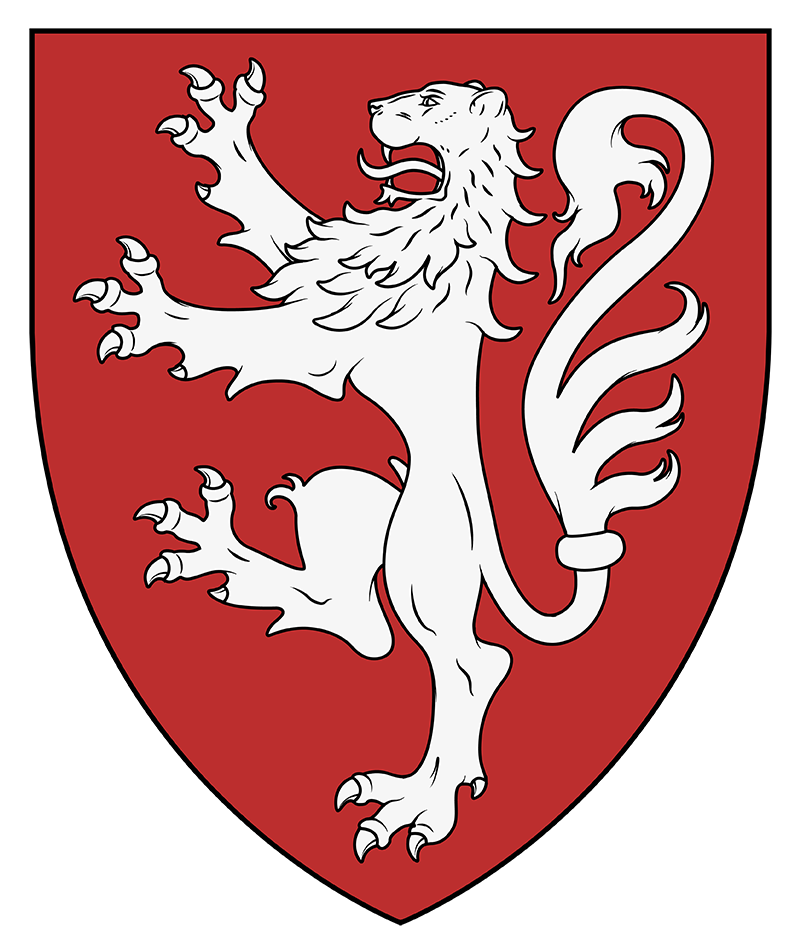
Robert de Mowbray - Earl of Northumbria
Robert de Mowbray was a powerful Anglo-Norman Nobleman in northern England. As Earl of Northumbria, he rebelled against King William II. He was the son of Roger de Mowbray of Montbray, near Coutances in Normandy, France.

After the Norman Conquest in 1066, Robert inherited significant English estates and became Earl of Northumbria upon Aubrey de Coucy's resignation in 1086. Robert fortified sites like Bamburgh Castle.
In 1088, Robert joined his uncle, Geoffrey de Montbray, in his failed rebellion against King William II to support Robert Curthose, but was later pardoned.
On November 13th, 1093, he led the army at the Battle of Alnwick, where King Malcolm III of Scotland and his son Edward died. Later that year, following the death of Geoffrey de Montbray, Robert inherited his uncle's vast estates, becoming one of England's most powerful barons.
Strengthening his political alliances, Robert married Matilda de l'Aigle in 1095, daughter of Richard de l'Aigle and niece of Hugh d'Avranches, 1st Earl of Chester. They had no children.
Later in 1095, Robert joined a rebellion supporting Stephen of Aumale for the crown. When most barons withdrew, Mowbray, Roger de Lacy, and William of Eu were left vulnerable. Robert seized four Norwegian boats on the River Tyne. The boat owners complained to the King, who summoned Mowbray to court. He ignored the summons, prompting King William II to march against him.
Consequently, Bamburgh Castle became Mowbray's refuge, but William responded by besieging the fortress and constructing a siege castle called Malvoisin, or “evil neighbor,” beside it. During the siege, Robert slipped away from Bamburgh Castle and was chased by besiegers to Tynemouth Castle. After six days of resistance there, he suffered a leg wound and returned as a captive to Bamburgh Castle, where his wife continued the defense. Ultimately, she surrendered the castle under threats to Robert's well-being.
Robert forfeited his estates and was imprisoned for life, initially at Windsor Castle. Chronicler Orderic Vitalis wrote that Robert "grew old without children." Orderic also described Robert as "Powerful, rich, bold, fierce in war, haughty, he despised his equals and, swollen with vanity, disdained to obey his superiors." After many years in prison, he became a monk at St Albans Abbey.
Robert's wife, Matilda, received an annulment from Pope Paschal II. She later married Nigel d'Aubigny, who gained Robert's forfeited lands in Montbray.
Sources differ on the date of Robert de Mowbray's death. Some claim he died after thirty years in prison, about 1125. William Dugdale claimed Robert became a monk and died in 1106. He was likely buried at St Albans Abbey.