The Marksburg
History
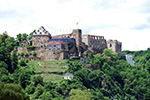
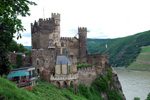
Originally named Burg Braubach, the Marksburg rises high above the right bank of the River Rhine, crowning a cone-shaped hill overlooking the town of Braubach. Of the roughly 40 hilltop castles between Bingen and Koblenz, it is one of only two that were never destroyed, and it is the only one that never fell into ruin.

The oldest stonework in the current castle dates from the 12th century. A fortification was first built here around 1117 to protect the town of Braubach and to reinforce the collection of taxes from those traveling on the River Rhine. The castle is first mentioned in documents in 1231, when it was held by the Lords of Eppstein. When the Eppstein family died out in 1283, Eberhard von Katzenelnbogen inherited the Marksburg through his wife. The Katzenelnbogens added the Gothic buildings that give the Marksburg its imposing shape and appearance today, and around 1340 they built a Gothic chapel dedicated to Saint Mark, which gave the castle its name.

Overlooking the River Rhine.
The castle stayed in Katzenelnbogen possession until 1479. The Katzenelnbogen family already possessed several other Rhine castles, including Burg Katz. With the death of Count Phillip the Elder in 1479, the castle passed from the Katzenelnbogens to the Landgraves of Hesse. The Marksburg was expanded to include batteries and bastions for cannons which may have had something to do with the Marksburg not being damaged during the Thirty Years' War when other Rhine castles were attacked. The castle had some additions in the 17th and 18th centuries but maintained its medieval character.
In 1806, Napoleon gave the castle to the Duke of Nassau, and it served as a state prison and a home for disabled soldiers. Prussia took it over after the Austro-Prussian War of 1866. In 1900, the German Castles Association (Deutsche Burgenvereinigung) bought the Marksburg for a symbolic 1,000 gold marks, and it has been the association's headquarters since 1931.

The Marksburg seen from below.
After surviving almost unscathed for centuries, the Marksburg suffered its worst days in March 1945, when it came under direct shellfire from American forces on the left bank of the Rhine, who were fighting Nazis hiding in the castle. Parts of the keep and nearly all of the roofs were destroyed or badly damaged, and it took several decades to repair.
Castle Highlights
The only way to see the inside of the Marksburg is by guided tour, and it is a well-designed one. After going through the Drawbridge Gate, the Fox Gate, the Notches Gate, and up the path, you will come to a covered entrance with roughed-in steps carved right into the slate floor. These steps were intentionally cut with a rough surface to keep the knight's horses from slipping on rainy days. After following the steps up to the courtyard, you will see the Great Battery, which houses the cannons that aim out over the lower Rhine, protecting the castle and the town of Braubach.

The Great Battery of cannons overlooking the Rhine.
Working around the upper bailey, you come to some steps that lead into the central courtyard where the Tower Keep rises 39 meters high. This is the heart of the castle. Giant wine barrels are located in the cellar below the Knight's Hall. You can visit the chapel dedicated to Saint Mark from the Knight's Hall, where the castle gets its name.
There is also a castle dungeon with many medieval torture devices on display and an armory displaying weapons and armor from different periods. The romanesque residential apartments include furniture to show the simple yet comfortable living conditions.

The Great Hall.
The tour lasts about 50 minutes, and tours in English run daily at 11:00, 1:00, and 4:00 in summer, and only on Saturdays and Sundays at 1:30 in winter. Well-behaved dogs are welcome. The Marksburg has a tavern and gift shop selling many items, including a paper scale model of the castle that you cut out and glue together to make your own Marksburg. I first visited the Marksburg in July 1990, on my first trip to see the castles on the Rhine, and it remains my favorite in Germany. If you want to see more than one castle on the same day, Burg Lahneck is just a few miles down the B42 toward Koblenz.
Burg Marksburg has a legend.