Inverness Castle
History
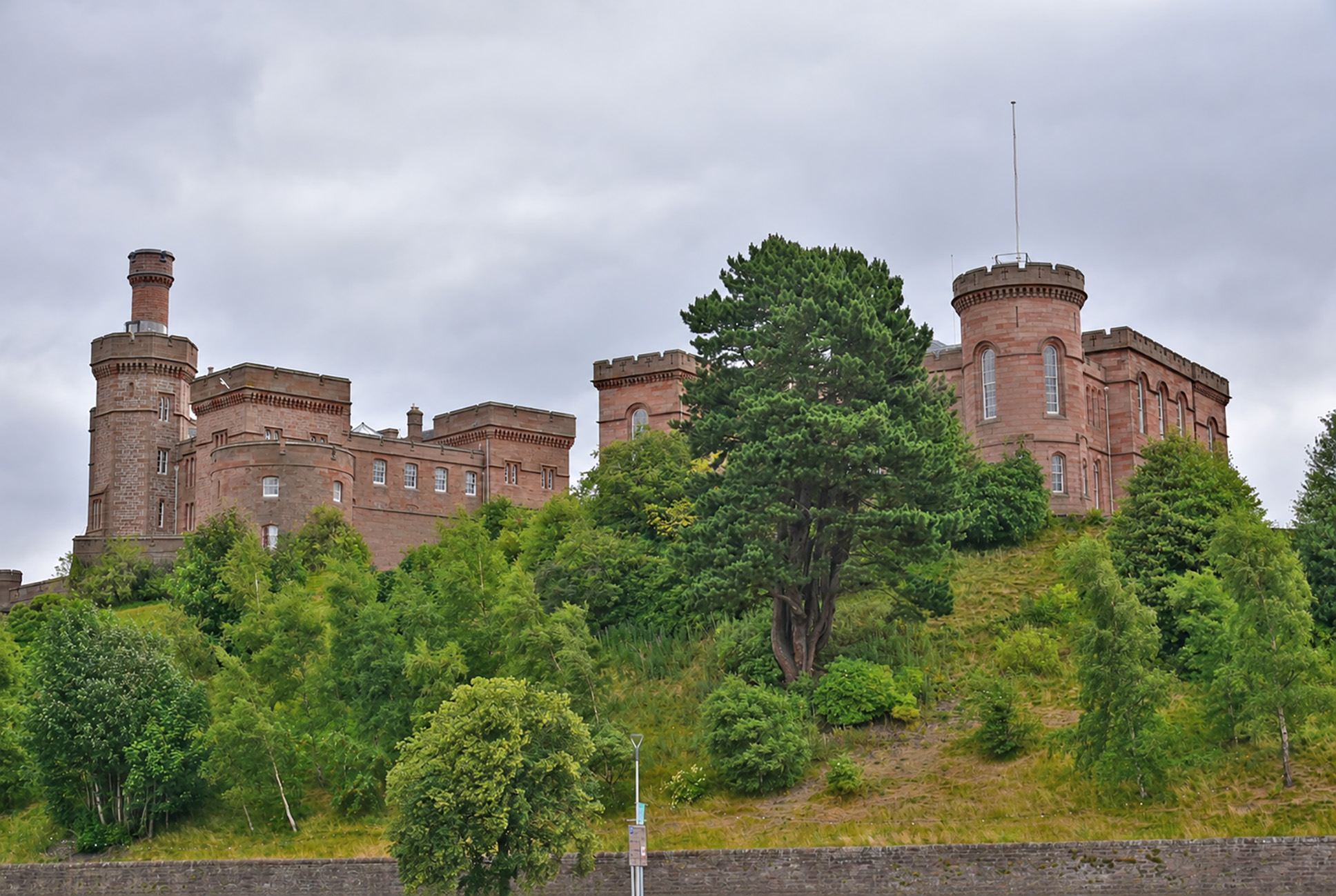
Inverness Castle sits on a hill overlooking the River Ness in Inverness, Scotland. A castle has stood here since 1057, though the red sandstone stronghold seen today was built between the 1830s and 1840s.
King Malcolm III is said to have built the first castle on this site in 1057 after destroying a castle associated with Macbeth at a different location, possibly Crown Hill.
In 1163, Malcolm IV appointed Shaw Macduff, Chief of Clan Mackintosh, as the castle's constable after he helped the King suppress a rebellion in Moray.
In 1307, King Robert the Bruce partially destroyed the castle by razing its battlements to the ground to prevent enemies from using it against him. The early castle was likely a timber castle.
The Earl of Mar began rebuilding the castle in stone in 1412. In 1428, King James I summoned Highland chiefs to a parlay at the castle, where he arrested and executed several of them on the spot. Alexander, 3rd Lord of the Isles, was taken prisoner and held for twelve months. After his release, he returned to Inverness with 10,000 troops and burnt the town in retaliation, though he failed to take the castle.
In 1491, the castle was occupied during the Raid on Ross. In 1498, Walter Ogilvy repaired the castle's two gemmel towers.
In 1509, King James IV made Alexander Gordon, 3rd Earl of Huntly, hereditary keeper of the castle and sheriff of Inverness. In 1548, George Gordon, 4th Earl of Huntly, added a tower to the castle as part of his obligation to James V and Margaret Tudor in connection with his marriage to Elizabeth Keith in 1530. George served as constable of Inverness Castle until 1562. Mary of Guise, Regent of Scotland, held justice courts at Inverness in August 1556.
In August of 1562, Mary, Queen of Scots, came to Inverness, where she was refused entry by the Gordons. They were soon ejected from the castle by the Clan Chattan, Clan Munro, and Clan Fraser. The clans besieged the castle for three days until it finally surrendered. Mary later hanged the governor, a Gordon. George Munro of Davochgartie and Milntown, who had helped Mary, was made keeper of Inverness Castle. In December, Mary ordered George Munro to resign as keeper and appointed John Ross, the Provost of Inverness.
In response to the Chaseabout Raid in August 1565, Mary, Queen of Scots, and Lord Darnley appointed Hucheon Rose of Kilravock as keeper of Inverness Castle on September 22nd, 1565. Then, in October, it was decided that George Gordon, 5th Earl of Huntly, should be keeper again.
In 1649, after the execution of King Charles I of England, royal forces in the north rose to support the exiled Charles II. On February 22nd, the Royalists entered Inverness and expelled the Covenanter garrison from the castle, demolishing part of the curtain wall and fortifications. Later, a Covenanter force under David Leslie, Lord Newark, approached, forcing the Royalists to retreat into Ross-shire. The Covenanters garrisoned nearby areas, but the Mackenzies retook the castle after Leslie departed.
In 1650, the castle was held by the Covenanters of Clan Fraser of Lovat, under James Fraser of Brea. Royalists under Lewis Gordon, 3rd Marquess of Huntly, besieged the castle, but it held strong, and the Royalists retreated. Oliver Cromwell then strengthened the fortifications in Inverness, building a new citadel near the mouth of the River Ness in 1652.
During the Jacobite Rising that followed the Glorious Revolution, when James VII was deposed in favor of William and Mary, the Clan Macdonald of Keppoch raided Inverness and the castle.
During the Jacobite Rising of 1715, Inverness Castle was held by Clan Mackenzie, led by John Mackenzie of Coul, with support from the MacDonalds of Keppoch. Government forces led by Simon Fraser, 11th Lord Lovat, assembled on the opposite side of the River Ness. Simon Fraser used diplomacy and threats to deter reinforcements to the castle. A small party was sent by boat to attempt a bold entry, but the boat's leader, Arthur Rose, was killed in a skirmish at the Tolbooth guard house. The Jacobites garrisoned in the castle under Mackenzie surrendered on terms and escaped to join the Earl of Mar's army.
Inverness Castle was later renamed Fort George in honor of King George I and was further strengthened.
In 1746, the old medieval castle met its end during the Jacobite Rising, just before the Battle of Culloden. Jacobite forces under Charles Edward Stuart, Bonnie Prince Charlie, captured the castle, plundered its supplies, and then destroyed it to prevent Hanoverian forces from using it.
In the early 19th century, the ruins were cleared to make way for civic buildings. The southern block, completed in 1836, included the courthouse. The northern block was completed in 1848 and included a prison and, later, an additional courthouse.
The current castle features a castellated style in red sandstone, with towers and battlements, giving it a castle-like appearance while serving its judicial origins. It served as a court and a prison until 2020, when the courts relocated.
In 2025, the castle opened to visitors after a £40+ million redevelopment, which includes an immersive visitor attraction focused on Highland history.
Castle Highlights
Inverness Castle stands in the heart of Inverness along the banks of the River Ness. The giant red sandstone castle, built in the 1830s, replaced medieval strongholds that had been destroyed several times.
Until recently, the castle was used as a court and a prison. When I visited Inverness in 2022, there was a lot of construction at the castle, and it was closed to visitors. The renovations are now complete, and as of 2025, the castle is open to visitors.
Though a relatively modern building, the castle now offers what they call "The Castle Experience," which spans the North and South Towers.
In the South Tower experience, voices of storytellers guide you through an immersive audio-visual journey exploring the people, heritage, and landscapes of the Highlands. In the North Tower, stories come to life through music and tapestries.
Other parts of the castle contain places to eat in the Saltire Bistro or Tea in the North Tower Bar.
For a more medieval castle experience, Duffus Castle and Cawdor Castle are to the east of Inverness, and Urquhart Castle is to the south on Loch Ness.