Doune Castle
History
Doune Castle stands on a rise between the River Teith and Ardoch Burn, a fitting home for royalty in 14th century Scotland.

In 1361, Robert Stewart, son of King Robert II, married Margaret Graham, Countess of Menteith. As a result of this union, he gained the Earldom, lands, and Doune.
He built the present castle between 1375 and 1425. Recent evidence indicates a likely earlier 13th century castle on the site, damaged during the Wars of Scottish Independence.
Robert became Regent in 1388 and Duke of Albany in 1398, effectively ruling Scotland due to his brother's injuries and his nephew's captivity. He was called "Scotland's uncrowned King."
Doune Castle served as his main residence and power base. It was planned as a courtyard castle with high curtain walls and ranges on all four sides, but only the northern and north-western ranges were completed.
Robert Stewart, Duke of Albany, died in 1420, and the castle passed to his son Murdoch. In 1424, King James I returned after 18 years in England and, distrusting Murdoch, executed him, his son, and his father-in-law in 1425. The castle then became crown property.
The castle became a royal retreat and hunting lodge, close to Stirling Castle and the forests of Glenfinlas and the Braes of Menteith.
The castle later passed to several Queens of Scotland as dower: Mary of Guelders, Margaret of Denmark, and Margaret Tudor. They received these lands only after their husbands' deaths. Until such time, the castle was managed as crown land.
Royal accounts record repairs to the stables in 1434 and the construction of a new brewery in 1467. By the 16th century, Doune Castle needed attention.
James Stewart, 1st Lord Doune, was constable when implicated in David Riccio's murder. He later supported Mary after her abdication in 1567.
In 1570, James was ordered to surrender Doune Castle but refused, leading to its first siege by Regent Matthew Stewart, 4th Earl of Lennox. After three days, James surrendered on the condition that the castle not be destroyed. Lennox garrisoned it, using it to imprison Mary's supporters. In October of 1570, George Buchanan and Duncan Nairn, Deputy Sheriff of Stirling, presided over the torture and interrogation of John Moon, a messenger at Doune. Moon was carrying letters to Mary, Queen of Scots, and Mary Seton.
James was reinstated and became Lord Doune in 1581. His son, through his wife, Elizabeth Stewart, inherited the title of Earl of Moray, becoming the Bonny Earl. The castle remains with the Earls of Moray and the Lords of Doune.
In 1580, King James VI sparked life into the castle when he noted that:
"At our last repairing towart our castell and place of Doune in Menteith, we persavit the samin and fields thereabout to be maist pleasant for our pastyme and verray commodious for our dwelling in the symmer season."
He instructed the castle's keeper to repair it under the master mason, Michael Ewing. Stonemasons' marks from these repairs can still be seen in the corbelled-out parapets of the curtain walls and the round turrets.
In 1654, during Glencairn's rising against Oliver Cromwell's occupation of Scotland, a skirmish took place at Doune between Royalists under Sir Mungo Murray and Cromwellian troops under Major Tobias Bridge.
During the Jacobite Risings—specifically in 1689, 1715, and 1745—Jacobite troops garrisoned Doune Castle. In 1746, following the Battle of Falkirk, they held government prisoners there.
John Home and John Witherspoon, notable prisoners, were held above the kitchen. Home later described escaping by knotting sheets into a rope, but it broke. Thomas Barrow, refusing to be left, climbed down anyway, falling and dislocating his ankle and breaking his ribs. Neil Macvicar tried to add blankets to the rope, but they gave way, leaving him badly injured and maimed, from which he never recovered.
By 1800, Doune Castle was a roofless ruin but remained a popular site for visitors. Decades later, in the 1880s, George Stewart, 14th Earl of Moray, began restoration, reroofing the castle and adding new floors and fittings.
Doune Castle was given to state care in 1984 and is now managed by Historic Environment Scotland and open to the public.
Castle Highlights
Doune Castle is a striking medieval fortress to explore. Its popularity has surged in recent years due to appearances in film and television, notably in Monty Python and the Holy Grail—where it served as Swamp Castle and Castle Anthrax—and, more recently, in Outlander as Castle Leoch, home to Colum MacKenzie and the MacKenzie clan's seat of power.
Even without its use in movies and TV shows, the castle is well worth a visit. Doune Castle's largest structure is the Gatehouse Tower. Unlike most castles that had a separate Keep, Doune's Gatehouse Tower served both as the main entrance and as private lodgings for the Duke of Albany. Entry was protected by fish-tail arrow slits in the walls and murder-holes in the ceiling. The Tower also included the Duke's Hall, a private space for business.
The Kitchen Tower dominates the other side of the castle, containing the kitchen, servery, and upper bedchambers, including the well-preserved "Mary Queen of Scots' Bedchamber." She may have stayed there during a visit on September 13th, 1563.
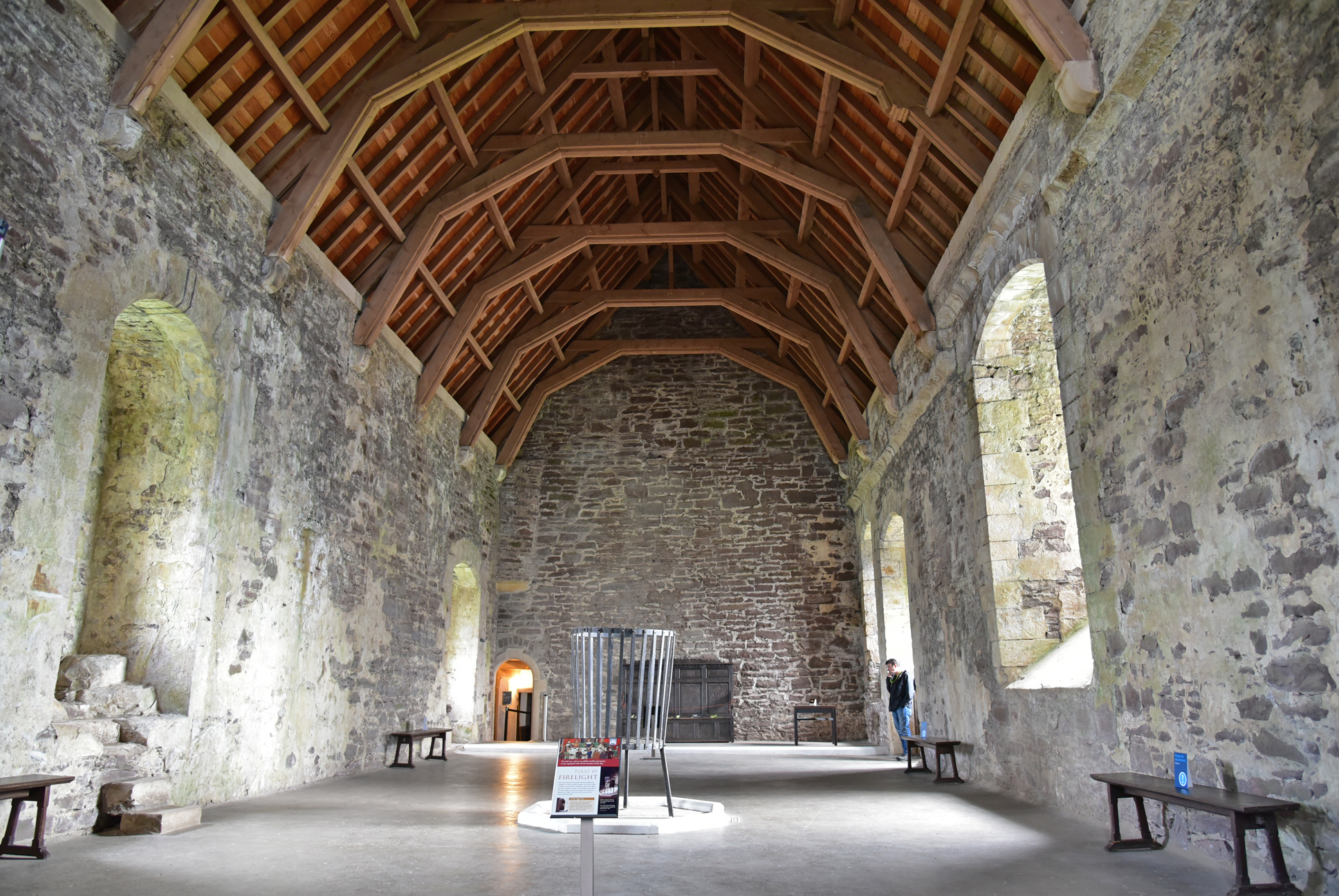
Between the Gatehouse and Kitchen Towers stands the Great Hall—the castle's largest room. Restoration in the 1880s renewed its roof and the minstrel's gallery.
Doune Castle can be explored in a few hours. For more castle visits on the same day, consider Alloa Tower, Bothwell Castle, Clackmannan Tower, or Castle Campbell. Stirling Castle is closest to Doune, but requires most of a full day to tour.